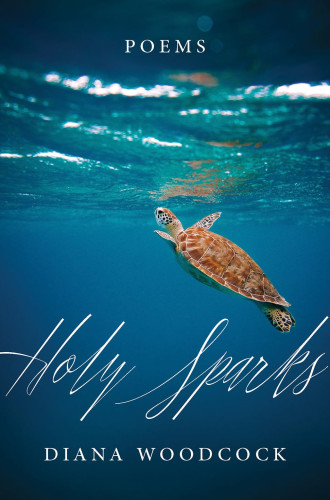
Holy Sparks
Poems
Holy Sparks, Diana Woodcock’s most recent collection, is a devotional cycle of poems written from within a Muslim-majority country that speaks across faiths to what is perennial: awe, grief, kinship, surrender. Her spiritual-environmental activism is concerned with “instigating hope / by writing the existent— / my final act of resistance.” This is poetry as moral witness, quietly revolutionary in its affirmation of existence and the fragile dignity of all beings.
Woodcock, a longtime resident of Qatar and professor at VCUarts, writes as one who pays close attention to her adopted landscape. The desert here is not merely a setting but a field of mystical revelation. The title poem begins with an epigraph from Thomas Merton—“There are holy sparks in all created beings”—and then proceeds to embody that vision, observing two palm doves “debating the possibility of mating” on her balcony while a cat watches from the other side of the glass. “I witness / holy sparks on both sides,” she writes, and so frames her poetic act as one of reverent beholding.
This is a book attentive to subtle thresholds: between human and nonhuman, devotion and doubt, life and the slow undoing of ecosystems. Again and again, Woodcock reminds us that our fates are bound to what we overlook or forget to bless. In “The Ecopoet’s Prayer,” she pleads:
to break down
the false boundary between
human and nonhuman species,
. . . . . . . . . . . . . . . . . . . . . . . . . . .
Aren’t you tired of all the false
barriers? . . .
. . . . . . . . . . . .
consider how our thinking affects
future prospects of each species.
Stylistically, Woodcock’s verse is spare and deliberate. She favors short-lined stanzas with room to breathe. Her use of repetition (both sonic and thematic) lends the poems a prayerful rhythm, while her diction remains rooted in plain speech. The result is a quiet formal integrity, an atmosphere of restraint that refuses both abstraction and excess.
Several poems reflect the poet’s life in a Muslim-majority country, not as an outsider exoticizing the culture but as one respectfully responding to it. “Subhanallah” opens with the recognition that Muslims whisper this word when experiencing divine beauty in nature. The poem offers a tender corrective: “If you complain the desert is drab, / I’ll know you’ve never watched it / transform under the sunset’s glow.” Throughout her unabashed love letter to creation, one hears echoes of Islamic stewardship, khalifa, and also Pope Francis’s insistence in Laudato si’ that the earth herself is a subject, not a possession.
More than thesis, Woodcock is interested in mystery. “In Between Haram and Halal” takes its title from categories in Islamic ethics—makrouh, mashbooh, mushtabahat—that represent shades between permitted and forbidden. The poem reflects:
Is it too late
to do an atom’s weight
of good, to read the book
of Creation? let each leaf
of the tree become a page of scripture?
This is interfaith poetry in the truest sense: rooted in one moral world, yet reaching toward a shared horizon. Theological parallels here are embodied. And at a moment of global fracture—political, ecological, and religious—such poetic gestures feel both timely and necessary: small bridges built across estrangement. In Holy Sparks, as a concerned global citizen, her humanity extends beyond the Arab world to all reaches of our green-and-blue planet, and she stands in solidarity with Indigenous peoples and their threatened homelands.
It’s heartening that Woodcock opens many of her poems with quotations from an eclectic mix of guiding spirits: Rumi, Gandhi, Swami Vivekananda, Dostoyevsky, Julian of Norwich, Carl Jung, Viktor Frankl, and Walt Whitman. Such timeless wisdom from artists, mystics, and seekers across traditions underscores that no one faith has a monopoly on meaning and that truth agrees with itself across time and disciplines. Woodcock summons us into prophetic witness through this line: “Oh to realize we are not gods,” and it becomes both confession and motivation.
It seems to me that her collection is structured somewhat like a pilgrimage, marked by five section breaks, moving from noticing to lament to liturgy. At first, the poet seems to linger on the small, the overlooked, the nearly extinguished. As the poems progress, the tone darkens and widens, entering the terrain of grief, ethical reckoning, and ecological lament. Yet it does not remain there, and toward the closing, the voice has ripened into something closer to praise: a liturgy shaped by sorrow but sustained by devotion. This movement, from astonishment to lament to meditative offering, echoes an ancient spiritual rhythm: to see, to mourn, and finally, to bless.
One of the poems in the book’s last section, “Feast of St. Brigit,” offers a glimpse of Woodcock’s Christian inheritance and its influence on her ecological conscience. “Perhaps if I hadn’t grown up reading / the Holy Bible since age seven,” she writes, “believing I wouldn’t go to heaven / unless I hurt not the earth, // neither the sea nor the trees.” This confession, simple and earnest, grounds her environmental ethic in childhood faith, where stewardship of creation was inseparable from salvation. That memory, carried into adulthood, animates the care and responsibility that shape her poems. For Woodcock, the poet’s vocation is inseparable from a life of service.
Holy Sparks is a tenderhearted, compassionate book: theologically intelligent, ecologically urgent, and stylistically unhurried. It calls us to recognize that in each creature and crack of light, there flickers a holy spark. And our task, however humble, is to keep it from going out.