In the apophatic tradition, declarations about God are deemed inadequate, and meaning is derived by engaging ambiguity. The anonymous 14th-century author of The Cloud of Unknowing views such tensions as entrance into a field of deep knowledge and mystical union. Artist Olga Lah lures viewers into a similarly nebulous sphere. In The World Over, she embraces uncertainty as a spiritual and creative act, negotiating unknowing to pursue a specific kind of intelligence, the open-ended love of God.
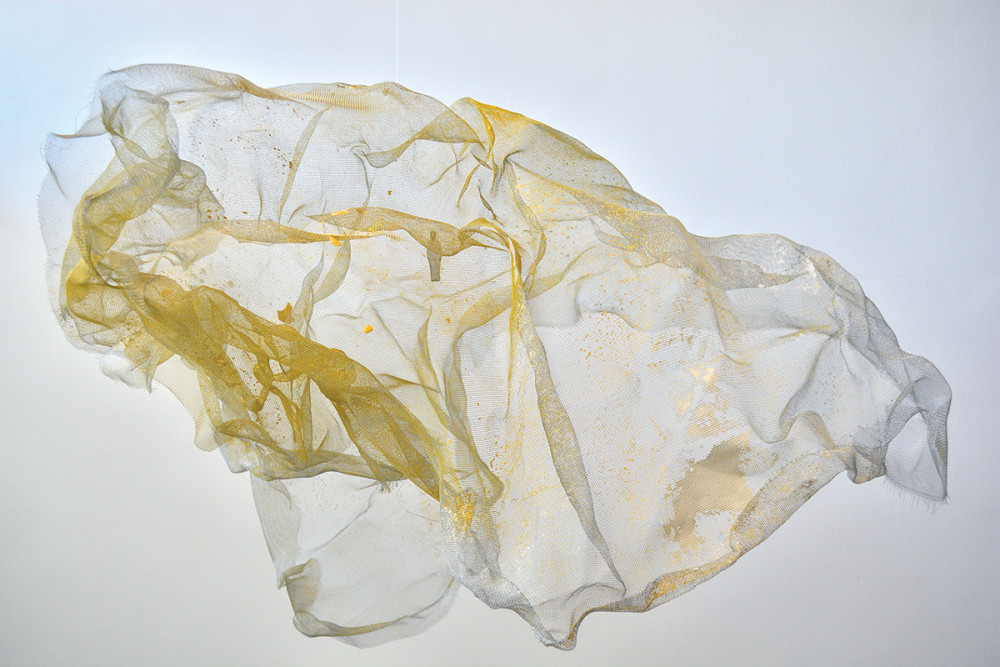
A former seminarian, Lah uses the paradoxical to point viewers toward contemplation. Floating metal mesh stretches outward and inward, creating pockets of opaqueness and transparency. The piece displays fragility and resilience, mass and weightlessness, movement and stasis. Conflicting formal properties uphold notions of flexibility, a summons to enter the cloud with one’s own complexities and join the small figure within.
The title is likewise unfixed. Does The World Over allude to a pervasive presence? Does “over” suggest an end and a subsequent beginning, or does it suggest a covering? Lah’s cloud is luminous, shifting from white to brass to gold to gray, resembling a bride’s veil in flight caught by the wind and light. Step under this tangible unknowing, and intimacy follows—sweet, mystical union.
“By love [they] may be touched and embraced, never by thought.” The medieval mystic claims intimacy is gained by knowing how to not know. Power in powerlessness is also Paul’s spiritual strength: Acknowledging weakness bids entrance to dwell in the power of Christ. The Cloud of Unknowing follows and dispenses this prescription. While the divine Other may not be fully comprehensible, every person is invited to step into the cloud, embrace the wisdom of sacred mystery, and attain a portion of divine love. Overflowing love floats, spins, and spills the world over.