By the river, Lydia, the dealer of purple cloth, gathered with other women. By the river, women of days gone by foraged, weaved, washed, and prayed. As entrepreneurs, household economic managers, and social engineers, women labored side by side. Their social exchanges transpired between neighboring villages, thus preserving peace and sustaining life.
In a New York City storefront by the river, artist Noemia Marinho hosts crafting sessions as part of the Gleaning Project. The program assembles a small crew composed of folks needing a safe bridge between joblessness and eventual employment. As Marinho’s hired art assistants, they formulate art objects from discarded materials, which are later sold to subsidize the program. Concurrent with the riverside legacy of women’s industry, Gleaning Project’s mutual labor permits convivial interactions where stories are told, techniques are shared, and each person is warmly regarded.
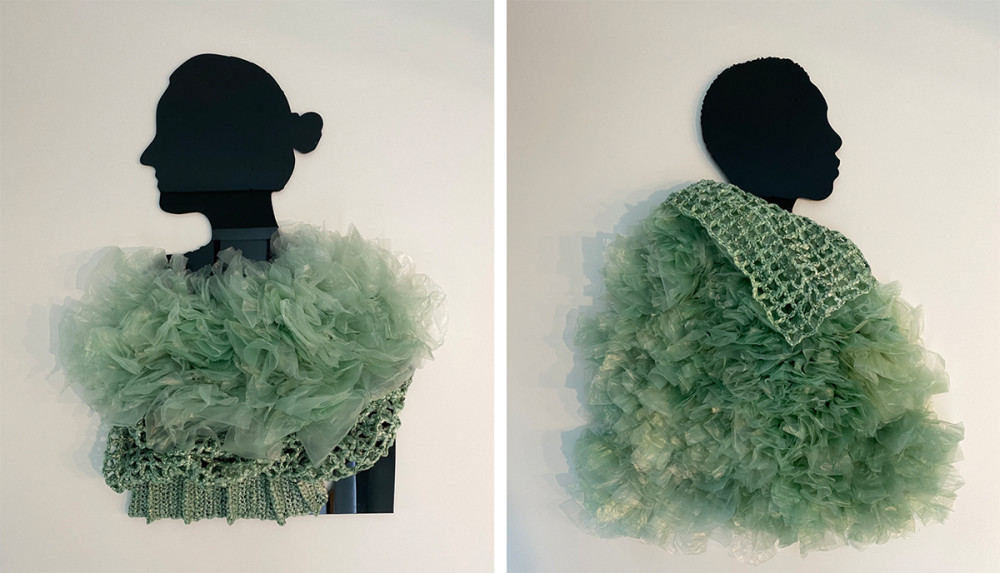
Indeed, Gleaning Project’s latest artifacts turn to the domestic. The exhibition Coverings comprises several textile goods in the form of purses, scarves, shawls, corded fringed belts—all made of recycled plastic. Some of the items are displayed on silhouettes of the makers. It is they who transmute ubiquitous plastic bags into appealing apparel. In doing so, they experience a theological assertion: transformation is possible.
Yet as oblique figures, the silhouettes symbolize another reality: fast fashion’s workforce. The use of grocery bags further conveys disposability. Both represent the thoughtless consumption of people and goods, with ensuing ecological and economic harm. Alternatively, and earnestly, Coverings reconciles by supplying beautiful, netted fashion pieces, handmade by a network of creators, to shift ideas about net worth.
Marinho, like Lydia, echoes ancient household economic practices, or oikonomia. Ethicist Elizabeth Newman relays that early Christian hospitality was tied to domestic economics as a type of spiritual formation. Giving abundantly of goods, skills, time, and good company signaled a belief in God’s provision. Coverings, like Christian oikonomia, counters ideas of a better life by practicing a deeper way of interacting with God’s creation. Indeed, through the Gleaning Project, Marinho displays the difference between production and being productive. The former tends to enslave, while the latter empowers and thus sustains.