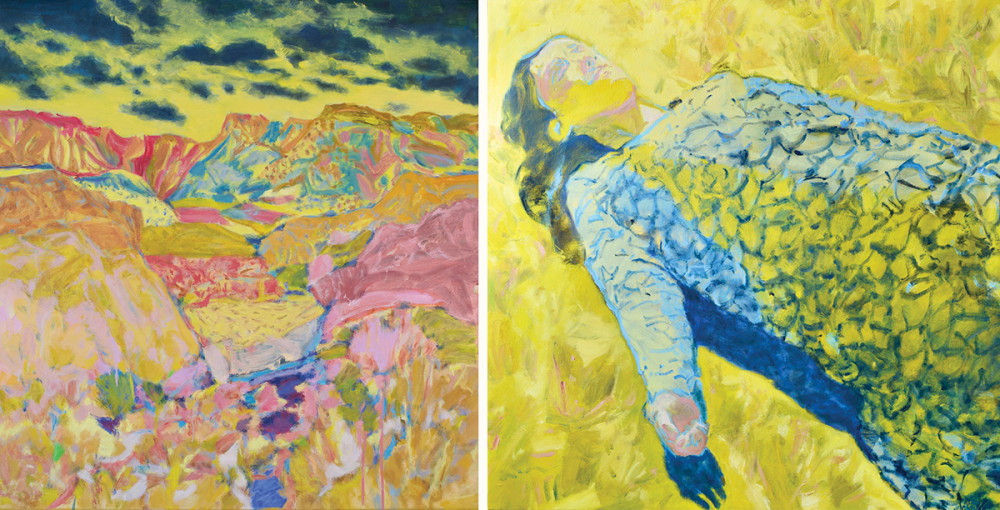
Jo Bertini’s career has been shaped by deserts across the globe, and the Australian painter (and art educator and writer) infuses her canvases with a sense of reverence and intimacy. Known for her vivid palette and gestural brushwork, her landscape paintings challenge traditions that cast deserts as vacant, barren, and hostile wastelands. Her works reframe them instead as living, vibrant, relational spaces: landscapes of resonance and tenderness.
“My paintings,” she writes in the catalog that accompanied a recent exhibition, “are a type of alchemy, turning the contemporary complexities of environmental, scientific and human concerns into the poetry of art.” Her canvases trouble what Nicolas Howe calls the spiritual gaze, marked by Protestant spiritual imagination: It encounters the landscape as a symbolic revelation of divine power, yet one often severed from a reciprocal relation to it. Where that gaze once framed deserts as empty stages for manifesting destinies, Bertini resituates them as sites of agency, memory, relationality, and regard.
In Reading a Fathom of Sand, the arroyos of northern New Mexico become reservoirs of seeds, water, and life. “They seem to me to be in a perpetual state of expectancy,” she writes, “incubators of wonder.” Rather than reinforcing narratives of progress, expansion, or ownership, the landscape in her canvases becomes a living archive of ecological vitality and spiritual depth. The life that may have once been concealed bursts forth in time. In Taken by the Sky, Bertini echoes Mary Oliver’s tenderness under the stars: to be gathered back and held by the earth so gently that one awakens profoundly transformed.
Bertini’s oeuvre participates in a process of dessoterramento—a Portuguese word that points to acts of unearthing what has been buried or suppressed. Beneath the contested narratives of the American Southwest, her paintings lift what still breathes under the surface: relations among peoples, lands, waters, stones, seeds, and skies. For the reverent beholder, her invitation is clear. The desert is neither absence nor wasteland—it’s the very sanctuary that sustains all of our otherworldly and earthly relations.