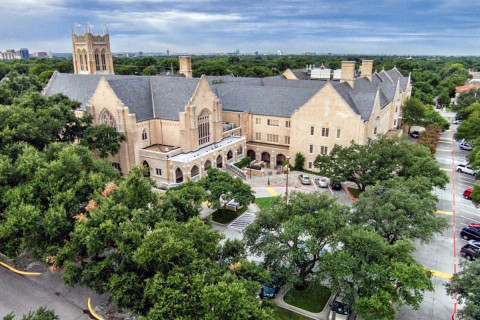
It had been more than 30 years since I was in a room full of Baptists. I walked into the conference for American Baptists thinking I’d give my talk, shake some hands, and be on my way. Instead, within hours I found myself pulled back into my first encounters with God and church as a 15-year-old, when I first walked into Rockville First Baptist so many years ago.
I am not sure if it was something about how people smiled, or the frequent references to scripture, or the thankfulness to the Lord for what he’s done. I left after a few years for so many of the reasons people leave churches and traditions—sermons that don’t meet the moment, beliefs trying desperately to seal themselves off from history or context, and, maybe most of all, disappointment in people who I thought would be there for me. So I wandered into nondenominational churches, some charismatic movements, and found myself among Methodists more often than not. Along with seminary and then doctoral work, I pulled a theology together that could make sense of the world for me. I had not given the Baptists of my youth much thought, frankly.

Read our latest issue or browse back issues.
And then I found myself in a hotel full of them. These American Baptists were certainly not the Southern Baptists of my early Christian days, but there was still a deep sense of being home that I couldn’t quite put my finger on. But as the day went on and we worshiped and prayed, I felt the call and response, the expectation. It was the testimonies that made me realize what made this space feel like home. In every service, every prayer, every sermon there was an expectation of a testimony, an expectation that God was going to be present or turn things around or make a way out of no way.
I had worked so hard to shed the literal biblical interpretation, the rigid legalism, the refusal to acknowledge realities of race or gender in the faith of my youth. But being back among Baptists allowed me to see something that continued to live in my faith long after I left them: a profound belief and expectation that God moves in our lives.
The power of testimony is not something I would have had language for when I left. I thought I knew what I needed to leave behind. I thought I knew what I needed to add to my faith. But what I didn’t account for was the fact that my faith wasn’t just a set of beliefs. There was a complicated network of lenses and hopes and intuitions and friendships and disappointments and betrayals that were not easily dissected from one another.
But being in those spaces, filled with expectation, ready with a testimony about what God has done, reminded me of what so often animated my faith in the decades since—of why I was drawn to a Pentecostal space, or to Martin Luther King Jr.’s sermons, or to Karl Barth’s Church Dogmatics. I was born into a family that expected God to move in the world.
How I understand God to move and what God desires and what God grieves—all this has changed over the years. But being among Baptists again also reminded me that I had, perhaps, let that expectation dim, especially in the last few years. I found solace in a dramatic political takedown, or a comforting social media post, or the communal rage of like-minded people when confronted by the latest asinine, violent act of a foolishly evil administration. Reading theories and histories gave me a sense that I could get my head around what was happening in the world.
Without even realizing it, I had drifted farther and farther from believing God will move. I was hoping some of us would survive. I had come to equate understanding with faith. And here I was with rooms full of people who seemed ready at any moment to testify to what God had done in their life, to what God had brought them up from. One could argue that these testimonies were rather personal and individualistic. But what struck me in the people I met and heard that weekend was just how much expectation creates the conditions to see what is possible, what was already happening, how God was already moving. I had become so accustomed to the constant drum beat of dictatorial victories and the sycophants falling into line like demon-possessed pigs that even the thought of expectation felt naive, even foolish.
I missed the ways people showed up in my life every day, the ways a community mobilized to resist the terror of ICE, the ways classrooms can become places that save people’s lives because they give them a way of seeing their belovedness. But these are all testimonies, moments in time when God shows up in the midst of us and through us to say another way is possible.
No, none of these things overturn empire tomorrow. But didn’t God show up today? And if I begin to look at the ways she showed up yesterday and today, perhaps I will be able to see a little more clearly how she shows up tomorrow. Maybe I will be able to testify to what she is doing right now. And as I learned in my Baptist church so long ago, when I hear the testimonies of others, I am also learning how to see what God might do in my life, in our communities. If we believe in God, should we expect anything less?