Voices

A desert gospel in San Francisco

In Mark’s wilderness and in my city, life emerges in unexpected ways.

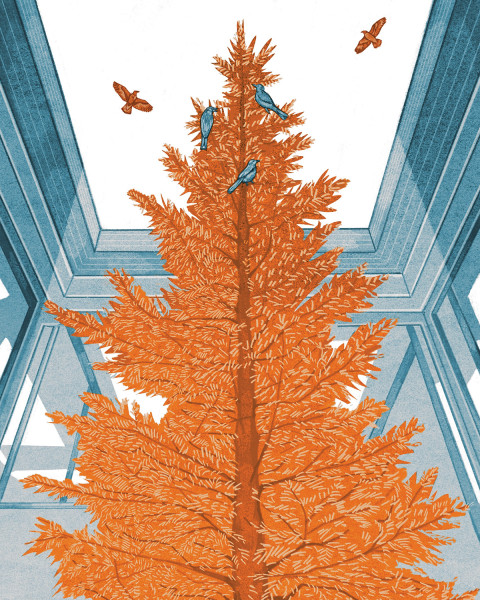
A redwood tree grows in the middle of a coffee shop I frequent, and it’s both glorious and strange. Glorious because it blurs boundaries, towering over everyone in the room. Strange because it feels out of place, odd to confine such a regal, communal specimen apart from its grove of peers. Here it sits in the Mission District of San Francisco, where there is more trash than trees on the streets. I wonder whether its roots have room to stretch and touch the roots of other trees. Thankfully, a large opening in the ceiling allows abundant sunlight to pour in, though it is still cut off from the marine layer that drifts daily through the city.

In short, there is deep ambiguity about this tree in this unlikely place. It provides shade and a tangible connection to nature. It is beautiful and stops people in their tracks. It is also undeniably out of place, and the tree’s isolation is a reminder of how far it is from home. Its outstretched roots have to navigate underground pipes and electrical lines with nary another root to touch and communicate and share nutrients. I wonder how it will fare long-term, cut off from the fog that is a vital source of moisture for coastal redwoods. For a tree, this bustling coffee shop is a barren desert.

The wilderness is often a site of contradictions: a place bereft of life where life persists, a picture of isolation that attracts seekers of solitude and refuge, a source of danger that offers serenity and peace.

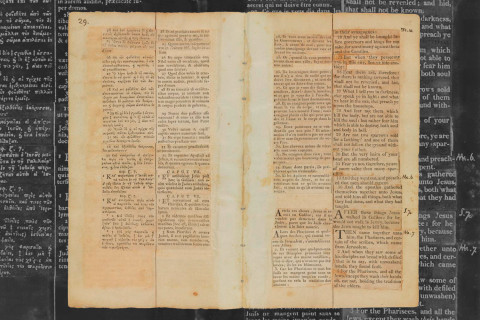
For all these reasons, I love that the Gospel of Mark begins in the wilderness, embracing all of the ambiguities and contradictions contained there. The very conditions that make the wilderness inhospitable to life provide the ideal setting for John’s ministry, a safe distance from comfort, prestige, and power. The wilderness theme appears again and again throughout Mark. Jesus is almost immediately driven into the wilderness (only 12 verses into the first chapter). It becomes a sought-after place of prayer for Jesus and the site of miraculous feedings. And the gospel ends with the women trembling and afraid, saying nothing to anyone as they linger in the emotional wilderness of their confusion.

When we consider these themes that emerge later in the gospel, it is hard to think of a better opening context for Mark than the wilderness, where a river flows and crowds gather. A weary, searching people congregate in the middle of nowhere. They come to hear a prophet and receive a baptism of repentance.

We are living in a time of many wildernesses, not only spiritual but also cultural, social, and political. In our divided age, when we need to hear each other out more than ever, we get our news in siloed sound bites that obscure nuance. Not only are we alienated from each other, we are increasingly isolated. But given the ambiguity of the wilderness as a place of both scarcity and resilience, there may also be reason to hope.

For analogous wisdom, I turn to two writers and theorists of urban life who have long observed both the promise and peril of human life in close proximity. They know that population density is no guarantee of community and that loneliness respects no geographical boundaries. Crowds can produce social anomie as readily as they create vibrant neighborhoods. It was this awareness that animated Jane Jacobs’s reflections on the “sidewalk ballet,” her vision of public spaces that foster countless small encounters among neighbors and strangers. Similarly, Jan Gehl urges planners and architects to attend to the “life between buildings,” shifting focus away from physical structures and toward the parks, courtyards, street corners, and public squares where human relationships take shape.

These thinkers remind me of what I appreciate about living in a city that is often maligned and misunderstood. Every day I walk past research labs and start-ups along the city’s biotechnology and innovation corridors, where discoveries and decisions reverberate across the world. I also walk past lines for brunch, salt bread, and ice cream. I recently heard that lines are the new third space, and I think that’s right. What may look like an inconvenience is often a sign of life: strangers sharing a sidewalk, neighbors dawdling in conversation, people choosing connection over isolation—these all exemplify Jacobs’s sidewalk ballet and Gehl’s life between buildings.

Without romanticizing either the desert or the city, life emerges in unexpected ways.

I wonder what drew the crowds to the Jordan River that day. What did they hope to find as they made their way into the wilderness to see and hear a strange teacher eating locusts and wild honey? What compelled them to stand in line for his baptism? What resonated about his message? Mark offers no explanation, just a simple observation: “The whole Judean region and all the people of Jerusalem were going out to him” (1:5). In Mark’s narrative, a place of scarcity becomes a place of abundance. Life flourishes where we least expect it.

Far from the center of empire and the halls of power, a prophet stands in the wilderness, offering little more than water and a story of hope. What looks like the last place life could flourish becomes an invitation to life. And the people hear and come and receive a new baptism. In the many wildernesses of our time, I find hope in these unexpected scenes: a redwood in a coffee shop, a crowd in the desert, a baptism of water that feels like too little, and a gospel that begins in the middle of nowhere. 

Peter Choi

Peter Choi is executive director of the Center for Faith and Justice in San Francisco and author of George Whitefield: Evangelist for God and Empire.

All articles »