As the weather in New York finally turned toward autumn, I found myself with an unexpected pocket of free time and a longing for the unique kind of solitude that comes in a mostly empty movie theater on a Tuesday afternoon. There was a new violent epic that promised to offer big themes that would make good fodder for this column, along with a couple of international films that would take me out of my habitual patterns of thought. But I knew exactly what I wanted to see: Practical Magic 2 (directed by Susanne Bier). That I knew I would have to rewatch it very soon with my tween daughter did not deter me; nor did the fact that I could predict the basic arc of the movie without even watching the trailer. I was not disappointed in my choice.
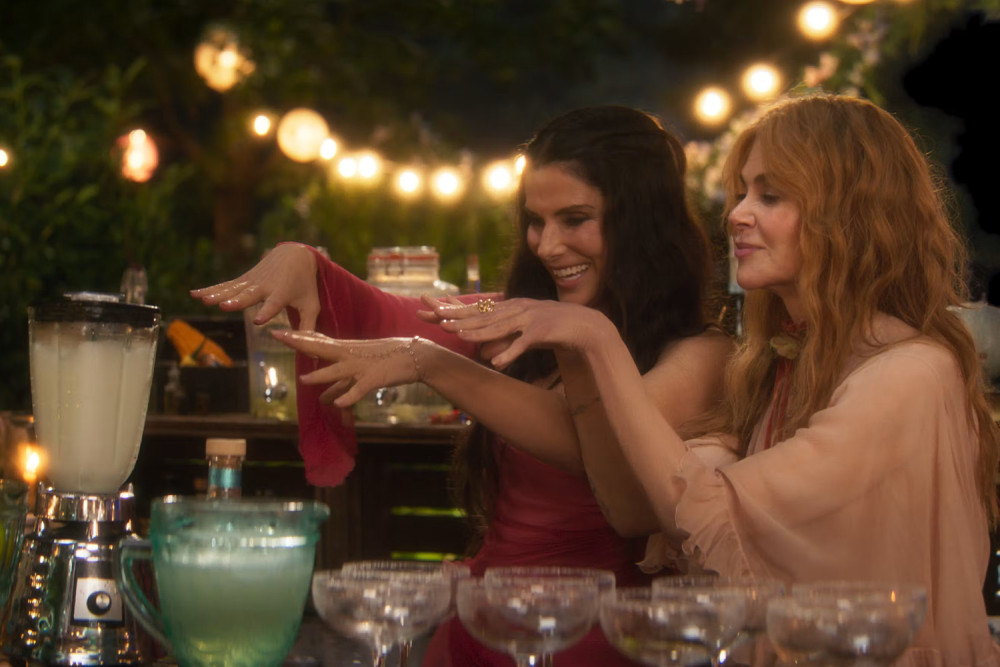
The original Practical Magic (directed by Griffin Dunne in 1998) introduced audiences to the long line of Owens women, powerful witches who have been blamed for all manner of shenanigans over the centuries. For over 300 years, they have suffered the effects of a spell that boomeranged into a curse that dooms any man they love to imminent death. Most of the first movie follows the ill-fated love lives of the younger Owens sisters—Sally (Sandra Bullock) and Gillian (Nicole Kidman)—as they rely on and sometimes rebel against the wisdom of the aunts who raised them, Jet (Dianne Wiest) and Franny (Stockard Channing). The first movie ends with a new generation of Owens sisters (Sally’s children) and the hope that the curse has finally been lifted.
Alas, when the sequel begins, 25 years after the action of the first movie, we learn this is not the case. Twice-widowed, Sally has given up on love, while Gillian blows through casual flings like a conscientious tornado, careful never to touch down long enough to catch feelings. Sally’s daughters Antonia (Maisie Williams) and Kylie (Joey King) have been raised without any knowledge of their witchy powers or the curse. When Kylie falls in love, that repressed knowledge comes crashing through their lives, opening old wounds and a clear plot for what’s to come.
The first movie was widely panned by critics for its narrative and tonal incoherence, but it quickly became a beloved classic, watched on repeat by many women in my generation. The sequel straightens out these narrative arcs, focusing on the origin of the curse as the means of its undoing. There are still the kind of narrative leaps that only Hollywood magic can provide—when the characters decide to travel from the US to England, for example, they seem to arrive the same night—and the kind that witchy magic demands: ancient books appear at just the right minute, magical devices are quickly explained to bring resolution to a tricky plot point.
I could try to convince you that the movie has deeper things to say about the power of sacrifice and what it means to struggle against and ultimately accept your heritage. “We are all the pallbearers of our ancestors’ pain,” Tom Lockland (Lee Pace), a smoking hot professor of witchcraft, explains to Sally and Gillian as they search for the means to end the curse. This is a beautiful way to conceptualize how the past continues to exert its power on the present. But Tom isn’t really there for philosophical reflection, and the pain of the ancestors is respectfully buried with remarkable alacrity. Practical Magic 2 understands its mission: brew up a strong potion of witchy comfort.
Practical Magic is often referenced as an original entry in the comfort-core genre: movies and television shows viewers watch with ritual regularity because they evoke a comforting set of feelings beyond the themes of the movie itself. More specifically, it is part of a collection of movies and shows sometimes called cottagecore or autumn-core, or what a film studies professor once described to me as “autumn-coded seasonality.” Small towns, close-knit communities, cozy sweaters, a landscape that inspires people to gather around the hearth or bake beautiful pies—these are the markers of fall comfort. Practical Magic shares these features with many other comfort-core favorites, from other witchy offerings like The Craft, Charmed, and A Discovery of Witches to cozy murder mysteries like The Thursday Murder Club or Only Murders in the Building to pretty much every movie made by Nancy Meyers or Nora Ephron.
But the real magic of the Owens sisters is the special comfort of their female-centric world. In this way, Practical Magic shares more in common with Gilmore Girls (an Ur-text of modern comfort-autumn-core) or older offerings like Anne of Green Gables, Little Women, or Sense and Sensibility and Pride and Prejudice. It is not that men are absent from these stories. The pursuit of romance and marriage structure most of the plots. The most important relationships, however, are those between sisters and aunts, mothers and daughters, bosom friends. Women in these stories live together, structure their days around each other, share their intimate thoughts and feelings in a constant stream of talk and intimate affection. Most problems can be solved by a good chat and some baked goods.
Maybe this is why so many younger women are rediscovering these shows and movies, or why Jane Austen and Anne of Green Gables have never gone out of style. Very little in our modern life makes this kind of connection readily available, but that doesn’t mean it is not hungrily desired, even more than a perfectly baked pie. When I found that theater on an early fall day, or when I introduced my daughter to Practical Magic (and Gilmore Girls and Little Women), it was this feature I most wanted to remember and impart: the power of finding women who will build and share a world with you. We can very rarely build a world we can’t imagine first, so sometimes we have to watch on repeat to remind ourselves where we hope we are headed.