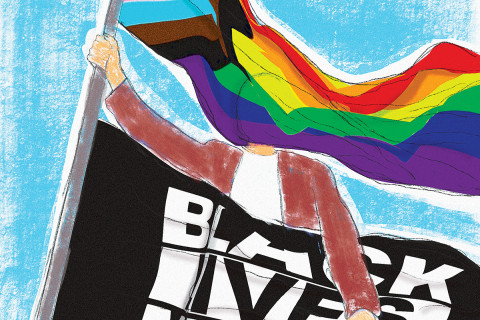
they ask me to remember
but they want me to remember
their memories
and I keep remembering
mine
—Lucille Clifton, “why some people be mad at me sometimes”
In August, the White House announced that it would conduct a “comprehensive internal review” of some of the Smithsonian Institute museums and exhibits “to support a broader vision of excellence that highlights historically accurate, uplifting, and inclusive portrayals of America’s heritage.” This review coincides with active debates about which statues should be publicly displayed, what content should be in our textbooks, and whose names should be on our buildings. In other words, this is just the latest example of the contestation over whose American history will be told and what we will remember.
Museums are not simply repositories of objects; each exhibit tells a story. Museums hold and facilitate the creation of memories. With the showcasing of uplifting stories comes the erasure of damning ones.
Christianity is deeply rooted in the act of remembrance. The word “remember” (zâkar in Hebrew and mnaomai in the Greek) and its derivatives appear over 200 times in the Bible (NRSV translation), with about 50 instances in the New Testament. In the Gospel of Luke, Jesus instructs his disciples: “Do this in remembrance of me” (Luke 22:19 and 1 Cor. 11:24). The command, recited during the Eucharist, serves as a unifying act of commemoration for believers. This sacrament invites believers to remember the salvific work of Christ, and it does more than just that—it invites them to become active participants through their remembrance, grafting them into Christ’s story, which is now their story. The feasts and fasts of the Christian calendar are replete with reminders to remember. These religious rituals and foundational stories both connect us to the past and shape our present Christian identity.
These acts of remembrance and reminders to remember stand in stark contrast to political tactics that urge us to forget. Though their goal may not be our forgetting; it may be that the banning of books and the revision of school curricula are simply attempts to make us remember a false version of history. To remember, as poet Lucille Clifton said, their memories rather than our own.
Though these schemes fill today’s headlines, this kind of challenge to the material record is an ancient practice.
The Roman Emperor Augustus developed a program of cultural renewal that included the promotion of origin myths, displays of an idyllic past, and propaganda that created the illusion of peace, prosperity, and stability in the empire. In a context with low literacy rates, visual culture was an essential form of communication. Coins, statues, inscriptions on buildings, and monuments were all places to convey the important stories of victorious battles, conquered enemies, and foundation myths.
While these images were propagated in the ancient world, the corresponding practice of systematically destroying or altering images to erase cultural memory developed alongside them. Damnatio memoriae describes an ancient Roman practice of attacking the memory of dead public figures. The erasure of enemies created the illusion of a “pure” Roman past. As archaeologist Susan Alcock notes, “an obvious aspect of memory politics is the manipulation of the past by rulers or ruling elites.” These elites become what Alcock calls “masters of memory” when they enforce decisions about what will be remembered. Attaining this type of mastery allows leaders to manipulate the past, present, and future.
One specific account of this ancient cancel culture comes from historian Jas Elsner, who highlights the damnatio erasure of palace eunuch Eutropius in the Theodosian Code:
All his statues, all his images, in bronze as well as in marble, in pigments, or in whatever material is suitable for portraiture, we order to be destroyed in all cities and towns, both in private and public places, in order that the stigma of our age, so to speak, may not pollute the sight of those who look at such images.
To purge a person’s image and not speak a person’s name was to utterly destroy their legacy, to render them invisible. This approach was not about accountability; it was an attempt to alter history and to deny the very existence of one’s enemy or opposition.
Just as the Roman elite made efforts to systematize the erasure of an unwanted past—to create the illusion of a pure one—so the legislatures across our country are attempting to do the same.
But the past is never pure. If a history seems pure, it means clarity was lost to time and the narrative of the elite overpowered all others. These attempts, past and present, to alter the material record bear witness to the connection between forgetting and remembering. The possibility of forgetting necessitates the demand to remember. Any attempt to alter the past will conjure the very thing the meddler wants to forget. The presence of gaps and silences, erased faces and scratched-out names, causes us to ask who or what we are being asked to forget. Archival research, archaeological digs, and the stories repeated in families unearth truths that may not appear in the official record, but they all bring us face to face with memory.
The past teaches us that the role of memory in identity formation is profound. Remembering who we really are is a sacred act. Histories are never objective, are always complicated, and are most often contested. We don’t have to look beyond our own families to know how often people respond to another’s memories with, “Well, that’s not how I remember it happening.” Both truths sit beside each other. Though memory is always haunted by the possibility of forgetting, it is the very act of remembering that fortifies our identity and reminds us who we are.
Let’s imagine that in 313, when Emperor Constantine’s edict prohibited Christian persecution, he also removed all crosses and crucifixes, erased and destroyed all traces of Jesus being crucified. In the ancient world, the cross was an emblem of a horrific imperial death, a death relegated to criminals and the poor. It was a sign of weakness and defeat. It’s certainly possible that Constantive wondered whether it would be better to only remember Jesus’ parables and miracles. We could skip all the difficult parts of his story. Why do we need to know that Jesus was tempted, or that he denied his mother and family, or that Jesus called a woman a dog? For that matter, why do we read four “eyewitness” accounts that tell the same stories differently?
Perhaps that’s what makes the story compelling. Remembering helps us sit with the complexities of life. Remembering challenges the oversimplification of our narratives. It forces us to confront our discomfort and ultimately helps us grow. The shameful death of Jesus was not stricken from the record, and the cross became the preeminent sign of a people who choose to remember both the good and the bad. Transformation is possible when we choose to remember. Christians are a people who follow one who claimed to be the way, the truth, and the life. Truth shines a light on the past and reminds us that even when empires strike, the people will remember who they are. They are children of God, peacemakers, guided and guarded by love. Memory does not need to be perfect(ed), it needs only to be.
In the finale of the Broadway musical Hamilton, the song “Who Lives, Who Dies, Who Tells Your Story” summarizes the accomplishments of Alexander Hamilton as a statesman. It posits the poignant question, “And when you are gone, who remembers your name? Who keeps your flame? Who tells your story?” Hamilton’s political enemies outlived him and minimized his contributions. Hamilton was relegated to a footnote in most high school history books, his image living obscurely on the ten-dollar bill. And then someone remembered his name and told his story.
Each time an image is seen, each time a narrative is read or a story is told, we engage in the act of (re)membering. Who gets to determine what stories matter? Striking through words or images is an act of violence. We need not strike out our past transgressions or defeats to be who we think we are. On the contrary, remembering who we really are requires that we embrace both our moral failures and our triumphs.
This means just as we can hold the tension between Jesus’ miracles and his crucifixion, we can also contend with America’s victories and its moral failures. Memory binds us together and helps us become who we aspire to be. But it only does this when we remember the real and complicated stories, stories of those who got it wrong but tried to be better and who inspire us to do the same. Despite the temptations or decrees to erase or forget, we must keep remembering—not their memories, but our own.