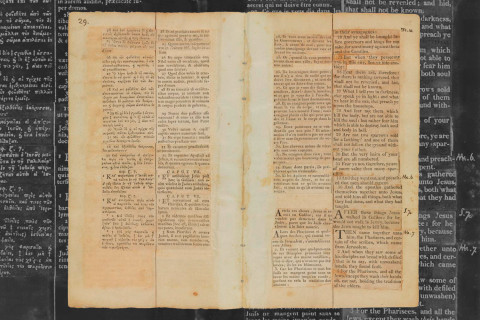
The line “bidden or not bidden, God is present” appears in the oddest of places. It is believed to have been given by the Oracle of Delphi to the Lacedaemonians, aka Spartans, when they considered going to war against Athens around the fifth century BCE. The Latin form was included among one of Desiderius Erasmus’s works in the 16th century. In the 20th, influential psychiatrist and psychoanalyst Carl Jung encountered the phrase in Erasmus and was deeply moved by it. He had it inscribed above the doorway of his home in Küsnacht, Switzerland, and on his tombstone. This sturdy little sentence keeps chugging along through millennia, across cultures, informing, edifying, and inspiriting all manner of folks.
The author of Psalm 34, whoever he or she or they might have been, knew the truth of it. The psalmists—all of them—were folks besotted with God. No need to look for God in a given situation. This was something more than just a credal statement; they knew that God was present with them everywhere and at any time. They knew that they could and should express the full range of human emotion—glee, joy, calm, sorrow, grief, anger, even rage—to God. Everything they thought and felt was ripe fodder for communication with God, for prayer. Without editing or airbrushing and without apology.

Read our latest issue or browse back issues.
Although our psalmist begins on a rather extravagant note with endless blessing and praise, even inviting the community to join in the celebration, they also pause to remember and claim the time before the praise. The recall of that time is vague, but there may be a clue to be found in a part of the psalm that we ordinarily omit. In most modern English translations, just above verse 1, a single notation informs the reader that this psalm is “of David, when he feigned madness before Abimelech, so that he drove him out, and he went away.” This recalls a threatening incident in David’s life, as told in 1 Samuel 21:12–15, though the threat is in fact from Achish, not Abimelech.
The claim of the superscription is almost certainly not factual. It is an editor’s way of filling in a gap: Why did you “seek the Lord”? What prompted you, “poor soul,” to cry out to be saved? What was the “trouble” you referenced but did not explain? David’s predicament must have seemed to our editor a splendid illustration of a possible scenario.
The editor no doubt wanted to help future readers. But the lack of specificity in the text is precisely what opens the psalm to people facing distress due to any circumstance and in any age. The Psalms, including this one, are not fixed to a particular age or culture or nationality; they are and have been gifts for anyone to use, especially when their worlds fall apart and their own words fail.
Our psalmist is a witness. The God of Israel, my God, your God, our God, is constant companion, savior, nurturer, redeemer. Unlike other gods of our psalmist’s milieu (or of ours), fickle gods whose allegiance is to the highest bidder, the most loyal sycophants, who boast of power but fail to deliver, this God is, as our psalmist proclaims, faithful, reliable, relatable, intimate.
In the 11 verses our lectionary sets for our use, the word Lord appears ten times. In the whole of the Bible, God is named, titled, and metaphored in several ways rendered in English: God, King, Ruler, Father, Mother, Rock, Help. For Israel, Lord stands in for the special name for God, the uniquely given, the ineffable, based on the Hebrew answer that God gave to Moses back at the bush in Exodus 3 when Moses asked for a name. Instead of an expected noun like Ba’al, God responds with a verb: being, a word that encompasses a world of essential meanings. “Being,” God says in the Hebrew, “this is my name forever” (Exod. 3:14–15). Attached to that name is the promise repeated several times in Exodus and beyond, into the New Testament: “I will be with you.” The Immanuel of Isaiah 6:14, Matthew 1:23, and Matthew 28:20 comes to mind. God with us.
And throughout the text of the Hebrew Bible, especially in times of trouble, distress, or calamity, the community and individuals tend to use this particular divine name, counting on the relationship and the power of the promise behind that name. The utterance of it is at once a claim, a proclamation, and a nudge to the Divine One: You and I are related; we have responsibilities to one another; by using this name and this name alone, I remind you of who you are and have been and shall ever be.