

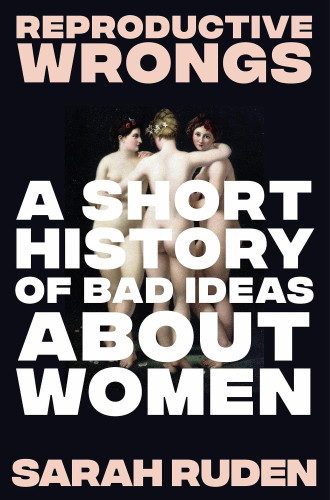
Reproductive Wrongs
A Short History of Bad Ideas About Women
If you are on the fence about abortion, this book may not be your cup of tea. When it comes to abortion, Sarah Ruden does not sit on the fence in any way whatsoever. It is closer to the truth to say she demolishes the fence, takes the splintered chunks into a field, burns them to ashes, mixes the sooty ashes with pigment and latex, and then paints the word propaganda on the headquarters of every antiabortion organization in the United States.
This energetic romp through the millennia was partially birthed by Ruden’s adventures among the conservative intelligentsia, who became enamored of her through her 2010 work Paul Among the People. She found that while they were willing to discuss many controversial ideas, there was an obstinate refusal to even start a debate about one particular issue: abortion. Ruden’s need to understand the culture that created this obstinacy led her back to her own field, the classics, and the seven chapters in this thickishly slim volume pave a road of antiabortion propaganda that reaches back to the Roman Empire.
Ruden uses the term propaganda quite often, and she is deliberate in that choice. For each of the texts she discusses, she puts forth the belief that those in charge deliberately printed and voiced falsehoods and exaggerations in order to influence and control a population. Those in charge were men; those they sought to control were women. Abortive procedures have been a part of human civilization from the beginning, and Ruden links women’s emotional and physical freedom to healthy and safe access to these procedures. Then, by studying particular works of Ovid, Paul of Tarsus, Augustine, Heinrich Kramer (who wrote the Malleus Maleficarum), Charles Dickens, eugenicist Marie Stopes, and supposed abortion survivor Gianna Jessen, Ruden shows how these works of literature attacked access to abortive procedures directly and indirectly in order to keep women in a state of social servitude or return them to it.
The detailed analyses of Paul and Augustine deserve particular mention, as Ruden brings their personal lives into the discussion in a way that is seldom done with such piquant energy. The ideal of history lays out the facts as we know them and then processes those facts through the lens of their contemporary context in order to understand them in the context of our modern lives. It is a rather dry ideal, Ruden complains in her preface, so she goes further. Basically, she calls bullshit on some of these writers, using what we know about their lives to argue that not only were they writing incorrect information about women’s reproductive health but they were doing so because of their own personality flaws and traits.
Regarding Augustine, she writes, “His own closest relationships were never anything but hideously complicated, and his longing to be free of the resulting anxiety, guilt, and shame was poison for his doctrinal legacy.” As for Paul, Ruden’s in-depth analysis of Timothy and Titus indicates that the actual authors of these books deliberately used Paul’s name to put forth ideas about women that were most certainly not the opinions of the globe-trotting, “educated cosmopolitan” Paul of Tarsus.
This is a must-buy book for two groups of people: those strongly in favor of abortion rights and those strongly opposed. The strongly in favor will howl with laughter at Ruden’s delightful language. Her turn of phrase is fun and inventive, and I guarantee you will want to poach some of her lines for your next social media post. The strongly opposed should read Ruden for the same reason Christians should read Christopher Hitchens: If you can argue with them, you can argue with anybody. Honing your rhetoric on Ruden’s sharp wit will give you plenty of exercise, and her insights into the weaknesses of some antiabortion arguments will be of service to your cause.


