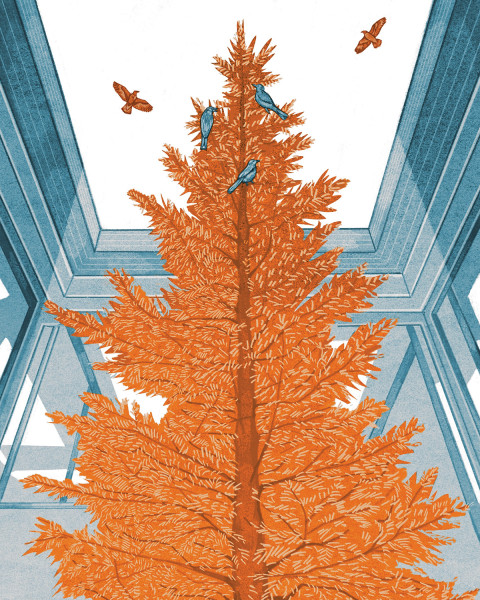
A redwood tree grows in the middle of a coffee shop I frequent, and it’s both glorious and strange. Glorious because it blurs boundaries, towering over everyone in the room. Strange because it feels out of place, odd to confine such a regal, communal specimen apart from its grove of peers. Here it sits in the Mission District of San Francisco, where there is more trash than trees on the streets. I wonder whether its roots have room to stretch and touch the roots of other trees. Thankfully, a large opening in the ceiling allows abundant sunlight to pour in, though it is still cut off from the marine layer that drifts daily through the city.
In short, there is deep ambiguity about this tree in this unlikely place. It provides shade and a tangible connection to nature. It is beautiful and stops people in their tracks. It is also undeniably out of place, and the tree’s isolation is a reminder of how far it is from home. Its outstretched roots have to navigate underground pipes and electrical lines with nary another root to touch and communicate and share nutrients. I wonder how it will fare long-term, cut off from the fog that is a vital source of moisture for coastal redwoods. For a tree, this bustling coffee shop is a barren desert.
The wilderness is often a site of contradictions: a place bereft of life where life persists, a picture of isolation that attracts seekers of solitude and refuge, a source of danger that offers serenity and peace.