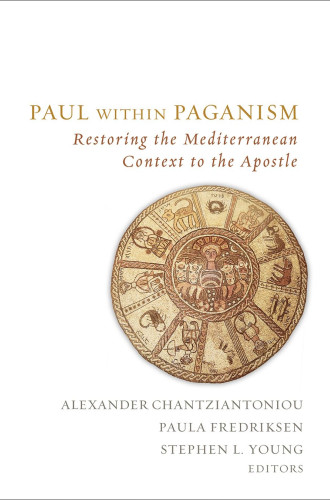
Paul within Paganism
Restoring the Mediterranean Context to the Apostle
This collection of essays—published as a companion volume to Mark Nanos and Magnus Zetterholm’s 2015 anthology Paul Within Judaism—brings together an impressive range of established and emerging scholars to consider Paul’s Judaism within the wider scope of ancient Mediterranean religious beliefs and practices.
The word paganism in the title is used in a narrower sense than many of us would use it. It is often associated with either having no religious belief or adhering to anything but Judaism or Christianity. Here, however, paganism describes the diverse religious landscape of the ancient Mediterranean world, the textured Greco-Roman tapestry of religions in which Paul found himself. As editor Alexander Chantziantoniou puts it in the book’s first chapter, “Paul is understood not apart from or over against so-called paganism, but, as it were, within it.”
Read our latest issue or browse back issues.
By challenging the common Western presumption that Paul was either opposed to paganism or ignored it, these scholars provide new perspectives on biblical passages. Their essays reference gods and idols, spirit possession, magic, epiphanies, divination, and other ancient Mediterranean experiences. As the authors examine Paul’s writings alongside pagan ideas and practices, it becomes clear that Paul’s experiences were not unusual for his era—and that his proximity to paganism gave him credibility in establishing his Christian communities.
Paul’s Christian message, especially the resurrection, makes sense within this wide religious landscape with its gods, rituals, philosophies, and spiritual practices. Although none of the scholars in this collection focuses on Acts 17:16–21, this text does provide a familiar backdrop for understanding their work. In this well-known passage, Paul speaks to a mix of Jewish, Epicurean, and Stoic philosophers in Athens. His listeners are not surprised by his message, and the Athenians invite him to the Areopagus to speak more on the topic of resurrection. Some there scoff at his mention of the resurrection; others promise to hear more about it another day. This was the spirit of the time.
In a chapter called “Paul, Epiphanies, and Social Formation,” Sarah E. Rollens demonstrates the essential role of epiphanies in the ancient Mediterranean world, exemplified by Paul’s vision of the risen Christ on the road to Damascus (Acts 9:3–19, Gal. 1:12–16). Such a dramatic instance of revelation would have given Paul credibility as the founder of new religious communities. Likewise Paul lists adversities in his ministry in order to add to his “myth of origins,” a story which binds disparate people together through a sense of shared identity. Paul recites his own hardships in ministry because his endurance through them speaks to his dedication to the common mission and demonstrates divine guidance in times of adversity.
Stephen L. Young’s chapter, “Gendering Sin and Salvation in Paul,” may prove challenging for readers who identify a sense of equality in Paul’s statement that there is “neither Jew nor Greek, neither enslaved person nor free, no male and female” because “you are all one in Christ Jesus” (Gal. 3:28). According to Young, equality—which Paul is capable of speaking about in other contexts (such as 2 Cor. 8:13–14)—is not Paul’s intent in Galatians 3. Instead, the “oneness in Christ Jesus” in verse 28 is “emphatically (and grammatically) a masculine one.” Young explains that this passage envisions those of lower status assimilating to the higher status, achieving a “oneness” in Christ that is shaped by Greco-Roman standards of perfection. “There is no longer male and female because all are a masculine one.”
Paul Within Paganism is intriguing and impressive, although it won’t be an easy read for those who lack extensive knowledge of ancient Mediterranean philosophers and scholarly texts. It left me surprised (and at times scratching my head) at Paul’s wider context, while also raising exciting new questions about the underlying perspectives that shaped the Pauline writings.