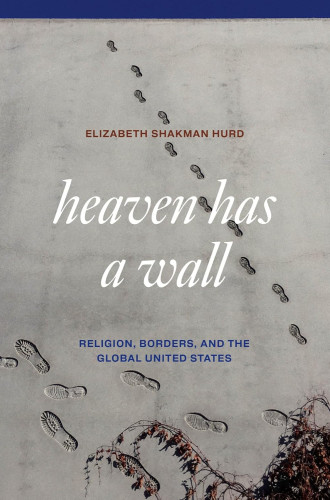
Heaven Has a Wall
Religion, Borders, and the Global United States
Borders are narratives. Borders are also realities, which is obvious for the very real people who try to cross them and who are often turned away, sometimes violently. The fact that borders are constructs that conform to the worldviews of those in power—and simultaneously real, demarcated spaces—makes borders and borderlands difficult to write about. What place-names do we use? Whose geography do we privilege? When does the limited language that we are given, and the decisions we make on how to wield our language, itself become an act of bordering?
As a writer who grew up in the borderlands of Texas and lives in the borderlands of the Middle East, I wrestle with these questions daily. Like many people writing in these spaces, I know the insufficiency of the frameworks I have been given and the possibility of harm if I don’t question them. To write about borders and the diverse people who live in borderlands is to accept that every sentence is a political decision on whether we should privilege the vocabulary of those embattled individuals whose stories we tell or surrender to the vocabulary of those who might be reading the story but have already assimilated into a different, dominant geography. I think of the trend among recent Latino writers not to italicize their use of Spanish in their writing in English. The italics were not only a typeface but a border, communicating a message of who belonged in the English-speaking world.
Read our latest issue or browse back issues.
And yet too often we still speak of borders as fixed spaces. I was recently listening to my friend Marie-Farouza talk about her grandfather Doos, who lived in a village in Egypt on the Nile in the 1940s, before the construction of the Aswan Dam. Every year, when the Nile flooded, it would deposit silt, changing the agricultural landscape of the surrounding villages. His job was to measure and reestablish the property borders of each house after the yearly flood. His story provides insight into a world that acknowledged the ever-changing geographical realities true for all of us. That which seems solid is not solid at all, nor is it forever.
All of this was on my mind as I read Heaven Has a Wall, Elizabeth Shakman Hurd’s audacious new book on the nature of US borders and how they shift and expand, sometimes even extending to other countries in a process she calls “border magic.” While it is common to note that borders are political spaces, Hurd argues that they are also sacred objects. In a genre- and discipline-bending work, she wrestles with the possibility that the ideas enshrined in the borders of the United States have become such acts of political theology that they should be classified as a bipartisan religion. Understanding why some people can pass those borders and others are deemed inadmissible requires that we be willing to examine borders as religious spaces that interrogate others regarding their orthodoxy. In doing so, we must implicitly question the extent to which we, too, are participants.
As a religious studies and political science professor at Northwestern University, Hurd is the ideal guide for an examination that requires fluency in multiple disciplines. She begins by exploring the myth of American borders as redemptive spaces. She notes that, by offering religious asylum, the United States projects the idea that it offers salvation in the form of religious freedom. Yet in practice, those seeking asylum are often forced to perform religion and assimilate into dominant narratives of what religious practice should look like. A Christian from Iran who celebrates Christmas with saffron pudding and not a Christmas tree might not be deemed “sufficiently Christian” if questioned by someone from the United States who holds bordered ideas of what Christianity should look like. Likewise, someone who is baptized but can’t quote the Bible might also be deemed as not authentically Christian. This mode of inquiry puts authorities in the position of determining what real religion looks like.
The religious freedom ostensibly offered by crossing the border is also unstable in its failure to treat religions equally. One contemporary instance of the US border rejecting individuals based largely on their religion is the so-called Muslim ban, the executive order President Trump issued during his first administration in which individuals from several majority-Muslim countries were prevented from entering the United States. Hurd discusses this at length. Yet I found her inquiry into how the construction of American borders itself disrupts the religious freedom of Indigenous communities to be even more revealing. She takes as her example the Tohono O’odham tribe, whose members stretch across both sides of the US–Mexico border. The militarization of the border has made it increasingly difficult for them to cross, threatening their access to sacred sites, traditional foods, and visits to family members. The same border that, if transcended, is meant to offer religious freedom to some individuals becomes the very impediment to free religious expression for others.
Hurd’s arguments on the expansion of borders feel especially timely. Her explanation that legally the border extends deep into US territory, encompassing most of the ten largest cities in the country, provides crucial context for the terrifying moment we now find ourselves in. As I write this, ICE is currently apprehending people in the streets of Minneapolis, and Rep. Jim Jordan of Ohio recently declared that ICE is “doing the Lord’s work.” Hurd discusses the globalization of US borders by using the example of security prisoners held in Guantánamo Bay in Cuba, among other extraterritorial spaces. Yet she could now just as easily discuss the prisons in El Salvador used to hold migrants deported from the United States, an expansion of borders designed to use fear as an act of deterrence.
Part of what is so fascinating about Hurd’s work is her decision to use vocabulary usually reserved for religion to discuss borders. She writes of a “reverence for national security, a liturgy of immigration, and an eschatological foreign policy.” In most cases this opens new possibilities for exploration. Yet in her discussion of the US relationship with Israel, she suggests that the border between the two is so suspended that we could name the relationship AmericaIsrael. Such a conflation runs the risk of narrowing discussion rather than expanding it, limiting the possibility that one might even be prioritized over the other.
Heaven Has a Wall focuses on border policies in the United States. Sadly, the violence of borders, often constructed in religious and colonial terms, is a global phenomenon. Australia has exploited extraterritoriality to imprison refugees and migrants on places such as Christmas Island and Manus Island. Europe has expanded its notion of borders in the name of security by paying the Libyan coast guard to intercept migrant boats. Likewise, it has long been accused of making conditions in places like the Moria Camp on the island of Lesbos intentionally awful as a form of deterrence. If we are to confront the brutality of this moment, it can only be in facing the reality of borders and simultaneously accepting that borders are porous and conceptual—and that change begins by interrogating the stories they tell. This book is an excellent place to begin.