
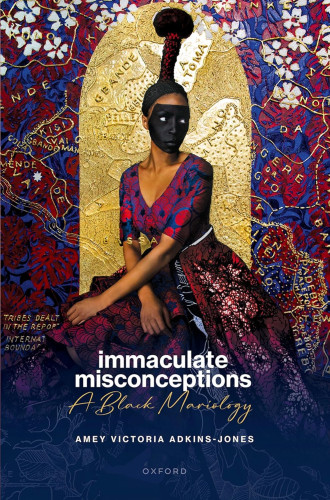
Immaculate Misconceptions
A Black Mariology
Opening with a stirring description of the discovery of Nossa Senhora Aparecida, the Black Madonna statue pulled from the nets of fishermen in Brazil in 1717, Immaculate Misconceptions wastes no time in detailing the central question of the book: What would it mean for the church to imagine Mary the mother of God as Black? Amey Victoria Adkins-Jones writes: “To claim—or rather, acknowledge—that ‘Mary is Black,’ is to state both the personal and the political as they are entrenched in the theological.” This interplay between political, historical, ethical, and artistic insights marks the entirety of Immaculate Misconceptions. Adkins-Jones’s writing is a master class in layered nuance and connections drawn between seemingly disparate aspects of the world and our understanding of theology. Unflinching in her account of Christianity’s collusion with colonization, Adkins-Jones lays out the aim of her monograph clearly: “Staged as a Black feminist and womanist theological conversation between the Black Madonna in image and icon, this project is a rally against the loss of sacred Blackness.”
Framed as a Black Mariology, Immaculate Misconceptions is a womanist study of the theology of Mary the mother of Jesus. Tracing the historical roots of doctrines and traditions surrounding Mary, Adkins-Jones explores how the church has shaped our understanding of the mother of Jesus, and in turn of the sacred itself, in a manner that impedes us from seeing Black as holy. Exploring the theological impact of art such as Christiaen van Couwenbergh’s Rape of the Negress (1632) and the numerous accounts of icons of Mary appearing as Black, Adkins-Jones explains that she is not asserting that Mary’s skin was black as a historical fact, but rather that these venerated representations of Mary as a Black woman “rais[e] the issue of who, or what, is iconic. Which is to say, of who can bear the image of God.”

Read our latest issue or browse back issues.
Adkins-Jones’s lens of study is both womanist and social justice oriented. She states that an icon of Mary “becoming Black” shows “a signal of solidarity with those who are poor, those who are oppressed, those who are in search of (and attempting to enact) liberation.” Readers who enjoy the writing and speaking of Wilda Gafney will find similar wisdom and heart in the writing of Adkins-Jones. However, Adkins-Jones adds her own musicality and tapestry of sources to this rich monograph.
Adkins-Jones’s arguments throughout the work are strong and are, at least to me, quite original. While the overarching questions of who can bear the image of God and what would it mean to broaden our scope of the sacred may first appear familiar, Adkins-Jones takes the conversation in startlingly new directions, based on copious research. She does not shy away from the difficult topics of sex trafficking and the “rescue industry,” the physical, embodied realities of motherhood, or how harmful the church can be in misshaping our imagination of the sacred. Her engagement with each of her sources educates readers and draws us not only into further understanding but also into deeper consideration of the topic. Sitting in one of her classes would be a joy.
It is worth noting that Immaculate Misconceptions is not a mere book but a monograph—a detailed written study on a single, specialized subject. The author’s level of research and mastery of the material ring in every sentence, creating a fascinating read—but far from an easy one. At times the chapters feel dense in their layers of argument. It takes careful reading to examine a statement or topic from the various angles presented, which is not a criticism as much as a warning to readers that this is an academic work both requiring and worthy of dedicated attention.
The price of this book also reflects its academic nature and its layered exposition of a complicated subject. With that being said, Immaculate Misconceptions makes an excellent addition to any theological library. It offers ample depth for a graduate student’s independent study or a professor’s lecture material. Students and teachers alike will benefit from not only Adkins-Jones’s insight but also the extensive resources that fill every page and are listed in the lengthy bibliography. Additionally, clergy and laypeople who are seeking wisdom regarding incarnational solidarity and a deeper understanding of the church’s impact on Black individuals, especially Black women, will find an excellent teacher in Adkins-Jones.
In chapter 4, entitled “A Womb of One’s Own,” Adkins-Jones asks readers:
What might the church, the world, look like were we to hold space for the Black Madonna in all of her emanations? . . . In other words, what is required, theologically, not just for Black mothers to be made well, but for us to see Black (m)others—those who gestate, nurture, and tend to Black life—as whole?
Adkins-Jones examines and imagines the answer to this question with a vision of Black Mary. Beautifully utilizing the Magnificat from Luke’s Gospel, she envisions a church committed to liberation, advocacy, and community. A church that sees Mary as “not a blank slate inscribed upon, but one whose ink took part in writing the Word of God within her. One who speaks her own words, nurturing the spark of a revolution, a Magnificat that begins with joy and rejoicing and calling down the high places of the wicked.”
A church that can view Mary as Black, observes Adkins-Jones, is a more whole, united church. She writes,
To say that Mary is Black is to consider that God lives and moves and has being in Black bodies. . . . God invites divinity to transgress the perceived boundaries of flesh in the most beautiful and darkest and holiest of ways and asks us to follow the way to also bearing God.
To that statement, all that can possibly be added is “amen.”