To receive these posts by email each Monday, sign up.
For more commentary on this week's readings, see the Reflections on the Lectionary page. For full-text access to all articles, subscribe to the Century.
For a period in northern Renaissance art, painters liked to zoom out from the Passion story to create a vast tableau. They painted ambitious, dramatic landscapes with swirling crowds of all types of people, in which the figure of Jesus is central but small.
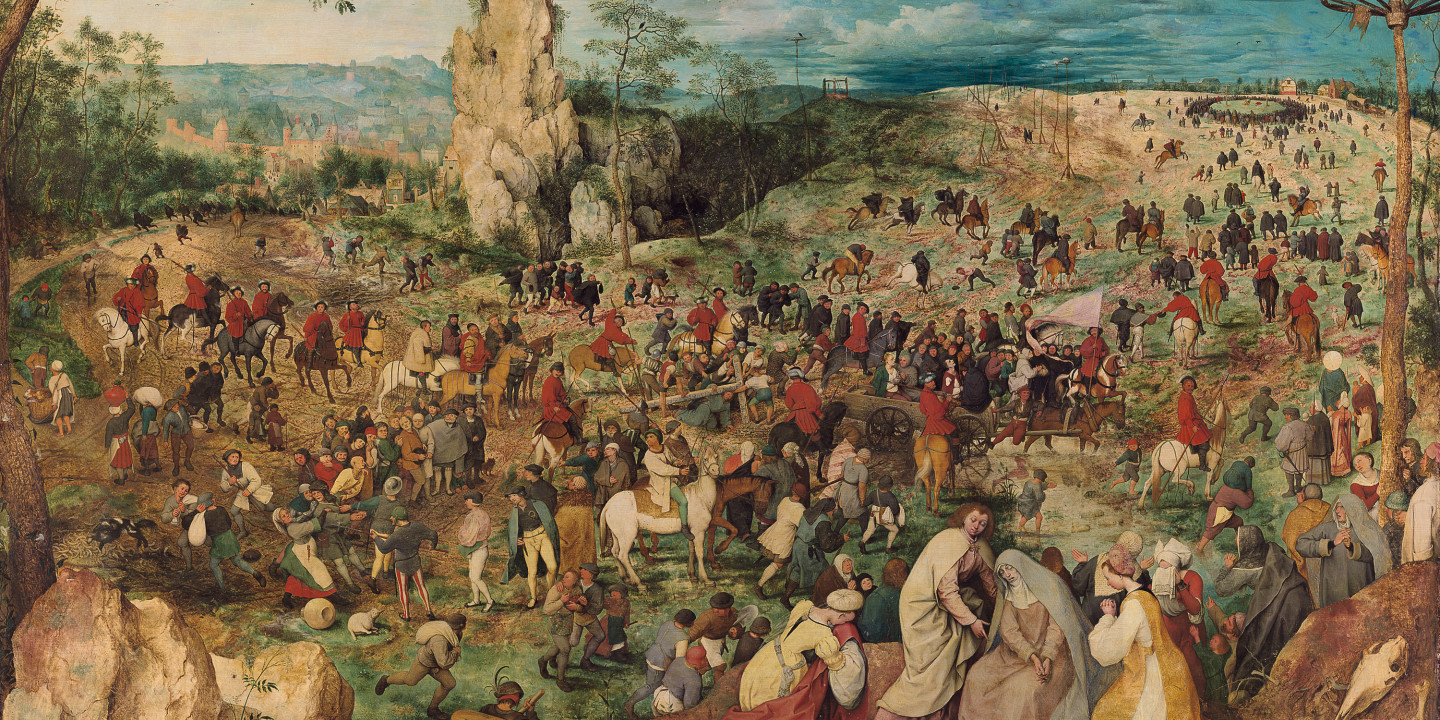
The pinnacle of this trend, and my favorite painting of the Passion story, is The Procession to Calvary by Pieter Bruegel the Elder (pictured above).
It might take you a moment to find Jesus, who is carrying his cross but has fallen. Familiar figures from the narrative are there. Mary, John, and other followers, oversized in the foreground, look toward the viewer and away from the scene. Simon of Cyrene is being dragged toward the procession to help carry the cross, his wife trying to hold him back. The two other condemned men are being ministered to by monks. The soldiers are dressed in the red livery of the army of the Duke of Alba, which had invaded the Low Countries in a campaign of repression that took thousands of lives while Bruegel was working. Their flag bears the faint double-eagle standard of the Habsburg dynasty that ruled over Spain, the Low Countries, and the Holy Roman Empire.
Then there’s the crowd. A swooping circular arc carries it from the city to the execution ground, where a second, smaller circle has already formed to watch. It’s not a mob welded together by anger or celebration; it’s more like a river current with eddies and tide pools. Some people watch with grief or anger. Some are flowing backward toward the city to sell goods. Children are playing. A child rides on a parent’s shoulders toward the place of crucifixion. To the right and in the background are torture wheels, one of many touches from Bruegel’s century transported back in time to connect it to the killing of Jesus.
Bruegel’s preservation of the intensity of the Passion story in the midst of a swirling social world, and his joining of the first century with his own time and place, strike me as a perfect representation of what preaching ought to do on Good Friday. Isaiah’s depiction of the “servant” in the day’s lesson is at once abstract and vividly specific. Psalm 22 places us in the midst of historical events, whether David’s civil conflicts or Jesus’ persecution, with language open enough to imagine our own world, our own time, and our own history within it. Perhaps today the wheels would be AI-powered death drones and the crowd would either be filming the scene on their phones or simply lost in them: Attracted and repelled, dismayed or indifferent, doing their miserable job or caught in the crossfire, the people bear witness to just another Friday and the most important one of all.