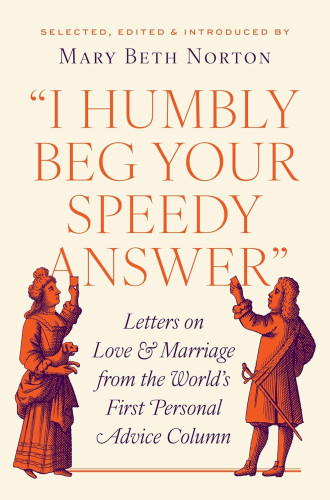
“I Humbly Beg Your Speedy Answer”
Letters on Love and Marriage from the World’s First Personal Advice Column
Some of the questions about life and love in Mary Beth Norton’s book are timeless: “Do most persons marry too young?” “How shall a man know when a lady loves him?” “Why does love generally turn to coldness and neglect after marriage?”
Some, not so much: “A person was some time ago married to a young woman, but not bedded. She did after marriage solemnly promise that she’d never alter what she had done, but at a certain time would come and live with him. . . . Can she do this lawfully?”

Read our latest issue or browse back issues.
Norton steers between the timeless and the time-lost in this all-too-slim book about The Athenian Mercury, the world’s first advice column. The Mercury was published in England from 1691 to 1697 and was produced by a three-person team headed by John Dunton, a London printer. The paper was printed in broadsheet format on both sides of a single large sheet of paper, with 10 to 20 questions garnered from the public—along with answers to them. As evidence of its success, a century after the Mercury’s demise, bound versions of its six-year run were still being sold, bought, and read, even in the Americas.
Before we say anymore about this proto Dear Abby, something must be understood. The English language of the 17th century is, well, kind of terrible.
Norton manages to wade through this without destroying the amazing liminal language structures that blossom forth when popular speech meets proper speech. The period from Shakespeare to Johnson’s dictionary was a time of incredible growth and change for the language. Culture, art, and literature were beginning to express the ideas and lives of the common people as valid subjects, which demanded a language that was energetic, quixotic, and malleable. However, the contemporaneous rise of the pure sciences created a need for accuracy and objective standards that demanded a formal and precise expression. These two forces crash together in the personal and public writings of this age, creating an entangled forest of ancient grammar, bizarre spellings, obscure localized slang, and polite terms for scandalous events which are now meaningless.
Norton has, in her words, “modernized and regularized” the Mercury’s contents with an admirable deftness. Bibliophiles will applaud Norton’s efforts in this sense. Ponderous filler phrases are eschewed, while the lovely particular words and turns of phrase that tell so much about a people are allowed to stay.
The Athenian Mercury answered questions on a variety of subjects, but Norton focuses on questions of love and sex, which one imagines the Mercury’s readers did as well. Norton tells us that Dunton employed “Mercury women” who sold copies of their papers to the bustling coffeehouses of London—the first intended audience for the broadsheet. It’s easy to imagine a man reading aloud the questions and answers to a table of his fellow java junkies and then enjoying all the loud arguments and laughing agreements that ensued.
It was to one of those coffeehouses that readers were told to send their questions. Dunton would then pick them up, sort through them, and send the ones to be answered to his coworkers, the Athenians. Though the Mercury promised veracity, one can’t help but wonder how many of the questions were from actual people and not crafted by the Athenians themselves. Norton assures us most letters were genuine, with only a possible few being fabricated.
It’s easy to believe, as there is a very genuine and real feeling to the questions. The answers as well correspond to many familiar rhythms of modern advice columns. The only major difference is the real and present judgment of a legalistic God.
There is a great deal of religious law in these Q and A’s. It’s jarring at first to read something sensible—Get her friends to like you—and then swerve to You have to marry a jerk because God says so. However, as one digests these contrasts, one starts to understand that these querists and the Athenians who answered them perceived God as alive, present, and real—a thing that one constantly had to worry about in a practical manner. When asking about breaking contracts of marriage, the terms of divorce, or sex before wedlock, the authority being appealed to is never neighbors and family like in Ann Landers. It’s God. In 17th-century England, the language of law and the language of God had yet to diverge, with often heartbreaking implications.
Norton shows that women were still getting the short end of the stick, no matter what language was used. But between the misogyny and materialism, a glimmer of hope shines through. Throughout these Q and A’s there is a general appeal to compassion, understanding, and reconciliation toward all but the most licentious of women, along with a ferocious condemnation of men who seduce, lie, and lead women to “ill ends”—a surprising tone for the 1690s. Parental authority is always upheld, but so is the idea that no child should be forced to marry against their will. And while in no way do the Athenians preach an equality of the sexes, the impression that women are only chattel or repositories of lust is not present in these pages. Women are seen as sensible, capable, wise, and virtuous. Not as sensible, capable, wise, or virtuous as men, of course, although this notion of superiority is soundly disproven by many of the letters’ descriptions of the antics of men.
Books like I Humbly Beg Your Speedy Answer give us a chance to see our own impulses expressed by people who were still figuring out how to speak, how to write, and, most importantly, how to advise. You’ll laugh at some of the answers given, but you will also recognize yourself in many of the questions. The past seems much less alien and strange when you can see yourself peeking out between the lines.