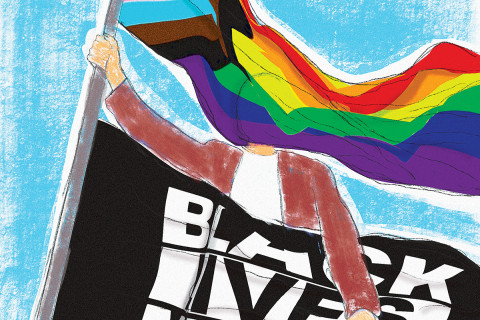
The word fascism evokes images from Mussolini’s regime in Italy or Hitler’s in Germany: the propaganda films, the mass rallies and book burnings, the concentration camps and death camps, the swastikas, jackboots, and marches. Yet we make a mistake when we see fascism as foreign or assume that it must be an exact copy of the fascism that came before. Fascism is adaptive, flexible. It is a chameleon shifting with the light—now a White supremacist’s shriek against the stranger, now an oligarch’s handshake with power, now an immigrant kid getting snatched off the street and sent to a secret prison beyond the reach of the law. Millions of people look away, ignore the threat, downplay it—and thus fascism proliferates. Fascists create a legal black hole where people are erased—literally dehumanized—while expanding a monstrous surveillance state and machinery of terror that continues to ensnare new victims.
Fascism exists in many forms in the United States: the neo-Nazis ready to commit murder tomorrow, the militias and gangs that harass minorities, members of the MAGA movement who are focused on immigrants “poisoning the blood” of the country or women having too many rights, voters who want a technological autocracy or a traditionalist Christian nation, intellectuals who feed birthrate theories of race, conspiracies about the elite, and legal strategies for consolidating executive power. Technology amplifies fascism and helps it reach young people directly.
Read our latest issue or browse back issues.
After the economic crisis of 2008, I noticed many of my fellow male millennials moving to the far right. I began to study the history of fascism. I was especially intrigued with the question of why so many young Europeans drifted toward fascism after the First World War. One of the early answers I found was surprising: The fascists knew how to throw a good party.
In December 1930, Albert Speer attended a party in Berlin. The young architect and professor was a rising star from an upper-class family. He taught at the Berlin Institute of Technology, which was, like other universities, overwhelmed by radical activism. The Communists were one powerful faction, but by 1930 there was another party Speer’s students told him about: the National Socialists. Out of curiosity, Speer decided to attend a party meeting.
It took place in an underground beer hall, the sort of place where working men gathered. “Dirty walls, narrow stairs, and ill-kept interior created a poverty-stricken atmosphere,” Speer writes in his 1969 memoir, Inside the Third Reich. The room was overcrowded; behind a small stage, professors were seated and watching. “Their presence gave the meeting an importance and social acceptability that it would not otherwise have had,” says Speer.
The main attraction that night was Adolf Hitler, then a political agitator who was not yet in power. The first thing Speer noticed was that the party leader was not in military garb. On posters and in drawings, Hitler was depicted in a military tunic with a swastika armband. But here he was in a “well-fitted blue suit.” It gave the event an aura of professional respectability.
As Hitler began to speak, the crowd went quiet. What happened next Speer could not have predicted. Hitler’s soaring speech soon carried the crowd into mass delusion. They cheered and clapped and roared with excitement. Even Speer, the curious onlooker, found himself joining in: the room’s intoxicating energy “swept away any skepticism, any reservations.” As the energy rose to a fever pitch, Hitler held Berlin’s finest in his hands. “It was as if it were the most natural thing in the world to lead students and part of the faculty of the two greatest academies in Germany submissively by a leash,” Speer wrote. “This anonymous assemblage wallowed for hours at a time in obsessions, savagery, license.” It was a rowdy bar, an ecstatic rave, and a hateful political rally all in one.
Speer went home that night with his thoughts jumbled. He later attended another rally in Berlin, this one led by Joseph Goebbels and featuring more insults and name-calling. This coarseness grated on him. Still, on January 30, 1931, Speer joined the National Socialist Party. He was 26 years old.
The Nazis had mastered something deeper than intellect or even political skill. They knew how to harness and release people’s unacknowledged emotions. For Speer—and soon millions of others—the most basic psychological transformation had taken place. The secret cheat code of fascism had worked, rendering uncertainty into victimhood and victimhood into vengeance. Fascism could see into the darkest parts of the human soul, speak to people’s deepest vulnerabilities, and win converts by selling a message of impending doom—and promised revenge.
Fascism creates spectacle. It gives its followers a rush of excitement, a gross theatricality that pulls them into a dramatic narrative: that they are aggrieved victims, part of a nation weakened by a dangerous element and in need of purification. The fascists put on a show of power, amusement, and violence—and people join, in great numbers.
Speer would go on to serve as Hitler’s chief architect, designing the gargantuan Reich Chancellery building in a neoclassical style. Aesthetics were an important part of the Nazi appeal, and they turned the art of ritual and spectacle into a spiritualized politics for a people starved for community. The Nazi aesthetic is on display in Triumph of the Will, in which Leni Riefenstahl’s clever camera work and use of shadow captures the essence of the Third Reich, its propaganda and absurd theatricality. The filmmaker later regretted her decision to join the Nazi propaganda machine: “It’s so terrible,” she said. “It casts such a shadow over my life that death will be a blessed release.”
Carl Jung spoke of the shadow that we all carry: that buried part of us where we’d rather not look, the part that contains all our capabilities for evil. Democracies have this shadow, too. While we may say we value elections, judicial independence, equality before the law, meritocracy, and decency, some part of our society yearns for an authoritarian to punish anyone who transgresses—minorities, women, dissidents. Democracy works by voluntary participation and civic engagement; its dark underbelly is one of revenge and retribution.
Fascism is the shadow of democracy. And when this shadow takes over, it manipulates the masses into hallucinatory fantasies of egotistical power and cruelty. It gives them license to commit savagery, treachery, and injustice. Through fascism’s charms and illusions, entire societies become collectively possessed. The demon takes over.
The term fascism elicits strong debate. Some deny that such a thing even exists. For many years, the word was little more than a slur in the United States. But turning a political ideology into a slur does not obviate that term’s coherence; if anything, the constant misuse of the term fascist to simply describe one’s political enemies can blind us to the reappearance of actual fascists who want to destroy democracy.
Fascism is best defined as a movement in which a single ruler, appealing directly to the masses, summons the impulses of narcissism and hatred, promises a return to the glory days of the nation, gains power via electoral means, is reinforced by militias on the outside, and then attempts to violently “purify” the nation. It is distinct from authoritarianism, traditionalist monarchy, and corporatism; it includes a mass party, hypernationalism, and a dictatorial regime premised on channeling the energies of the masses. It uses force externally as well as internally: along with unleashing violence on the masses and demanding total compliance, it builds up arms to threaten and invade countries deemed inferior. Hallmarks of a fascist regime include intoxicating rituals and celebrations, a narrowing of the range of thought, and a secret police force.
Fascism is the suffocating reality of always being surveilled, of unmarked police cars driving slowly through one’s neighborhood, of nurses and doctors alert to the possibility of their patients being kidnapped and deported, of churches no longer free to provide for the needy without being assailed, and of vigilance with one’s words. In the fascist state, we are all being watched, always.
The term fascism is perpetually debated in academic circles, with little consensus as to what it means. Historian Stuart Joseph Woolf even suggested that the term be temporarily banned. This is partly because fascism is a nationalist ideology, so it takes on the cultural particularities of any society where it finds root. Mussolini, the founder of fascism, likened it to a spiritual movement. Russian revolutionary Leon Trotsky saw it as a mostly middle-class phenomenon. “When a state turns fascist,” he wrote in his 1931 pamphlet What Is Fascism?, “it does not mean only that the forms and methods of government are changed in accordance with the pattern of Mussolini.” The Italian fasces symbol—a bundle of rods with an iron axe—originated in the Roman Empire, the emblem of law and power. This emphasis on both Rome and the violent force of the modern nation-state are central to fascism.
Four major attributes of modern fascism stand out. First, it is a revolutionary ideology, with the goal of replacing existing institutions by recalling past myths of national glory. Second, it draws energy and recruits from young people, especially boys and young men, capturing their disillusionment about war, a bad economy, and changing social mores. Third, it expertly uses pageantry and spectacle, turning politics into an aesthetic and spiritual experience. Finally, fascism is fundamentally about consolidation of all power, subsuming all civic and social institutions within the state. Fascism’s policies of expulsion and extermination derive from its zealous drive to create a new man and new society.
For millions of Americans, this is not just theory. The terms deportation and immigrant and great replacement are more than just abstractions; for countless people, fascism is a matter of life and death. When fully realized, fascism wins by feeding off democracy like a parasite, eliminating the humanity in each of us. Even the rational and compassionate person, who has a natural instinct toward justice and a strong sense of right and wrong, may begin to falter. Fascism reduces us to either victims, bystanders, or perpetrators—even passive perpetrators—of machineries of terror.
Fascism works by eliminating rational thought and dissent, by making people question the reality before their eyes, by eradicating our ability to recognize the pain of others, by burning and banning books, and, where all else fails, by using pageantry and entertainment to distract and deceive the public. The lies fascists tell can spread rapidly across the world, backed by threats of violence, demoralizing the public while liberals are busy moralizing among themselves. Fascism is a cult of power, and it works by intoxicating half the population and filling the other half with dread and despair.
Shortly after Hitler seized power, Goebbels, an academic and failed journalist, established the Ministry of Public Enlightenment and Propaganda. This department was charged with converting the masses to Nazism through media—books, newspapers, films, and radio. Goebbels kept a copious diary during his years as propaganda minister. On March 25, 1933, he defined the objective of his propaganda ministry as the “spiritual mobilization” of the people. The Associated Press quoted Goebbels as saying, “Our propaganda is primitive because the people think primitively. We speak the language people understand.” At the 1934 Nuremberg rally, Goebbels reminded the masses how the Nazis came to power: Propaganda, he declared, “was our sharpest weapon in conquering the state.” For Goebbels and the Nazis, propaganda was most effective when it was turned into an art, attempting to express what was already latent in the human soul.
Propaganda was the art of conveying—through emotions and even spirituality, not intellect—the all-encompassing ideology that ruled one’s life. It “works best,” said Goebbels, “when those who are being manipulated are confident they are acting on their own free will.” It’s not that the receivers of propaganda have no agency; in fact, they are cocreators of the delusion. The public would participate in Nazism’s grand theater and mutually created mania. Millions of Germans joined the audience for the Nazi play, in which Hitler played the glorious leader and the regime ruled ruthlessly while spinning stories about its own rectitude.
Nazi spectacle was built upon layers of not just performance but lies. There was the “noble lie” of Plato, which said that lying for noble causes was permissible. This became the “big lie” of Goebbels, which said that if you told a bigger lie, it was more believable. There was also a third kind of fascistic untruth: the “pointless lie.” This was the superfluous, gratuitous lie—the lie told only as a demonstration of power. This was the lie in which the masses were told not to believe what they saw and heard.
The fascists had already told many lies. Regimes of other totalizing varieties tell lies too. But it was the pointless lie—such as denying the obvious or exaggerating a leader’s accomplishments—that made fascism different. What was true yesterday is false today, and what was false yesterday becomes true today. Goebbels wanted to use modern forms of technology to tell alternative stories about people’s reality. He wanted to bend people’s reality such that they could no longer tell the difference between true and false. He needed them to lose their judgment and discretion so that they would come to rely on something being true just because the regime said so.
For Goebbels, it was important that propaganda be creative and not too obvious. In 1934 he chastised the German film association for making too many extremely pro-Nazi films. His project was about permeating the masses, gradually lulling them with propaganda. It required enough subtlety and nuance that people could feel like they were coming to their own conclusions. The messaging of Goebbels’s propaganda ministry was, according to one German writer, like a medieval sermon, with tales of redemption through service and transcendence through loyalty to a cause.
One of the opponents of Nazism was the writer and translator Victor Klemperer. A convert to Protestantism, Klemperer was considered a Jew by Nazi racial law. He was thrown out of his professorship and banned from using the public library, and he began documenting the subtle changes in words he began to notice—in government speak, in books, in news broadcasts, in products at the supermarket, and in common parlance. Less than two months into the Nazi regime, Klemperer observed that even the toothpaste he bought from his local pharmacy now had a swastika on it.
A student of language, Klemperer documented how the Nazis bastardized certain words or subtly modified their connotations. They were masters of euphemism. The word fanatical acquired a positive sense. Evacuation described deportation. Someone forced into a jail or concentration camp had gone away or been put in protective custody. Someone who received special treatment was marked to be murdered. Phrases like alien to the species were used to describe Jews. Strength Through Joy was the Nazi leisure organization. Hitler was not a dictator but the people’s chancellor. New words like Nordify were invented to denote implantation of Nazi racial doctrine. Truth was inverted: “Work Makes You Free” was written at the entrance to a concentration camp. The point was to conform language to lies, to narrow the range of thought, to obscure the truth, and, over time, to get people to believe in illusions. If you tell enough lies enough times, eventually people—including you—will believe them. Resistance will be quashed before it is even considered.
Klemperer also noticed how often Nazi propaganda used superlatives and hyperbole: Things were always the biggest or most glorious of all time. This was borrowed directly from American sports reporters, with their propensity to exaggerate to make a point, often by citing absurd numbers. After one of the Nuremberg rallies, the Nazis said the event was so great that a stack of all the German newspapers published that day would reach 20 kilometers into the sky. Nazi language was especially similar to the language of boxing and other physical sports: Everything was a fight to win, a fight for survival, a fight to dominate and crush. One key tactic the Germans learned from Americans was that sensational American sports reporting was meant to show bravado.
But the Nazi variant was used to numb and mislead. If everything is the best, the claim loses its meaning. Language became another area of culture to defile. Language is a mechanism to structure our thoughts and give expression to our ideas, so the objective was to eliminate any possibility of critical thought. For Klemperer, it all came down to “a bad conscience; its triad: defending oneself, praising oneself, accusing—never a moment of calm testimony.” And what could be more defensive and self-aggrandizing than choosing a weaker person to pick on, to transfer all of one’s anxieties to, and then to harm for daring to comply?
When we look at the fascist propaganda from that era, with its emphasis on narrative and spectacle, one thing is clear: While liberals understood thoughts and arguments, fascists understood emotions. What the theorists and practitioners of fascism understood was that for propaganda to work at a large scale in technologically advanced societies, it had to become so good as to become invisible, just part of the general milieu of daily life. It had to be believed by millions, who were to be reminded at every moment of the regime’s greatness. German political theorist Hannah Arendt later wrote this:
A mixture of gullibility and cynicism had been an outstanding characteristic of mob mentality before it became an everyday phenomenon of the masses. In an ever-changing and incomprehensible world, the masses had reached the point where they would, at the same time, believe everything and nothing, think that everything was possible and nothing was true.
This was the aim of fascist propaganda: to prey on people’s vulnerabilities and to stoke cynicism. Cynical people were quick to believe that everything was corrupted anyway; the more cynical the populace became, the likelier they were to give power to fascists promising a glorious future once they fixed things. By making people feel deeply insecure and afraid, the fascists could pose as their saviors. Fascists invited the masses into a collective hysteria, in which they could transcend themselves and their individual realities. They spread cynicism and paranoia and allowed the masses to participate in creating a glorious illusion. In other words, the fascists told a more riveting story.
Imagine if Goebbels had lived in the social media age. He had the largest megaphone in Germany after Hitler’s, and it was intended to bombard people with so much Nazified language and propaganda that they could only succumb to its lies. Goebbels today would be a digital czar, running several tech and social media companies and holding a state monopoly over free speech rights. Perhaps he’d be a tech bro, one who had the brilliance and potential to change the world for the better but ended up pursuing evil instead. One can imagine him sitting in a palatial office with dozens of computers and phones and hundreds of employees scurrying around, publishing posts every second.
Goebbels with social media and artificial intelligence and multiple algorithms and surveillance capabilities at his fingertips—and censorship power—would be unstoppable. He would have the capability, with AI tools and advanced analytics, to spread propaganda around the world, all the time, without much effort. He could automate his propaganda and sit back and watch it multiply and memeify across the internet he controlled and surveilled. He would own apps people used to message, call, transact, and interact in the digital sphere. He would operate several blockchains and cryptocurrencies on the side, keeping his own interactions secure while enriching himself and his cronies.
It would be easy for him to peer into anyone’s digital life and to dispatch the secret police to their home to arrest them for their social media posts or even private messages. He and his propaganda henchmen, assisted by the wealthy owners of information channels, could utilize the greatest propaganda tool: accusation. Fascists don’t respond to left-wing criticism or engage in debate; they accuse their enemies of what they themselves are doing. They flip the terrain of the discussion itself. How can I be a thief, a fraud, or a wannabe tyrant when you are the thief, the fraud, the wannabe tyrant?
As anyone who has ever held a conversation with a serial liar and hypocrite knows, their first move is to lob a counter-allegation. This distracts from the conversation and forces you to expend energy on a fictitious issue. By the time you have gotten your bearings, you will have either forgotten about or will be too tired to argue for the original point. This psychological trick, the fascists understand, destabilizes, demoralizes, and discourages. It unleashes torrents of accusations, charges, and inflammatory comments until they accumulate into psychological trauma.
When fascism overtakes the United States, it will elevate private power; it will be futuristic and technologically sophisticated. It will have the rough American undertone of racial violence, and it will glory in the flag and “traditional American culture.” It will be televised and streamed and broadcast, its untruths repeated every minute. It will have sycophants and influencers at its beck and call, and it will take pleasure in telling obvious lies and taunting the masses. It will disorient and distract, and it will demolish anyone who stands in its way. And wherever all other tactics have failed, it will simply silence the masses until people accept defeat.
Though fascism is currently working hard to absorb people in its funhouse circus of continuous nightmares, there is still time left on the clock to defeat it. There is time for the left, center, and commonsense right to come together, imagine a better future, and build something worth passing on to subsequent generations. For that to happen, however, there needs to be a reimagining of what the future can hold and the policies needed to get there.
The first answers to the fascist need for spectacle and amusement are moral seriousness and the ability to tell a better story. When markets crash and pandemics spread and wars are about to start, people need a steady hand. We need leaders who start by being serious but who also tell a good, positive story, one that uplifts people. Be serious—see the misdirection, recognize the head fake, call out lies. Perceive truth clearly and conscientiously and cultivate inner moral clarity.
There is a certain fire of justice and rightness that burns in us all, and for those who don’t sell their souls, fascism provokes this fury. Observe the spectacle and note its core features, its theatrics, its cultural changes—but do not become absorbed by it or so brainwashed that you cannot accurately discern reality. Think critically—but do not yield to cynicism. It is easy for liberals to lose the ability to problem solve and think positively, to be so scrambled that the regime can continue its games of distraction. Retain your ability to think positively, affirmatively. See the simulation for what it is and then fight for clarity and truth. That is where resistance begins—with truth.
This article is adapted from the author’s forthcoming book, Shadows of the Republic: The Rebirth of Fascism in America and How to Defeat It for Good, which will be published this month by Broadleaf Books. Used by permission.