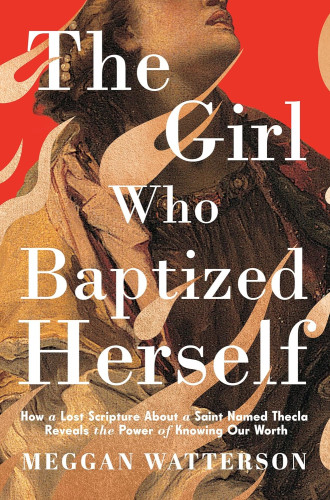
The Girl Who Baptized Herself
How a Lost Scripture About a Saint Named Thecla Reveals the Power of Knowing Our Worth
Meggan Watterson, best known for her work on the apocryphal Gospel of Mary Magdalene, continues her search for “the Christianity we haven’t tried yet” (as the subtitle of her 2019 bestseller Mary Magdalene Revealed puts it). While stuck in a cycle of returning to a dysfunctional relationship and deep in the isolation of the coronavirus pandemic, Watterson turned to another apocryphal work—the Acts of Paul and Thecla—for inspiration. The result is The Girl Who Baptized Herself.
Watterson mines Thecla’s ancient story of conversion and ministry for insights to apply to the lives of contemporary women. For context: Watterson is very clear that she has never belonged to any Christian church aside from the one she started, and she is primarily interested in the institution as an object of critique and analysis. She wants to recover the radical egalitarian energy of the “Christ Movement” without necessarily believing in the divinity of Jesus or being invested in the reformation of the church from within.
Read our latest issue or browse back issues.
From her reflections on the Acts, Watterson maps out a seven-step journey for personal growth, which includes hearing a call, answering it, dying, and experiencing resurrection. Though Watterson explicitly rejects calling it a “hero’s journey,” it is useful, I think, to read her project as a retooling of Joseph Campbell’s framework as a prescriptive model for life, with the important revision of placing women—any and all women—in the role of protagonist.
Watterson repeatedly reminds her readers that she trained as a theologian at Harvard, and the book makes two interrelated moves that seem vital to me in introducing an ongoing academic conversation to a wider audience. The first is to recover Thecla’s story for the Western church. The Acts of Paul and Thecla is a wonderful little book, which Watterson dates to AD 70 and which was definitely in circulation in the second century. Though Thecla is widely venerated in some Orthodox traditions, I had never encountered her story before reading Watterson, and it is well worth seeking out.
Thecla is a firecracker of a character, full of bold conviction and utterly unconcerned with convention. A lot of her story beats are familiar from other stories of female saints, most notably the miraculous preservation of her virginity. But Thecla is extraordinarily gutsy in baptizing herself after being told by Paul that he doesn’t think she’s ready (albeit in an arena while being attacked by lions; she didn’t have a lot of options), in dressing as a man as she takes up her own itinerant ministry, and, ultimately, in leading a monastic community.
The second move Watterson makes is to bring attention to questions about the formation of the biblical canon. The Girl Who Baptized Herself doesn’t do anything especially new in this area, but again, Watterson has a broad audience and brings a pointedly feminist lens to her critiques. The historical record suggests that the Acts of Paul and Thecla was repressed because of its celebration of Thecla as a powerful female church leader. Tertullian, at least, hated it for its positive representation of a woman as a religious leader. Whatever one believes about the biblical canon the councils formed, it seems well worth considering the role of patriarchal frameworks both in the development of the canon as we’ve received it and in contemporary biblical interpretation.
The Girl Who Baptized Herself does not pretend to be a scholarly monograph, though, and will sorely disappoint anyone who is looking for sustained academic engagement with the Acts of Paul and Thecla and its history. I counted two peer-reviewed sources in the book’s citations, with another one or two in the recommended reading list. There is a rich interpretive history of the Acts that Watterson doesn’t acknowledge at all. It’s a missed opportunity to demonstrate that there is an ongoing conversation about the canon and about how it informs the historical and contemporary experiences and roles of women in the Christian church. Watterson isn’t the first person to break this ground, though readers likely won’t pick that up without some significant reading between the lines.
The book is centrally a self-help one, with an emphasis on following Thecla’s model of being “true to who she actually is within her.” The path that Watterson suggests includes learning to use meditation to consult our nous, which she describes as being like “a Magic 8 Ball hidden deep in the body” and making self-empowering choices out of the power of love. The style is breathless in the way this genre can be, with fragments piling onto each other to a crescendo of rage or exultation:
The apocalypse that most concerns me is the unearthing of these voices that were buried by the end of the fourth century. And to refuse to discount them—to take those banned scriptures, those silenced voices, as seriously as the voices that were canonized. As if all those words that were lost to us, relegated to the shadows, serve to correct our collective vision of what’s sacred, as if we’ve been perceiving the divine like a cyclops, and now in our lifetime the other eye might open.
In my reading experience, the pathos of The Girl Who Baptized Herself often seemed stronger than its logos. In saying this, I do not intend to discount Watterson’s own emotional and spiritual journey, which she shares very vulnerably, or her academic credentials, which are significant. But I am concerned when an individual person’s experience dominates the interpretation of a text with the purpose of developing a one-size-fits-all prescription for fixing others’ lives. That seems to me to be what’s happening here.
But I hope that those who might be, as I was, put off by the framing of Watterson’s book don’t write off the Acts of Paul and Thecla. The Girl Who Baptized Herself is, at its best, a welcome invitation for more Christians to read and talk about this ancient saint.