
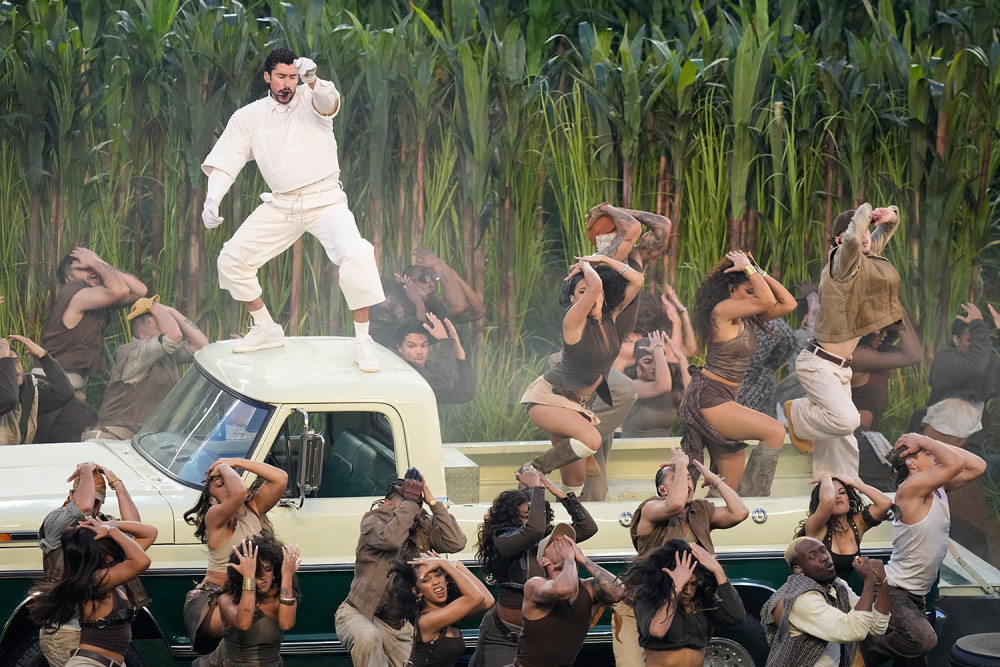
Bad Bunny swerved, subverting everyone’s expectations of a political statement.
Since it was announced in September that Benito Antonio Martínez Ocasio (Bad Bunny) would be the halftime performer for Super Bowl LX, the question being asked was, “What political statement will Bad Bunny make?”
Back in 2018, during his US television debut on The Tonight Show Starring Jimmy Fallon, Bad Bunny performed “Estamos Bien” (“We’re good”). A trap song with dreamy synths and wistful piano chords, “Estamos Bien” is a declaration of hope and assurance for Puerto Ricans who were still facing worsening electrical outages and the devastation wrought by Hurricane Maria the year before. As images of Maria’s violence flashed on screen, Bad Bunny described the losses, adding, “More than 3,000 people died, and Trump is still in denial.”
Right-wing pundits remembered this criticism when, after announcing his current world tour, Bad Bunny told I-D magazine that the reason he did not include stops in the US mainland was concern about ICE raiding his shows. His comments sparked immediate backlash. Then, during a Grammy award acceptance speech the week before this year’s Super Bowl, Bad Bunny intensified his opposition to ICE, saying, “Before I say thanks to God, I am going to say, ‘ICE Out.’”
The stage was set for a direct confrontation at the Super Bowl. But what Benito delivered was politics at a more fundamental level.
This year’s halftime opened with images of Puerto Ricans dressed as jíbaros, a complex symbol of Puerto Rican identity, working on a sugar cane plantation. The setting evoked histories of slavery and, later, the hard labor of a free-but-abused class of cane cutters. The football field at Levi Stadium was organized into a maze of sugar cane and “grass people,” creating a narrative trajectory that began in the narrow rows of the plantation and opened to the wider world of América (including North, Central, and South America and the Caribbean). As he moved through the maze, Benito highlighted real small businesses, cultural touch points, and family gatherings that mark the experience of Puerto Ricans (and other Latinos) who migrated to the US mainland.
By beginning in the plantation, Bad Bunny evoked the history of Black people carried to América in the transatlantic slave trade. These same people furnished the instruments, developed the rhythms, and cultivated the collective performances that are foundational to Bad Bunny’s music. The show included bomba, salsa, and of course reggaetón, all of which are musical genres with Afro-diasporic roots.
The narrative of the show was carried forward by Afro-diasporic music and dance, both of which operate as the base for what religious scholar Albert Raboteau refers to as “danced religion.” In América, the religious practices of enslaved people coalesced around common patterns inherited from a diverse collection of (largely West) African religions. These patterns are what Raboteau calls danced religion, and they include polyrhythmic music and dance along with singing and shouting.
Danced religion is not particularly concerned with establishing a strict, organized set of beliefs. Its spiritual practice instead creates liturgies for belonging. The performance of danced religion, the literal movement of bodies to music, enfolds people into a creative community with the Divine Spirit and with human others. Because of the musical complexity, the various drumbeats and vocal melodies, the community makes room for bodies to dance and sing at multiple registers; the ways to participate and belong are many.
In January, Apple Music dropped a teaser for the halftime show. In it, Benito walks toward an árbol flamboyán (royal poinciana tree) and plays his salsa song “BAILE INoLVIDABLE” from an iPhone. People from distinct ethnic groups and of various ages appear before him and join in dance. An older Black woman dances to the song traditionally. A fireman pops and locks. A younger Asian woman jumps with Benito as if the song is punk rock. A cowboy line dances. Eventually, the collective of people surrounds Benito, dancing their own rhythms as the words “The World Will Dance” flash on the screen.
Delivering on the teaser, at Super Bowl LX Bad Bunny performed danced religion and invited everyone in América to a peoplehood marked by love rather than hate.
Danced religion is identified with two outcomes. First, people who have been rejected and dehumanized by the world recover their sense of self and freedom. Second, the dance creates subversive, open forms of kinship, mutuality, and solidarity between people. Both outcomes were made visible through guest performers in the halftime show.
Ricky Martin is one of the icons of the 90s Latin Explosion, a collection of Latin pop artists who had crossover success in English markets. Martin’s success demanded he assimilate in order to make him palatable to US audiences. At this year’s show, he stood next to a musician playing Puerto Rico’s cuatro and sang Bad Bunny’s anti-imperial anthem, “LO QUE LE PASÓ A HAWAii.” The song warns Puerto Ricans about the danger of continued encroachment from US investors gentrifying the archipelago. It points to Hawaiʻi as the possible outcome if gentrification is not curtailed.
The performance was brief, but it displayed the recovered agency and prophetic power of danced religion. Martin represented all Latinos who have experienced alienation through assimilation as he expressed his full self and his passion for his people’s freedom.
More surprising was Bad Bunny’s invitation to Lady Gaga to perform a salsa rendition of her hit song “Die With A Smile.” Staged as the wedding singer for a real wedding that took place during the halftime show, Gaga sang, “Our love’s the only war worth fighting for. / Wherever you go, that’s where I’ll follow.” Gaga is wearing a custom baby blue dress designed by Dominican American fashion designer Raul Lopez and a flor de maga, the official flower of Puerto Rico.
Taken together, the look, lyrics, and wedding depicted the formation of a spiritual kinship that challenges the relational dynamic between the US and its colony, Puerto Rico. As decolonial scholar Nelson Maldonado-Torres put it, Gaga and Bad Bunny dancing together “reveals a Puerto Rican-ized US. The entire Afro-Caribbean performance explodes into a party that transforms las Américas.” Benito punctuates the mutuality made possible through the dance by citing the words of Jacobo Morales, the Oscar-nominated director who plays an older Bad Bunny in the music video for “BAILE INoLVIDABLE.” He says in Spanish, “While one is alive, one should love as much as one can.”
As a Puerto Rican formed by the Pentecostalism that spread from the 1906 Azusa Street revival in Los Angeles to Puerto Rico, I resonate with Bad Bunny’s performance—because my own religious practice has roots in danced religion. I encountered God in a community that taught me how to be both Christian and Puerto Rican. The two were mutually constituted through liturgical practices like coritos, songs repeating short musical refrains of praise or lament. The congregation brought their own bongos, güiro, and other instruments with plantation origins to participate in the polyrhythmic music-making. We sang. We danced. We became one people through the move of the Spirit.
The Holy Spirit is notorious for challenging boundaries and engendering belonging where there was previously alienation. When the disciples first receive the Spirit at Pentecost, their gathering spills into the streets, causing confusion and curiosity. Travelers passing through hear the testimony of Jesus in their own languages, and the community of Christians expands, immediately becoming characterized by multilingualism and an open kinship that would destabilize the Roman empire.
Bad Bunny’s performance similarly spilled into the streets on Sunday, subverting US demands for boundaries and social order.
The halftime show was political at a deeper register than mere confrontation. People expecting a show of force were confused, disappointed, or even missed the political import of what they saw. Some saw joy that “mostly avoids politics.” Others suggested the performance lacked political bite. Some wrestled with Lady Gaga’s inclusion.
These commentators all seemed to miss the spirituality of the performance. Benito invited everyone to a party that could be the beginnings of an América marked by love and born from the spiritual practices of danced religion. As he reached the end of the narrative, the literal end zone of the football field, Bad Bunny gathered to himself dancers carrying flags representing each nation in América. He held up a football that he had carried throughout the show and revealed the hidden message written on it: “Together We Are America.” Together in the Spirit and dance, we can be one.