I call processions “parades.” It started during my supply priest era, as I attempted to bring some life into a world-weary parish community. I didn’t know what to do, so I turned up with a pack of dollar-store kazoos, handed them out, and declared a parade.
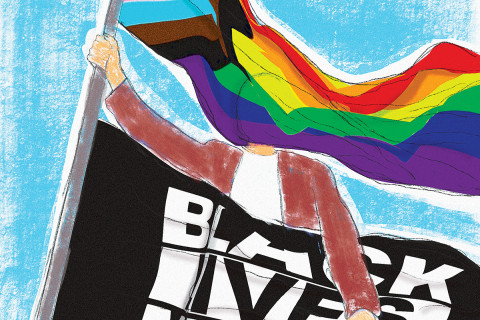
Parades interrupt the ordinary with childlike wonder: on Palm Sunday, we bring out the best outfits and all our props, with branches and thuribles and singing. Parades—or processions, as I’m told they’re technically called—structure our lives with their motion; they help us process what’s going on. Even the secular world knows the glory of a parade: harvest, Christmas, Pride. We delight in joining a party on the move. It’s so camp: a parade lineup, a pack of kazoos, getting honked at as we circumambulate the block.
Read our latest issue or browse back issues.
Jesus is doing a parade here, and the crowd joins in. I imagine them blocking the intersections with their red carpet of coats as Jesus approaches on a donkey—the kind of improvised celebration that in the South we would call an extremely duct tape and WD-40 situation.
Our parade is headed toward Jerusalem. It’s about to be Passover, and it seems like the whole Jewish world is converging on Jerusalem to prepare for the celebration.
In Marcus Borg’s classic analysis, as Jesus’ parade approaches, Pilate, the governor, also enters the city, in imperial majesty, from Caesarea Maritima. That palatial beach city is an ancient imperial power center, a technological wonder, a center of arts and sports. I’ve sat in the stands, looking out over the water, getting sunburnt to a crisp, closer than I wanted to be to the brightest sunshine and bluest sky I’ve ever seen. Who would want to leave Caesarea Maritima? But Pilate has to, to keep the crowds under control.
It doesn’t take much to see why Jesus’ parade makes Pilate nervous, why it might make him see Jesus as a threat to the tender peace of Jerusalem. As the Roman and the ragtag converge in the holy city, we parade into our worship spaces singing “Hosanna,” only to realize we’ve been following Jesus’ hearse—lights blinking, police leading and following—the whole time.
“When he entered Jerusalem, the whole city was in turmoil,” says Matthew. A note in The Jewish Annotated New Testament connects this line to the Magi story earlier in this gospel. When the Magi ask Herod about “the child who has been born king of the Jews,” Herod’s response is to be “frightened, and all Jerusalem with him” (2:1–3). So begins the slaughter of the innocents, with Herod just as scared of a tiny baby as Pilate is of a parade led by a donkey.
Jesus knows the consequences of what he’s done, riling up a crowd. He knows he has riled up his own funeral procession. As Lizzie McManus-Dail writes, “He knows these powers of empire will kill him, and yet there he sits, on a donkey, laughing at the devil with a few palm leaves as improvised, earnest props and a crowd of hungry, desperate, freedom-seeking people.”
“If we’re stuck on a ship and it’s sinking,” sings Frank Turner, “then we might as well have a parade.” Turner’s folk punk ballad, called “Love, Ire, and Song,” ends like this:
Darling, just for one day,
we can fight and we can win,
And if only for a little while,
we could insist on the impossible.
Leave the mourning to the morning: pain can be killed
With aspirin tablets and vitamin pills.
But memories of hope, and of glorious defeat,
Are a little bit harder to beat.
Our delight in the impossible insistences of Palm Sunday doesn’t even make it halfway through the Sunday morning service before the pain of Jesus’ crucifixion overwhelms us. Still, the power of parading behind a poor and holy king is hard to beat.
But, unlike Frank Turner’s parade, in the hands of God Jesus’ defeat in the Passion actually is glorious. For this is the power of resurrection: it withstands, and even requires, death. A parade becoming a funeral procession cannot stop resurrection. All the power in Caesarea Maritima cannot stop resurrection. Death itself cannot stop resurrection. In the light of Christ, the impossible becomes a reality we can insist on, laughing in the devil’s face.
So we might as well have a parade.