Mister Rogers was from Squirrel Hill neighborhood in Pittsburgh, and it was here that he built a career on a small, perhaps radical idea: that showing up for your neighbor, day after day, is its own kind of moral work.
But the neighborhood that made him famous—the same one that gathered in 2018 after the deadliest antisemitic attack in US history—is now consumed by a fight over what neighborliness is worth when there’s money, and a family’s retirement, on the line.
For three decades, one grocery store has anchored Squirrel Hill’s kosher life. Soon it will have new company: a rival supermarket opening just blocks away. The family that runs the original store says the new store was built in part on their own private financial records, shared in confidence during a sale that fell through. The newcomer, for its part, says it has “acted properly” throughout.
The dispute is now headed to a rabbinical tribunal, where both sides will make their case.
The fight reflects a broader shift already underway in kosher retail, where small, single-location grocers are increasingly competing not just with each other but with regional chains and delivery networks that didn’t used to reach a market this size.
For Ellie Feibus, 39, who lives within walking distance Murray Avenue Kosher, the store is less an occasional stop than a daily habit: coffee some mornings on her way to work at a synagogue preschool, lunch, dinner in the evening, a Thursday wine tasting. She often has her dog, Anschel—a blind, toothless, 12-year-old pug—with her. She greets people by name, wishing “Good Shabbos” to those she passes and “Hi, honey” to several others.
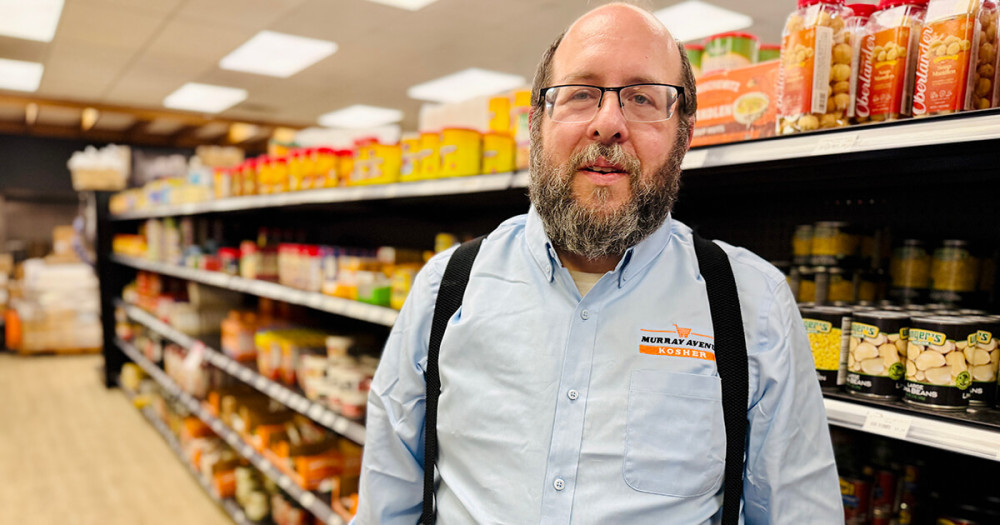
When Feibus got COVID during the pandemic, she called Aryeh Markovic, who runs the store with his parents, Saul and Beth. He personally delivered groceries to her doorstep. Without being asked, he added a container of chicken soup.
It’s that kind of care, she said, that would be hardest to replicate in a new store: “the part that’s going to be missing.”
Step outside and you’re in the heart of Squirrel Hill, home to a large swath of Pittsburgh’s roughly 50,000 Jews, three day schools, and about a dozen synagogues across the denominational spectrum—a community that has been here, largely intact, for generations.
“In Squirrel Hill, everybody lives cheek by jowl,” said Mark Oppenheimer, who wrote a book chronicling how the neighborhood held together after the 2018 Tree of Life synagogue shooting. “Even the more liberal and Reform Jews will power-walk with the Orthodox on their lunch hour. In a lot of cities there’d be real distance between those worlds. Here, there isn’t.”
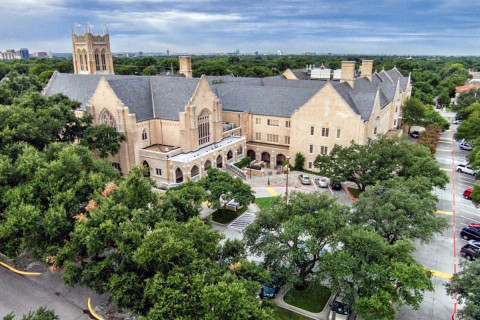
The neighborhood’s epicenter is the corner of Murray and Forbes avenues, adjacent to the Jewish Community Center, and the same intersection where the community gathered for a vigil the Saturday night after the shooting.
That corner was, until recently, home to a Rite Aid. But after the financially strapped drugstore chain declared bankruptcy in 2025, the building became available to lease.
Yitzchok Glassner, a transplant to Pittsburgh, wanted to get into the kosher supermarket business. The timing seemed fortuitous. Saul and Beth Markovic bought Murray Avenue Kosher in 1996; their son Aryeh joined as a partner in 2021. By last year, Saul and Beth were ready to retire—just as Glassner came looking for a store to buy.
In June 2025, Glassner expressed interest in Murray Avenue Kosher, and the two sides signed a non-disclosure agreement. Over the course of several weeks, the Markovic family handed over the store’s tax returns and profit-and-loss statements.
Glassner wanted to put his supermarket—with the name Murray’s Market—in the former Rite Aid building. Doing so meant winning approval from a bankruptcy judge working with Rite Aid, who needed proof the new venture could pay the rent. The Markovics allege that without their permission or knowledge, Glassner submitted their financial records along with a declaration stating that Murray’s Market was, in Glassner’s words, “acquiring Murray Avenue Kosher.” No such acquisition existed.
The Markovics say that they had yet to reach a deal with Glassner when he told the court he was acquiring Murray Avenue Kosher. They also claim that Glassner broke the non-disclosure agreement by sharing their private financial information, which is now in the public record as part of a filing in the Rite Aid bankruptcy case.
“Nobody is going to buy the business now if there’s a competing store opening 200 feet down the block,” said Shaya Markovic, Aryeh’s brother. “Had we known he intended to use the documents to open a competing store, my parents would never have given them.”
Talks between the Markovics and Glassner broke down.
Brandywine Communities, the owner and landlord of the former Rite Aid building, announced in August that Murray’s Market was granted the lease. Renovations are expected to begin in the coming months with a planned opening in 2027.
Whether it gets there without further complications is an open question. The underlying fight—over whether Glassner owes the Markovics anything and what should be done if he does—is now headed to the Beth Din of America, a rabbinical high court.
Few outside the Orthodox Jewish world have ever heard of the Beth Din of America, let alone know that a fight like this one could end up decided there, by a panel of rabbis rather than a judge or jury.
Murray Avenue Kosher’s Markovic said what he wants is straightforward: financial compensation from Glassner for damages he believes were caused to his business.
Glassner struck a different note: “In the interest of peace, we attempted to reach an understanding with another establishment, but sadly, those efforts were unsuccessful,” he wrote in a statement. “Nevertheless, throughout the process, we have acted properly, and we remain confident that all matters will be settled amicably.”
The Beth Din of America functions much like private arbitration in the secular world. Both sides have to agree to bring a dispute there, and once they do, the ruling is binding. A losing party can’t simply refile the same case in civil court and abide by that ruling instead.
Cases like this one are typically decided by a panel of three rabbinic judges. The Beth Din of America, modeled after the rabbinical courts in ancient times, maintains a roster of rabbis it works with, each with different specialties—one might have more experience with family law, another with contracts and business disputes. Some of the rabbis are lawyers themselves.
The arbitration can take place at the Beth Din of America’s Manhattan offices, or any other location that the parties and the Beth Din agree to, with follow-up sessions sometimes held over Zoom.
Sources who have previously worked with the Beth Din of America expect a case like this to be litigated in the coming weeks—with perhaps a slight delay due to Yom Kippur and Sukkot. A written ruling can take additional weeks to finalize.
Rabbi Yitzi Genack of the Vaad Harabonim of Pittsburgh, which certifies kosher establishments in the city, did not respond to multiple requests for an interview. A spokesperson for Brandywine Communities, the landlord and owner of the former Rite Aid building, declined a request for an interview.
The new Murray’s Market is not facing off only against one other kosher option.
Directly across the street from Murray Avenue Kosher, the local Giant Eagle—a large regional supermarket chain—runs its own in-house kosher bakery and stocks a decent selection of kosher meat: cold cuts, chicken, beef, steak, and brisket. There was already competition, in other words, long before Glassner decided to open a new store.
“For over a century, many important kosher establishments have served Pittsburgh’s diverse Jewish community, including Adler’s Delicatessen and Grocery, Kosher Mart, Murray Avenue Kosher, and Prime Kosher,” read a statement from Glassner. “For many years, these establishments—often operating side by side—contributed greatly to the Jewish community.”
In the 1940s, Murray Avenue supported at least 10 kosher butchers, a handful of kosher poultry stores, two fish stores, six bakeries, and 14 grocery stores, according to Eric Lidji, director of the Rauh Jewish History Program & Archives at the Heinz History Center. Rabbi Bernard Poupko, who led Congregation Shaare Torah in Squirrel Hill from 1942 to 1996, once called the street the yidisher gas, the Jewish street, even as the businesses lining it kept changing hands.
Adler’s Delicatessen is a case study in how the markets have changed. Founded in the late 1910s, it became a Murray Avenue fixture—until the Adler family sold it, in 1974, to U-Se Chu, a Korean immigrant. Under Chu’s ownership, the deli kept its kosher-style menu and its Jewish character for decades, before the family retired and sold it in 1997.
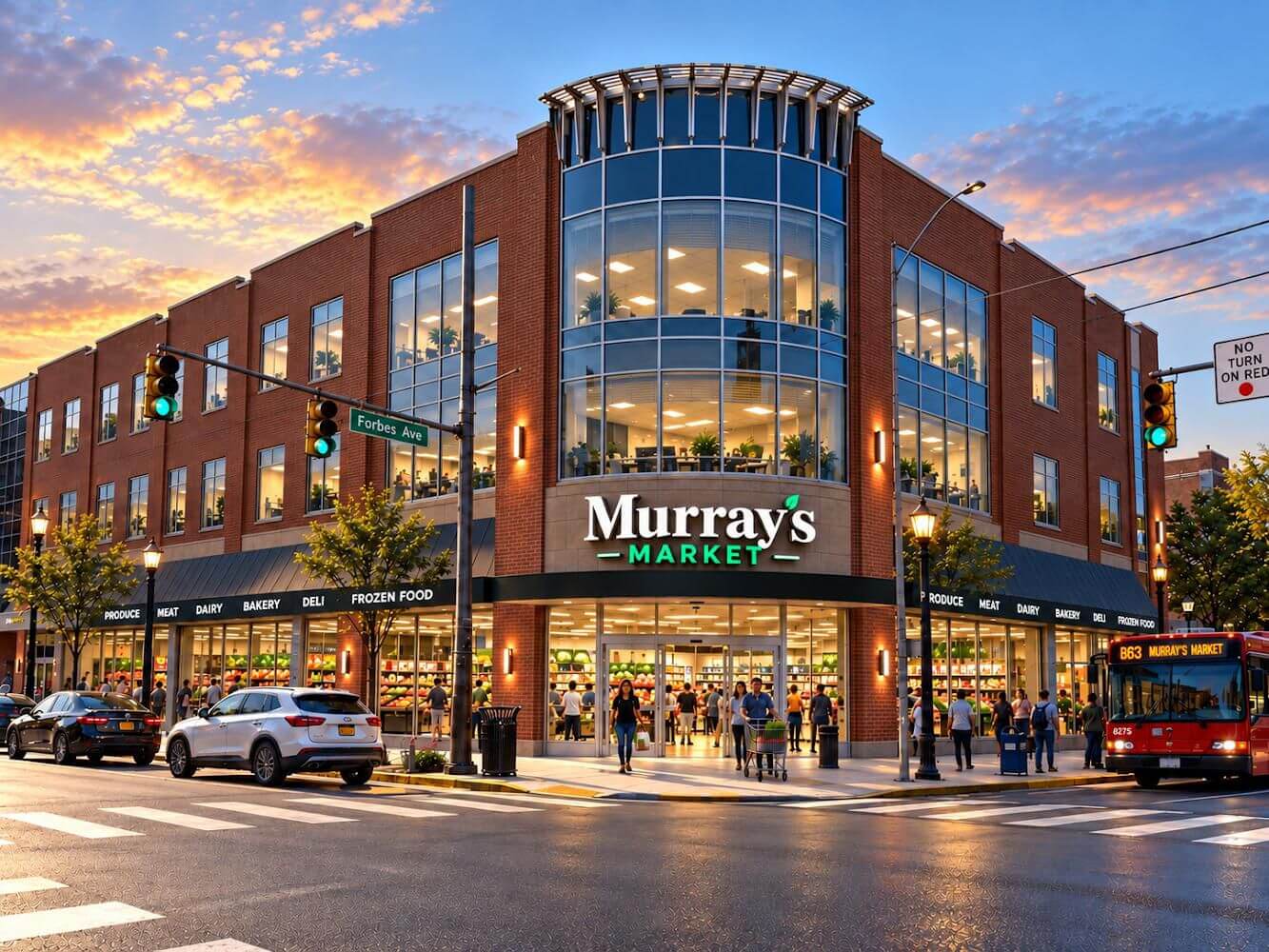
A rendering of the future home of Murray's Market in Pittsburgh (Courtesy of Isaac Glassner)
On Murray Avenue, in other words, a kosher institution outliving—or even changing hands entirely from—its founding family is not a new story.
Kosher shopping in Squirrel Hill does not even require a storefront anymore. Evergreen, a kosher supermarket chain with locations in New York and New Jersey, makes bulk kosher deliveries to eight cities across the Midwest as well as to Pittsburgh—part of a broader pattern of national and regional players reaching smaller Jewish communities that, until recently, only had access to whatever their local grocer carried.
Customers have noticed. Feibus, a devoted Murray Avenue Kosher shopper, said some of Pittsburgh’s newer transplants from the northeast have grown used to bigger, more polished kosher chains like Seasons and want the same thing locally. The Grove, a South Florida-based kosher supermarket chain, has added locations in Ohio and Michigan in recent years. Many Costco and Trader Joe’s locations across the country stock kosher chicken and other products for Jewish customers.
This fight is bigger than one grocer and one new competitor. Mom-and-pop kosher stores no longer have these smaller Jewish communities to themselves.
Not everyone in the neighborhood sees a second kosher store as a threat. Ronna Harris Askin, 78, a longtime Squirrel Hill resident, said she plans to shop at both.
“Competition is always good,” she said. She’s fond of Murray Avenue Kosher—it “mostly meets my needs,” she said—but doesn’t think one store should have to carry the whole neighborhood. “It’s good for the economy to have two places. It makes everybody be on their toes to do a good job.”
Harris Askin has seen the alternative firsthand. Her daughter and son-in-law live in Toco Hills, a heavily Jewish Atlanta neighborhood, where both Kroger and Publix stock kosher meat and other products alongside two dedicated kosher markets—evidence, to her, that a bigger Jewish community can support more kosher retail without strain.
Markovic isn’t waiting around to find out what the Beth Din of America decides.
He’s already working on what comes next at Murray Avenue Kosher. In the coming months, he plans to move the deli counter to a new space in the store and expand its offerings to include restaurant menu items like chicken sandwiches and hamburgers. He’ll be adding tables for seating. He has also hired a chef to make fresh sushi daily.
A year ago, Markovic was contemplating getting out of the business. Now he is doing the opposite: pouring money into the same store he nearly sold, betting that the surest answer to a rival two blocks away isn’t a rabbinical court, but a better rotisserie chicken.
“It’s imperative to get it done quickly,” Markovic said. One of his brothers is flying in to help him push through the vendor calls and the small decisions that used to take him weeks to get to. “I have 97 phone calls in between everything I want to do,” he said, and laughed, a little wearily, before picking up to answer another one. —The Forward
This story was originally published in the Forward. Click here to get the Forward’s free email newsletters delivered to your inbox.