

Features

Whose Christian nationalism?

If political power were distributed based on a census of the founding era, the United States would be run by Episcopalians and Congregationalists.

On Sunday, May 17, thousands of believers gathered in Washington, DC, to celebrate the Christian roots of the United States in anticipation of the nation’s 250th birthday. “America was founded as a Christian nation,” Defense Secretary Pete Hegseth said earlier this year. “It remains a Christian nation in our DNA, if we can keep it.” Samuel Rodriguez, president of the National Hispanic Christian Leadership Conference, echoed the point by saying the lineup of speakers at Rededicate 250—most of them evangelical—is “pretty much a depiction, a screenshot of our foundation.”

Hegseth and Rodriguez had better check their DNA tests again. The religious ancestors of the evangelicals leading the event on the National Mall—not to mention those of the Catholics and the one rabbi who also spoke—were outcasts in 1776.

Much of the criticism of Rededicate 250 has argued that it conflicts with the separation of church and state (and it does). I want to focus on a different point: For most of early American history, the folks leading this effort would have been viewed as heretics, worthy of suppression. If there was a Christian America, they would not have been included.


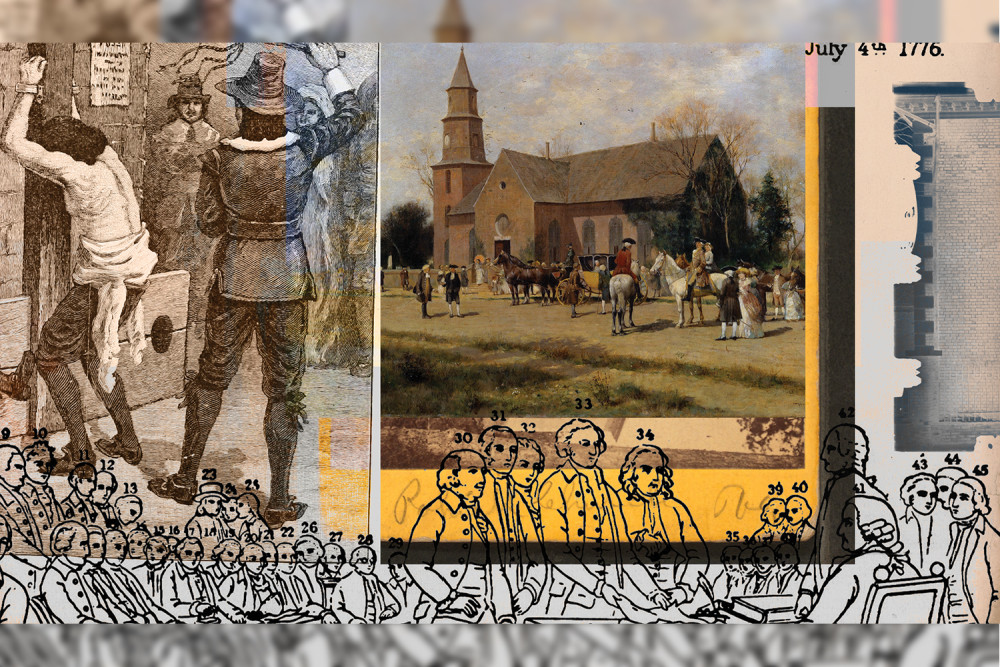
It’s true that most people in the colonies before the revolution belonged to religious denominations now considered Christian. But the Christianity practiced by the nation’s leaders was much more narrowly defined. It certainly didn’t include Catholics, who were banned from even voting in five of the colonies. In most places, heretical and dissident Protestant denominations were harassed, too. In 17th-century Massachusetts, the Puritans hung Quakers for their heresy.

Most significantly, the Baptists of the day—primary ancestors of today’s evangelicals—were routinely tossed in jail for daring to not be Anglicans. From 1760 to 1778 in Virginia, 45 Baptist preachers were jailed. Archibald W. Roberts was indicted for using hymns and poems instead of the Psalms. David Barrow was attacked by a mob while leading a service; they forced his head into the mud and water and nearly drowned him. David Thomas’s service was disrupted by protesters who hurled live snakes and a hornet’s nest into the room. Other attacks were described at the time in words such as these: “Frequently taken from pulpit—beaten.” “Meeting broken up by a mob.” “Tried to suffocate him with smoke.” “Severely beaten with a whip.” “Jerked off stage—head beaten against ground.”

This wave of violence against Baptists was especially significant because it happened in the counties surrounding James Madison’s home. He fumed about it in a 1774 letter: “That diabolical, hell-conceived principle of persecution rages.”

If we were to distribute political power according to a Christian census of the founding era, Episcopalians and Congregationalists would run the country. They were the dominant forms of Christianity then; today they make up about 2 percent of the population. The evangelicals who now claim America’s Christian founding as their own? They would not have been welcomed into leadership.

The first 150 years of life in the colonies can be viewed as a series of experiments in the Christian nationalist approach. The Americas were indeed settled as a Christian land. In Jamestown, Virginia, the failure to observe the sabbath was, after the third offense, punishable by execution. In Massachusetts, John Cotton explained the Puritans’ approach to religious tolerance: “Theocracy, or to make the Lord God our governor, is the best form of government in a Christian commonwealth.”

But this theocratic approach was soundly rejected by the Founding Fathers—and the driving force behind that rejection was 18th-century evangelicals, the very ancestors of today’s Christian nationalist movement.

The evangelicals of the day came to think that even efforts to help religion would backfire. They teamed up with Madison to oppose a Virginia effort to use taxpayer funds to support all clergy, believing that such support could encourage laziness among clergy and could evolve into harassment. A Baptist petition noted that once early Christianity received state sanction, via the Roman emperor Constantine the Great, “how soon was the church over-run with error and immorality.”

The Christian nationalists are right about one thing: Most of the founders thought religion was profoundly important. “Our constitution was made only for a moral and religious people,” John Adams said. “It is wholly inadequate to the government of any other.” Some maintained that the fragile new nation would need help from God or, as the Declaration of Independence put it, a “firm reliance on Divine Providence.” Another argument was more practical: A strong republic required citizens with a moral compass, and that could not happen at scale without religion. As George Washington put it, “Reason and experience both forbid us to expect that national morality can exist apart from religious principle.” How, for instance, could the criminal justice system work if people lied under oath, which religious people would surely never do?

But Christian nationalists take this truism and jump to a tremendous non sequitur: that the founders therefore wanted the state to promote Christianity. On the contrary, the evangelicals and their Enlightenment allies believed that the best way to encourage Christianity was to keep the government away from it.

In a letter he wrote later in life, Madison reflected on how well the First Amendment had worked. Interestingly, he pointed not to a decline in religious persecution but to a rise in religiosity:

On a general comparison of the present & former times, the balance is certainly & vastly on the side of the present, as to the number of religious teachers, the zeal which actuates them, the purity of their lives, and the attendance of the people on their instructions. . . . The number, the industry, and the morality of the priesthood & the devotion of the people have been manifestly increased by the total separation of the Church from the State.

If he were alive today, Madison and his Baptist allies would say that the best way to help Christianity and the nation is to reject Christian nationalism—and that the best way to promote religion is to have the government leave it alone.


This article was first published by Religion News Service.

Steven Waldman

Steven Waldman is author of Sacred Liberty: America’s Long, Bloody and Ongoing Struggle for Religious Freedom. 

All articles »
