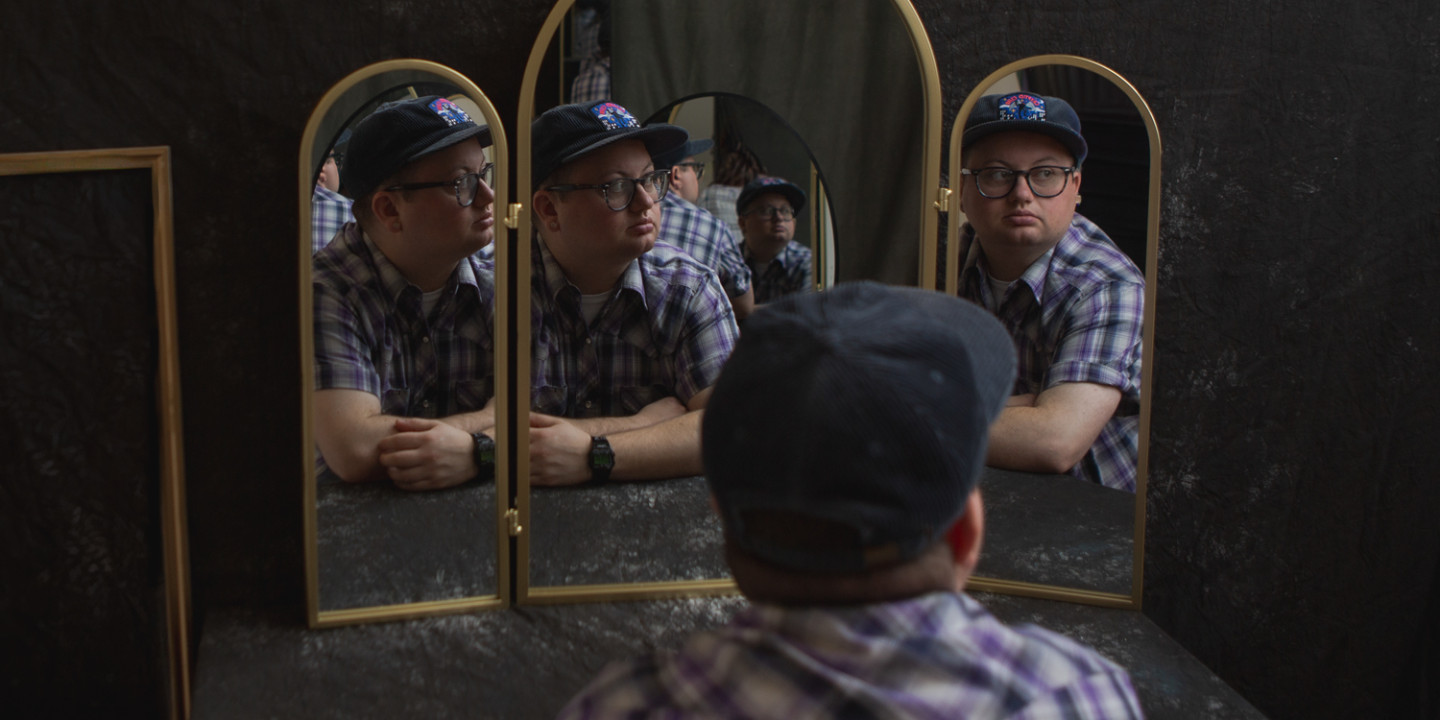
There are many arguments against God’s existence and many against the existence of transgender people, though the people making them tend to be different. As a trans man who transitioned while attending seminary, I am in the awkward minority of those who insist upon the existence of both. My tendency when I encounter either debate is to get defensive. Just look around you! I want to shout. But then I remember Thomas Aquinas.
In the Summa Theologica, Aquinas seeks to demonstrate the existence of God in five ways, each using known facts. His arguments range from the cause of motion to possibility and necessity to the design of nonconscious beings. But Aquinas’s work was not about debating atheists. He was writing in 13th-century Europe, where his readers were a bunch of other monks and friars. God’s existence was assumed as axiomatic—therefore, none of Aquinas’s five ways is watertight as a formal proof. Nor does he claim that they are original arguments; he borrows freely from Aristotle and others from antiquity. I point this out not because I’m concerned that the contemporary reader will misunderstand the five ways as an apologetic, but because I don’t want to be misread as an apologist myself.

Read our latest issue or browse back issues.
Try as I might, I have a hard time imagining my readers as being anything but cisgender. In a women’s studies class in college I learned about the female gaze, an effort by feminists writers and filmmakers to describe themselves and the world as they experience them rather than through the norms and expectations of men. Women must consciously construct the female gaze in a patriarchal culture; the ability to interpret their lives from their own perspectives is a learned skill. So, too, I am attempting to cultivate my own transgender gaze.
It’s hard. I feel myself straining against the urge to prove to the hypothetical cis masses how I could be Christian and trans at the same time. I see myself through a gaze not my own: a curiosity or an abomination.
But both my faith and my gender are axiomatic to my life. They are natural. There is nothing to prove.
The first way: Motion
1. All bodies are either potentially in motion or actually in motion.2. “But nothing can be reduced from potentiality to actuality, except by something in a state of actuality.”
3. Nothing can be at once in both actuality and potentiality in the same respect.
4. Therefore nothing can be at once in both actuality and potentiality with respect to motion.
5. Therefore nothing can move itself; it must be put into motion by something else.
6. If there were no “first mover, moved by no other,” there would be no motion.
7. But there is motion.
8. Therefore there is a first mover, God.
(Here and in what follows, the summaries of Aquinas’s arguments are from the Hypertext History of Philosophy, an online project [now defunct] created by Alex Levine and used here with his permission. The portions in quotation marks are directly from the Summa.)
I remember my first trans thought. It was in the parking lot of the public library where I was waiting for my mom as she dropped off books. East Liverpool, Ohio, circa 2004. I think it was in February, with a paper-white sky and piles of slush hugging the curb.
Apropos of nothing, I thought, If I were a boy, I’d be the same person I am now. I squinted for a moment, trying to imagine what else about me would change if my gender did. Nothing came to mind. This felt like a revelation to 13-year-old me, but one with the quality of a thought experiment more than anything else. I filed it away for later.
After a disastrous first year of high school, my parents transferred me to a small Quaker boarding school in the hopes that I could remake myself. And I did, sort of. My sophomore humanities teacher was the first out gay person I had ever met, and in a matter of weeks I came out as queer. I met another kid, a trans girl, who taught me that gender and sexuality are different things, and by senior year I had changed my name and clothes and haircut. I wish I could say that life got easier then, but the truth is that no one believed I was trans—not even me. We all just thought I was insane. And I was, sort of.
We didn’t know that I was bipolar, just that the list of medications that didn’t work for me kept growing, with no explanation as to why. So when I wrapped duct tape around my sports bra to try to flatten my chest, that was thrown into the same category as my desire to die. I wanted to get better; I really did. And getting better meant embracing the gender laid out for me at birth. In my quest for health, I tried to become a woman. I went to a women’s college. I minored in women’s studies. I interned at a feminist bookstore. The thing was that I literally could not stand to live as a woman.
This is where I have to stop myself. I’m turning to the role of the apologist almost immediately, trying to prove that my masculinity won out in the epic battle for my most authentic self. But the problem with trying to construct a grand trans narrative is that immediately all nuance goes out the window. I didn’t pull out some phallic Excalibur from a stone lodged in my unconscious that appointed me male. God is the one who taught me to seek the things that made me feel better, little by little, about being alive. Some of those things were gendered; some weren’t. My decision wasn’t to transition—it was to grow up. I decided that if growing up meant becoming a man, that’s what I needed to do. Our bodies are all potential until God makes us move.
The second way: Efficient cause
1. Nothing is the efficient cause of itself.
2. If A is the efficient cause of B, then if A is absent, so is B.
3. Efficient causes are ordered from first cause, through intermediate cause(s), to ultimate effect.
4. By (2) and (3), if there is no first cause, there cannot be any ultimate effect.
5. But there are effects.
6. Therefore there must be a first cause for all of them: God.
Here’s a confession for you: I hate the word transgender. The prefix trans is a throwback to the memory of a person I once was, and I want to be something more than an ex- of someone else. Ex-addict, ex-convict, ex-lover—no one wants to be an ex. I write on whatever form I’m handed that I’m male, no trans in sight, and except at the doctor, no questions are asked. I feel protective about my former girlhood the way you would with a wounded animal. It was wild and anguished and not to be put on display.
I’ve never had much desire to question why I turned out a man when I was raised to be emphatically female. The question presupposes some root cause, some deviance from the natural and supposedly inevitable that I find suspect. It’s like believing in predestination. There’s something tempting about the idea that our fates are already seeded for better and for naught and that God is the one who plants them. Jesus even tells a story about this. “A farmer went out to sow,” he says, and all manner of things happen to the seeds that he scatters (Matt. 13:1–9). As a child, whenever I heard the parable of the sower I wondered what kind of dirt I was. Would satanic birds snatch the word of God away from me? Would God’s love be choked out of me because of my greed or wither away because I was a coward? How could I know?
A cousin of predestination is the sense of purpose so many of my classmates chased through seminary. They had, many of them, a call story—like the prophets in the Old Testament but set at a summer camp or similar locale. Some defining moment in their past helped these students know who they were meant to be and that seminary was the way to get there. There was a lot of discussion about vocation, which is what God wants people to do with their lives, and how to ensure that one is on the right path. I’ve never known what to do with that, since I’m not an especially career-focused person. But perhaps my transition, which was mostly a seminary endeavor anyway, is my call story.
The third way: Possibility and necessity
1. “We find in nature things that are possible to be and not to be”: contingent beings.
2. Everything is either necessary or contingent.
3. Assume that everything is contingent.
4. “It is impossible for [contingent beings] always to exist, for that which can not-be at some time is not.”
5. Therefore, by (3) and (4), at one time there was nothing.
6. “That which does not exist begins to exist only through something already existing.”
7. Therefore, by (5) and (6), there is nothing now.
8. But there is something now!
9. Therefore (3) is false.
10. Therefore, by (2), there is a necessary being: God.
This could be the part where I write about suicide statistics, particularly among trans youth. I could write about my own overwhelming suicidal thoughts, which lasted from my mid-teens through the better part of my 20s. It’s common for trans people to want to die, not because there’s something incapacitating about being trans, but because our societies seem to hate us so much. The idea of living in a world where our existence provokes so much anxiety and rage in the people around us that they compare us to nuclear weapons, as Pope Francis did, or try to legislate away our rights to health care, education, and bathrooms, like any number of US politicians do, can make every day feel precarious. And that’s before the discrimination, harassment, and open violence in our jobs, housing, shelters, hospitals, prisons, and public places make us wonder if there’s anywhere on earth where we can be safe. The question of being contingent is a live one. It is possible for us to be—not to be right or to be good, but just to be—but sometimes just barely.
It may seem strange, then, when I say that for me, transitioning has always been a response to God’s will for me to live. I know that I am a contingent being, dependent on the merciful hand of God, because it was when I stopped trying to will myself into the roles I thought I had to assume that God loved me back into life. I got top surgery in consultation with an Episcopal priest; I decided to start taking testosterone after listening to a sermon on the transfiguration of Jesus. As for my name, well, what kind of person names himself after a major prophet? Except that I didn’t exactly name myself so much as allow the name to rest on me. I thought I would call myself Jonah, after a fool of a prophet who ran away from God. Instead I am called to be complicated poetry, full of hard and beautiful words. My name means “God is salvation,” and that has been true for me. God led me out of the wilderness of myself.
Trans narratives are conversion stories. Like Paul’s vision of Jesus on the road to Damascus, sometimes the evidence of your gender builds up inside of you and shatters your self-image. Sometimes it’s like Elijah, and you tell God you’d rather die than accept the grace of change. Like the woman at the well in Samaria, you start to realize that Jesus loves every version of yourself that you’ve ever been. Like Mary, you find out that accepting this love can crumble empires.
The fourth way: Gradation
1. There is a gradation to be found in things: some are better (hotter, colder, etc.) than others.
2. Things are x in proportion to how closely they resemble that which is most x.
3. Therefore, if there is nothing which is most x, there can be nothing which is good.
4. It follows that if anything is good, there must be something that is most good.
5. “Therefore there must also be something which is to all beings the cause of their being, goodness, and every other perfection; and this we call God.”
I’ve always wanted to be good. If you had asked me a couple of years ago what I meant by that, I’m not sure I would have been able to answer. But now I know. “Good” isn’t a thing in and of itself; it’s always in comparison to something else.
There is this phenomenon—anecdotal, but no less real—of the good trans kid. This is the person who feels ashamed of their transness on some level and decides to make it up to the world by being the best student or family member or friend they can possibly be. It’s an impossible goal, really, to be so good that someone forgets that you’re trans, but we still pursue it. In their memoir Hijab Butch Blues, Lamya H writes about “queer indispensability,” a phrase that encapsulates the work of making yourself unabandonable. If you’re always the one to bring your friends soup when they’re sick or cat-sit when they’re out of town, they’ll want to keep you around, never mind that you love the wrong people or your gender is strange. I have often been this kind of student and family member and friend, but even more than that, I am this kind of Christian. I have always wanted to be good, and by “good” I mean worth loving.
Henri Nouwen, a priest, prolific spiritual writer, and closeted gay man, writes in The Return of the Prodigal Son that he always felt like he was on the outside of God’s love looking in. He says that he spent most of his life trying to earn love and acceptance in the form of success and popularity, only to be continually disappointed. It was so hard to come home to God’s love, he writes, because the voice of God feels much quieter than that of the social order. For me, and I suspect for Nouwen, too, that’s because the idea that we are worth what we contribute feels like we have some say, some security, in God’s opinion of us. To trust that God loves regardless of merit presents us with the devastating risk of being turned away by the Creator.
I wish I could say that I was all better existentially after I transitioned, but I was still bipolar and therefore still miserable. I was 28 years old before I gave up white-knuckling it and went back to a psychiatrist, which I hadn’t done since college. I was afraid of entering the endless purgatory of appointments and meds and side effects and waiting, waiting, waiting to get well that had characterized my adolescence. And there were about six months of that, sure, and another several months of tweaking the meds that I had started. I saw a psychiatric nurse practitioner first, who described herself as a radical lesbian feminist socialist and told me that I was bipolar because I was trans. She put me on an antidepressant that made me so nauseated that for two months I could only eat peanut butter and saltines. Then my insurance changed, and with that came a new psychiatrist who found a combination of medications that actually helped me to function.
Through this process, I felt, at times, radically abandoned by God. I felt like I had committed a grievous moral failing by being unable to contain my thoughts and emotions without medicine. Again and again, I fell into the trap of conflating wellness with goodness. Looking back, though, I am able to see how the whole experience of recovery was shot through with God’s grace.
It’s been roughly ten years since I transitioned and three since I restarted psychotropic medications. I am more at home in my body and mind than I ever thought possible. I have a job that I enjoy and friends and a girlfriend. I am, for the most part and most of the time, happy. And yet still sometimes all I want is to be good.
The fifth way: Design
1. We observe that natural bodies act toward ends.
2. Anything that acts toward an end either acts out of knowledge, or under the direction of something with knowledge, “as the arrow is directed by the archer.”
3. But many natural beings lack knowledge.
4. “Therefore some intelligent being exists by whom all natural things are directed to their end; and this being we call God.”
The summer after eighth grade, I asked a cosmologist if we could find God by looking at the big bang. I don’t remember what he said to me, only that he didn’t take my question seriously. I was at a science camp at the National Radio Astronomy Observatory in Green Bank, West Virginia, and was trying to decide whether I was more interested in quantum mechanics or astrophysics as a means of connecting with the Divine. I had some vague sense that God was hiding and that if I could only learn enough, I would be able to find him or her. The last 18 years have been, in some sense, a continuation of that quest. In college I realized that physics wasn’t working for me and aimed instead for philosophy; when that wasn’t it, I tried systematic theology. And then that was unsatisfying, so I tried feminist biblical studies, which got closer but still wasn’t it.
Frustrated, I went to see a spiritual director, a priest who functioned like a couples’ therapist for God and me. “You’re trying too hard,” he said. “God wants to know the real you, not the person you think you should be.” He was right. God has been teaching me to let myself be myself all along, to settle into my body and mind and to be honest about what I need to inhabit them. It hasn’t been an intellectual or moral venture at all. Yet I know that it is from God because God creates us for joy. I’ll never forget the joy of using Old Spice deodorant for the first time, or of shaving my head, or of wearing a white undershirt under a new button-down shirt. There was the joy of hearing my voice drop month after month on testosterone and the joy of practicing my signature with my new name.
“Humility consists in being precisely the person you actually are before God,” says Thomas Merton in New Seeds of Contemplation. When I was busy scouring the skies and my textbooks for signs of God, I had no idea that letting myself be was the greatest clue for finding out who God is.
The five ways of Thomas Aquinas are all cosmological arguments, meaning they work backward to determine how it is that the universe exists. They are a posteriori; they are all based on observed facts rather than predictions or assumptions.
At the end of his life, and at the height of his intellectual powers, Aquinas stopped writing. He seems to have had a vision during the celebration of the mass on the Feast of St. Nicholas in 1273. He told his scribe, “Everything I have written seems to me as straw in comparison with what I have seen.” We can’t know for sure, but I think he experienced a kind of joy beyond words in the presence of that divine reality, knowing that someday he would be fully joined to it.
I have struggled throughout this essay with how to tell a true story about my relationship with God, particularly around my gender, though it is so often apophatic. Like the stories of the lives of the saints, there is often a flattening process in trans people’s comings out, as though it were inevitable that we would become who we are now. If it weren’t, the trolls’ line goes, then who’s to say my gender isn’t just some elaborate trick? But people are complicated, and gender is ineffable. It is not an argument, and as such it cannot be proven or disproven any more than the existence of God.
I love a good syllogism as much as the next person; I take comfort in being able to show my work. But there is a whole world beyond the apology. There’s a richness—and a joy—to reality that an argument can’t capture.