Sitting on a stump beneath the jocote tree in his nursery, Don Fausto explains how he learned to graft trees. As he speaks, his hands and eyes move gently over the dozens of citrus and avocado rootstock seedlings in his care. He prunes some, repots others. We are his visitors today, so his attention is divided, but these young plants are his regular conversation partners. When the saplings have grown sturdy enough, he will cut in shoots from mature trees and transplant them in his milpa. There, intercropped among corn, squash, and beans, planted between felled trunks, they will produce fruit in years rather than decades.
To make room for new life requires utmost attention and tenderness. This recognition has turned Don Fausto and other native seed guardians into careful students of generations of wisdom. Evidence suggests their ancestors began cultivating corn on the Yucatán Peninsula some 6,000 years ago. So intimate has been the joining of their lives to the lives of wild seeds that now the existence of each is inseparable from the other. Maya scriptures explain that the first humans were made not of mud but of corn. The seeds’ presence sustains them at every meal, whether in the salted tortilla in times of scarcity, in festive tamales, or in the most lavish of feasts.
Read our latest issue or browse back issues.
Through millennia in the land, Maya people have patiently grafted themselves into the life of these seeds. Seeds and people have become family. Don Fausto belongs to a peasant collective that honors this relation in its name: Colectivo In Laak Le Ixiimó—Our Sibling, Corn. The Indigenous farmers joined together several decades ago to form a regional mutual aid network with similar groups. When extreme weather caused crop failures in one area, the network provided affected farmers with seed corn to replant. Now, the groups host seed festivals across their ancestral territory to celebrate abundance and cultivate Maya self-determination.

Seeds convene these farmers. Seeds speak to them. As the collective council gathers one morning, they invite us, outsiders from the United States and Canada, to listen in. The group works to articulate the nature of their relationship with seeds. They remind one another that seeds summon them to joyful rebellion in defense of Land, Water, and all the lives that make their lives possible. (They capitalize these names in recognition of their relationships: Land and Water are not inert property nor resources, but sacred beings.) This alegre rebeldía is an inheritance they receive and pass on in the face of trade policies, extractive interests, and land reforms that seek to privatize the sources of their life.
After lunch, collective members Don Eduardo and Doña Elena take us to a field where they have sown native corn. (All names have been changed at the seed guardians’ request.) Like the forest that flanks it, the land is held in common trust by the local ejido. The ejido is a Mexican structure for communal land ownership that takes its name from medieval Spanish law and its inspiration from a form of Aztec land tenure. The ejido preserved Indigenous landholding by prohibiting the rental or sale of land beyond its established membership. These safeguards over land use rights have made it a perennial political target of domestic and foreign investors. Changes to the Mexican Constitution in the late 20th century paved the way for NAFTA by reforming property law and weakening these protections.
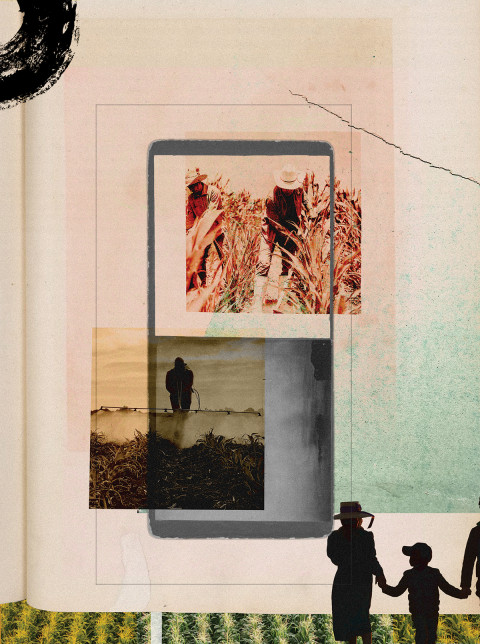
Standing at the forest’s edge, we see vast tracts of industrial corn production on the horizon. To the north, an irrigated parcel 100 times the size of the family’s plot grows patented seed for the multinational pharmaceutical and biotechnology company Bayer. To the south, tenant farmers—recent, German-speaking Mennonite immigrants—grow these and other patented seeds with the help of agrochemical inputs. Don Eduardo tells us that not long ago, pesticide drift from these fields killed a portion of his family’s crop.
Unlike Don Fausto’s intercropped milpa, Don Eduardo and Doña Elena’s field grows only corn. The collective recognizes many ways to be seed guardians. Work in the fields is as important as work in the kitchen, and the harvest as essential as the fiesta. Yet they do not equivocate about the harms and existential threats they face. They denounce the exploitation of the land and aquifer that has spiked since the 1980s, when European Mennonite colonies began arriving with large families and industrialized agricultural practices.
Life here in the Chenes depends on groundwater and rainfall. There are no surface rivers in this part of Maya ancestral territory. The name Chenes evokes the Yucatec Maya word for water wells, yet artisanal wells here have been contaminated with agrochemicals and are running dry. Increasing swaths of forest have been converted to farmland without regard for the traditional milpa cycles of rest and recovery. Commodity imports have devalued corn and made it increasingly difficult to subsist on traditional farming. Nidia, a mother and member of the collective, tells us this confluence of political ecological factors has pushed both local fauna and Maya youth to migrate in recent decades. “They’ve both become rarer,” she says.
Their European Mennonite neighbors are themselves no strangers to migration. Facing depleted wells and scarce land in their colonies in northern Mexico, these German-speaking Mennonites bought and rented arable ejido and national land in the state of Campeche to support their growing families. Their grandparents migrated, too. In the early 20th century, they negotiated an immigration deal with the Mexican government for mutual benefit. Fearing cultural assimilation in Canada, whole colonies moved to Mexico. Their presence and industry as farmers helped the government stabilize territory in the wake of the Mexican Revolution and launch the Green Revolution. In return, Mennonite colonies received an exception to the constitution that afforded them the religious freedom they sought: to use land and teach their children as they wished, without fear of conscription or government intervention. Go back a couple generations further, and their ancestors settled Indigenous lands in Canada as immigrants from Russia, to which their forebears had migrated, fleeing religious conflict and the violence of poverty in Western Europe.
One Mennonite farmer speaks of his family’s migration and the transformation of forest into farmland as acts of faith. “We wouldn’t be here if it wasn’t God’s will,” he tells us in his Campeche farmhouse. Nearby sits a chest his family carried from Russia. On each arrival, these Mennonites cleared the land and its history to set the stage for the drama of their faith: bearing witness to the faithfulness of God through productive lives on the land, set apart from the world. At each departure, they were pushed on by religious purity and threat of poverty, drawn forward by the promise of land of their own.
As European Mennonites have arrived in Maya ancestral territory, the Maya collective has developed deep concerns about the health and future of their people and the land. Yet they have a long memory. Mennonite farming colonies are but one manifestation of a much longer pattern. Instead of feeding hostility with their new neighbors, the collective names these patterns—the replication of colonial systems, structures, and institutions—as the target of their resistance.
This is why we have been invited here. We are part of a North American coalition committed to repairing the harms of the extractive and exploitative systems that shape so much of the world we share. Nourished by Mennonite theological commitments to antiviolence, we work to recognize our interdependence and to uproot the tangle of violences that underwrite our lives. Our reputation for working to compost these economic, social, racial, religious, and political systems and grow life-affirming patterns and structures of relation led the Maya collective to reach out seven years ago. Since then, we have worked together to promote the mutual self-determination of all who live in this storied land.
These efforts resonate with what political philosopher Olúfẹ́mi O. Táíwò calls constructive reparations. Táíwò suggests that accounting for the harms of centuries of extractive economic relations requires building new structures and patterns of relation. The work of repair is a shared spiritual and political ecological project. Our faithful, collective efforts create the conditions for greater self-determination, even as the horizon stretches beyond the reach of any one generation.
This animating vision of becoming good ancestors to our moral descendants is at once ecological and non-adversarial. Nidia hopes for a shared future in which Mennonites and Maya remain distinctively themselves but also recognize their fundamental interdependence with the many other beings in the land. Members of the collective practice this future now, grafted into the land with many diverse beings. Don Fausto negotiates his taxes with the birds who feed in his milpa. Don Óscar leaves the birds’ favorite trees to stand in his cornfield and tells us he always plants a few extra seeds in each hole so the insects may also eat. “The little ant is hungry, too,” he says.
The notion that the more-than-human world—whether birds, water, or the land itself—is full of fellow creatures to whom we are responsible is an idea as natural as breath to the writers of the Hebrew Scriptures. In The Hebrew Bible and Environmental Ethics, Mari Jørstad argues that the way these earliest scriptural communities inhabited the world shares more in common with Indigenous peoples’ ways of being in the world than with White Christians like us. These present and historical companions teach us that forests can grieve deforestation, that land bears witness to our actions on it, that seeds have agency. They invite us to live in a world filled with sacred beings, and to imagine human communities not excised from them, but among them—each with essential roles to play.
In this spirit, the Maya collective recommits itself to the diligent, gentle work of joining many peoples into one land, so that each may flourish alongside the others in that place. Yet every graft holds a wound at its source. Queer Chicana theorist Gloria Anzaldúa calls this herida abierta—formed where bodies and land touch and political and economic forces collide. It’s the site from which shared life flows.
The pain and promise of shared life call us together in the Chenes. At the collective’s invitation, we listen to Mennonite and Maya farmers in their fields and homes, in participatory mapping workshops, council meetings, and church services. Maya people make up the vast majority of the region’s population, and while at least 17 Mennonite colonies have settled among them, mutual understanding is limited. We focus on communities where members of the seed guardians network live and the colonies adjacent to them, while aiming for a representative sample to situate both in broader context. Over six weeks, we hear and reflect their concerns, values, and interests. Perhaps together we can find paths toward new ways of relating in the land.
As we visit, we hear Mennonites voice concerns over climate, debt, and inequality. Drought and increased pest pressure are making their work of growing corn, soy, and sorghum untenable. Most Mennonites in Campeche live in colonies structured around two institutions: the church and the corporation, the guardian and the gatekeeper. The church preserves the moral and social order, while the corporation provides access to finance, seeds, and agrochemical inputs. Buttressed by economic systems beyond the borders of the colony, these interlocking institutions offer little incentive to innovate. Many families puzzle over how to make ends meet and provide an inheritance of land for their many children. As economic inequality pushes the poorest to migrate, medical and agricultural debt constrain the choices of many who remain.
Yet innovation happens. Some of it succeeds. Communities tangle and blend. Mixed feelings abound.
Several years ago, Maya activists organized community meetings in Mennonite colonies across Campeche. Organic agriculture could be a more profitable use of limited land, they said. Their strategy was to seek mutual benefit and harm reduction: organic practices could also mitigate key negative ecological impacts. Of the many Mennonites the group spoke with, three were curious enough—free enough—to experiment with alternatives. One set aside a test plot for organic inputs. Another learned from his Maya neighbors to tend hives of honeybees. Together, two built a machine to scale organic fertilizer production to an industrial level.
But unspoken friction with colony structures and established patterns slowed these projects to a halt. When we speak with these three men, they point out the dormant experiments in their farmyards but have only warm things to say about their Maya collaborators. The absence of a market for organic fertilizer in the colonies stopped the inventors’ machine in its tracks, while pesticide and pollen drift from neighboring fields prevented certification of the organic crops. The current system works well for members of the colony who hold land and capital, one farmer tells us. The rest do what they must. Mounting medical bills for his wife’s chronic care following repeated pregnancies led him to triple his rented land holdings in a single year. Though the fields are an hour away by tractor and the financial risks are enormous, he felt he had no choice.
Members of Maya communities echo similar sentiments. On one of our last days in the Chenes, as we walk with Don Óscar to his milpa, a Mennonite who rents nearby farmland passes in a horse-drawn buggy. Economic pressures and youth migration have led many Maya in the area, including Don Óscar and Don Fausto, to rent their fields to Mennonites. Yet these economic arrangements sometimes run afoul of the parties’ religious commitments. Don Óscar speaks with regret of a Mennonite tenant farmer eager for higher yields who abused the land under his care by using heavy agrochemicals and planting on land not intended for cultivation. Since then, the elder has leased his fields with more caution, on annual contracts only.
But not all the young people are leaving. Several young mothers have taken up farming and lead local reforestation efforts, with the help of government subsidies, but they also wonder about the future. Unable to convince the majority-male ejido council to admit them into membership, they say they lack voice in collective decision-making and assurance they may remain in the land.
Under a tree in his milpa, Don Óscar recalls the agreements he and his father made with the aluxes in his childhood. These spirits hold a special relationship with the land. They watch over the fields that farmers clear and plant. If the aluxes are not consulted, they may choose to frustrate the farmer’s plans.
It has been an exceptionally dry year. Don Óscar doesn’t see aluxes much anymore, but only weeks ago he gathered with his neighbors once again. They gave thanks, renewed their commitment to shared life in the land, and asked the spirits and deities for rain. Before they had finished, rain began to fall.
Sitting together in the shade as grackles chatter above us, we wonder how we might learn to gather and share in the land. If as Christians we listened to our scriptures and to our Indigenous neighbors, if we believed Land and Water were family and allowed the site of our wound to become the place of our joining, what good fruit might we bear?