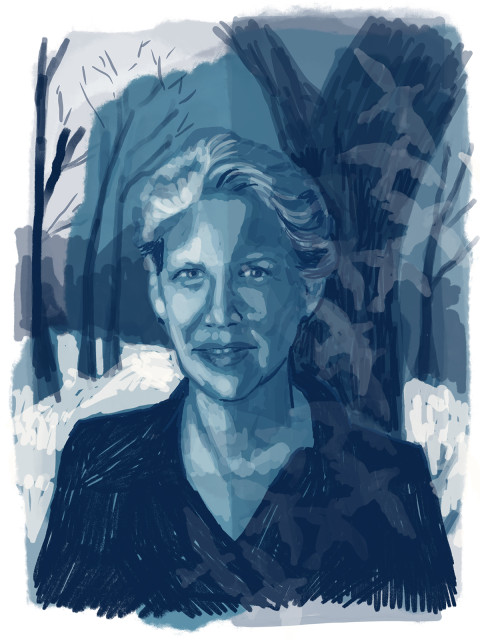
When I learned that writer Annie Dillard died, I did something I haven’t done since my dad died four years ago. I knelt on the floor and cried.
I’m embarrassed to admit this. Dillard was not a relative of mine, not a steadfast friend. We exchanged letters once, decades ago, but we never spoke, never bonded over a cup of coffee. What exactly was I mourning as tears fell onto my jeans?
I first encountered Dillard’s writing in 1994, as a seventh grader at writing camp. I had applied because my childhood best friend, who was a few years older than me, said living away from home came with the perk of unlimited ice cream.
That summer I moved onto the grounds of a rural Pennsylvania liberal arts college, and I spent six hours a day studying creative writing. Dillard’s “Living Like Weasels” was the first essay we read in class. It’s a quirky, potent meditation from Teaching a Stone to Talk (1982). In it, she describes an encounter with a weasel she crosses paths with on a suburban walk. They lock eyes, and their brains cross like phone lines. Suddenly, she knows what it is to be governed by impulsivity and instinct, by primal wants untampered by propriety. The weasel, she says, surrenders to its calling to simply be in its most undiluted, unfettered form. “People take vows of poverty, chastity, and obedience—even of silence—by choice,” she writes. “The thing is to stalk your calling in a certain skilled and supple way, to locate the most tender and live spot and plug into that pulse.”
I didn’t know that words could be so ferocious. I didn’t know spirituality could be, either. Her words electrified my fingers, my feet, my eyes. This was the closest I would ever get to an altar call. To what will I give my life? For what will I take a vow?
I came home from camp and read every Annie Dillard book I could find—Holy the Firm, Teaching a Stone to Talk, The Writing Life. As a suburban New Yorker with neither a night of camping nor a pair of hiking boots to my name, I had little interest in nature writing. But I devoured each distilled image of divine glory, every impenetrable question about good and evil that Dillard raised. She made faith visceral and mystical, ascetic and charged all at once. She taught me why it’s important to wrestle like Jacob, and she was brave enough to own that the battle can leave you parched, frayed, disappointed, and disenchanted.
She was the first writer I saw myself in. Or perhaps the truer thing to say is she’s the first writer I wanted to be. It’s hard to know the difference in retrospect, but regardless, a kinship grew between me and her words.
As a freshman in high school, I memorized “Living Like Weasels” for my public speaking class. I dog-eared my copy of Holy the Firm.
The summer I turned 15, I scoured Connecticut phone books, found Dillard’s address, and wrote her a letter. She sent back a handwritten postcard with answers to all my questions crammed onto it, the black ink splotched with raindrops. She referred to me as “Ms. Tumminio,” not as a child but as a woman deserving of an honorific. “Inner life is always a mystery,” she wrote. She mentioned that her child was at camp and that her husband had just had open-heart surgery the day before.
This stunned me. Annie Dillard has a child? Annie Dillard has a husband? I thought writers gave themselves entirely to their craft with mind, body, and soul. How did she have time for anything else?
During my senior year of high school, Dillard gave a talk at the 92nd Street Y, a mere hour’s train ride from where I lived. I’d never seen or heard her in the flesh. I didn’t know what she looked like. I wasn’t even sure how old she was. All I knew was what her books and that postcard and my imagination told me.
Seated in the audience, I remember thinking that she read her own work too quickly and that the pitch of her voice didn’t match the earthiness of her essays. I had no right to those critiques, but there you have it. I suppose what I really meant was that I was disappointed, though I couldn’t pinpoint why.
I suppose I hoped that I’d experience another electric shock, seeing this literary icon in the flesh. That we might lock eyes as she had with that weasel. The opposite happened—a kind of repulsion from getting too close, from knowing more than I should. I felt I’d violated the terms of the writer-reader relationship by bringing it into the flesh. I left the talk as soon as it was over, wishing I’d never gone.
Maybe I made a mistake, like Moses in Exodus 33. I asked for too much. I broke the covenant—not because Dillard was some kind of god, but because writers and readers are supposed to relate to each other in a certain way, and this wasn’t it.
Writers are mirror makers. They use words to create a sheen onto which we see all manner of reflections. Sometimes we see truth. Sometimes we see ourselves. Sometimes we turn away and our whole world has changed. It’s miraculous, isn’t it, that a relationship mediated by a page can do that? The writer pens her thoughts and then releases control of them. The reader finds them. Then we ingest and interpret them and make them their own.
Hands never touch. Eyes never meet.
This is a relationship we traverse in spirit alone, paradoxically distant yet intimate. But it’s also a partial relationship. The writer reveals something of themselves—Annie Dillard had a kid? a husband? a voice?—but that revelation is curated. We see only what they choose to disclose, what they’re willing to release control over, what we need to know. They give us the illusion of seeing face-to-face, though in truth we only ever see dimly.
Writers are not God, and yet, isn’t this what our relationship with God is like? God wrote a story for us long ago that we get to read, mark, and inwardly digest. All too often, we see what we want to see in it. Like Paul says, we see God as a reflection in a mirror, and only after death do we see God face-to-face (1 Cor. 13:12). We cannot, in this life, understand the fullness of this divine author, and it isn’t our place to do so. If we try, it can be so overwhelming, so beyond our expectations, that we turn away in shock.
It’s tempting to want more, and yet there’s such a gift in these liminal relationships. They remind us that we’re interwoven in ways beyond flesh and blood, that we can learn something from people whose faces we haven’t memorized, whose voices we never hear. Through them, we catch glimpses of the God who made us, whose revelation is clouded yet fierce. In The Writing Life, Dillard asks, “What do we ever know that is higher than that power which, from time to time, seizes our lives, and reveals us startlingly to ourselves as creatures set down here bewildered?”
I think of those nights I sat on my twin bed dog-earing pages of Holy the Firm as grace, freely given and thankfully received. I imagine a woman with a shrouded face sitting at a desk, writing by hand, tapping her pencil to the rhythm of her sentences. I imagine she’s bequeathing a gift to readers as opaque to her as she will be to them.
It’s all a kind of prayer between writer and reader, isn’t it? So perhaps it’s no wonder I found myself kneeling on the floor, hands on my knees, in the same posture I would be in if a priest were about to offer communion. I wasn’t mourning a friend. I hadn’t lost a colleague. And yet something was gone, and the loss shot through me with the force that struck Dillard and that weasel all those years ago: It was the loss of the girl who read to pray, and the fierce grace of the woman who—knowing neither my face nor the sound of my voice—dared to pray with me.
This article was edited on September 28 to correctly state that Dillard’s essay “Living Like Weasels” appears in Teaching a Stone to Talk, not Pilgrim at Tinker Creek.