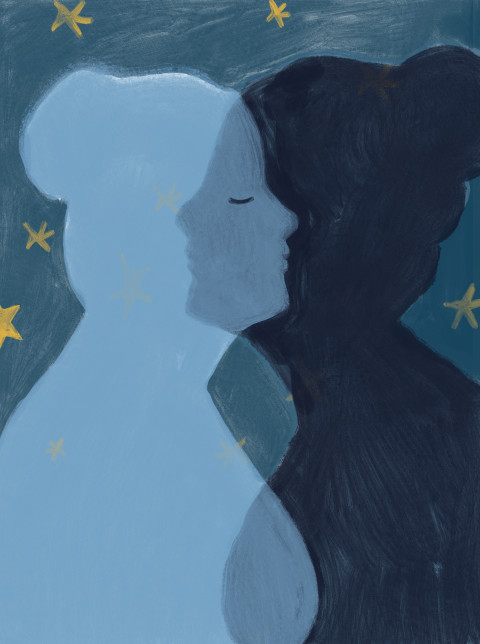
In my culture, dreams are invitations, as valid as any form of knowledge transmission. After years of becoming more aware of my roots and more open to my dreamworld, I’ve learned that when dreams arrive, it’s best to pay attention.
Perhaps it was the anticipation of an upcoming academic conference that led my sleeping mind to wander into that setting one night in 2024. In this particular dream, I was attending a panel on character in America, a fitting topic just before the presidential election. But questions of how universities shape the character of people and communities have animated my work in the academy for a long time. Much longer, in fact, than I’ve been paying attention to my dreams.

Read our latest issue or browse back issues.
I stumbled into character education over the years as an educator and administrator. Broadly speaking, the term refers to those things that implicitly or explicitly shape the moral imagination and habits of young people toward particular ways of being. It can help orient students toward what is good for the world rather than what is merely good for them.
Character education in K–12 settings and religious communities is a well-defined effort, often with explicit values and formation goals. In contrast, most colleges and universities are neither explicit about the kind of character they seek to form nor clear about how to go about this. While higher education mission statements often include lines about developing “virtues” or “students of character,” they often are not direct as to what this means. There are handbooks, codes, mottoes, and policies that suggest how to act and treat one another while on campus, but it isn’t always clear what young people might need or do to become good or better. Making matters more fraught, the historical definitions of virtue and goodness have not always been inclusive, resulting in hesitancy about whose values are worth adopting.
In my dream, a scholar I once admired was the main panelist. But rather than discussing his views on character—views I generally share—they were discussing his own personal character. I confidently raised my hand in the audience to ask something that in a typical waking state would have been a side comment to a sympathetic colleague or a group text to my fellow graduate students: “Will this character of yours lead us to love?”
The image of the dream was sharp, the professor under a spotlight, everything else shrouded in darkness. He looked right at me, tears streaming from only his right eye (dreams really are weird), and said, “No.” Then I woke up.
I never would have actually asked such a person such a question. But in the dream, his personal character illuminated the futility of his ideas. What had seemed like muddy and confusing intellectual interactions became a clear picture of character gone awry.
In waking life, the scholar spoke of a community of character that included difference. He seemed kind, and he cared about goodness, truth, and beauty. By all standard accounts and virtue measurement, he had character. But in my dream, his posture, his executive fashion, his perfectionism, and his need for control were amplified. I could see that his heart and soul were hardened by a deep insecurity fomented by privilege, the pursuit of power, competition, and a deeply rooted desire for approval and validation from men like him. He was the kind of person who judged everyone in terms of how they made him feel, ignored anything beyond self-logic, and crushed souls who crossed him. His virtue and his power required him to be the center of every meeting, idea, conversation, and dream. He and those like him were moral exemplars to which all others should aspire. His character was the “owning” rather than the “knowing” type, emblematic of the White male self-sufficiency described by Willie James Jennings in After Whiteness.
I’m not a trained Jungian analyst, but I know that symbolic dream interpretations are more powerful than literal ones. This dream wasn’t only about the person or my relationship to him; it was an illumination of the way patriarchal expressions of character education and formation were rooted in my unconscious mind.
On occasion the scholar and I had engaging discussions from which I still draw inspiration. Their subjects included the fact that character education most often reproduces the culture of which it is a part, as opposed to changing that culture; the way it functionally holds together moral orders and communities; and, perhaps most interestingly, how it can’t be only about emotional regulation and heady commitments to virtue—how it might be even more about the habits and practices embedded in institutions and communities. I learned from him what brilliant theorists—Marx, Durkheim, Weber, Tocqueville, Bellah, Geertz, Bourdieu, Arendt, Gramsci, Foucault, Lukes, Berger, and Hunter—all said about the formative power of culture and the relationship between character and context.
Some of these discussions were contentious. I found it simplistic to expect good character to emerge from people living under disadvantaged social conditions; he agreed in theory but seemed to see inequality and power struggles across race, class, and gender as a simple fact of society. I was interested in historical examples of character for social change from the margins of society; he was more interested in character for stewardship and leadership at the top levels of society.
Overall, these debates were generative, respectful, and enlightening. They built a connection between the two of us, despite our differences in thinking and social position. Our conversations, much like academic panels, were analytical. They removed the self from the topic and divorced relationships and embodied experiences from viewpoints and perspectives. There were moments when I felt bothered by his comments, like when he said “race is performative” when I pushed on character and intersectionality or “swallow it” when I was crying over breakfast one day about the increasing sense of separation I felt from myself during graduate school. However, I understood as a scholar in training that this was part of the disciplining process. Part of my own character was being shaped into that of a scholar, which meant my direct experiences and emotions were less valuable than the knowledge attained through empirical methods or rational thought.
Guided by the dream, I’m now curious about what kind of character education leads us to love. If the illusory character that emerged between the scholar’s speech and action as its own kind of pedagogy fails to embody love, then what might? I’ve been replaying my dream in my waking mind, a scene that reveals explicitly how character is what we do, how we act, and how people feel about themselves when they are around us.
I’ve looked back on the nature of our differences of opinion about character and of differences of perspective I’ve experienced with others in the field, all stemming in part from our different social locations and experiences of formal and informal character education. As a biracial woman from the South who grew up in fundamentalist Christianity, I’m often attuned to a different America than the one most established scholars seem to inhabit. This scholar was attuned to a world beyond my reach and welcome. The son of a business executive, he summered in New England and held memberships at exclusive clubs, destined for leadership. While experience doesn’t necessarily offer moral authority or superiority, attention to the margins widens the field of sight.
“One America is beautiful for situation,” said Martin Luther King Jr. in his 1967 “The Other America” speech, “and in a sense, this America is overflowing with the milk of prosperity and the honey of opportunity.” I typically avoid the impulse to use King’s name to invoke the need for a certain kind of character education. Character education’s lineage is by most accounts conservative, and character educators often use King’s language generically, including the oft-cited “content of their character” line. These honorable mentions of King often lift character out of context, ignoring discussions of the specific character traits King might have wanted his children and other children to embody. Character educators who want to cite King, however, need not pretend that the normative direction of the content is inconsequential. King articulated in this magazine a clear vision of the beloved community and the kinds of habits and practices required to achieve it (see “Nonviolence and racial justice,” February 6, 1957). My hunch is that the kind of character required for beloved community is some of what he meant when he referred to the “content” of character.
In “The Other America,” I find that King’s naming of two Americas clarifies the way that the place one comes from might inform the kind of character one thinks we should teach. He reminds us that people are often formed differently for and within the Americas they inhabit:
This America is the habitat of millions of people who have food and material necessities for their bodies, and culture and education for their minds, and freedom and human dignity for their spirit. In this America, millions of people experience every day the opportunity of having life, liberty, and the pursuit of happiness in all of their dimensions. And in this America, millions of young people grow up in the sunlight of opportunity.
In this America, any emergent character or character education looks a bit like noblesse oblige: To whom much is given, much more is expected. Character education in the “sunlight of opportunity” might be spacious, addressing leadership, kindness, becoming generous, hopeful, sober, temperate, honest, charitable, and virtuous in all things. In its contemporary expression, it may show up as civic-mindedness or cultural and intellectual humility held by exceptional men and, more recently, women. This is the America that often holds the majority and the moral exemplars of our collective unconscious—what it means to be good, true, and beautiful in America.
Despite the wideness of a vision of the good that often includes compassionate care for others, according to King, there remains another America. Though my own father became a successful entrepreneur and I therefore experienced “sunlight” opportunities and the first America, many of my relatives endured an unfair share of cotton and tobacco picking, sharecropping, poverty, and discrimination in the Jim Crow South, along with the challenges that tend to emerge from such history. This has certainly influenced my attunement to the other America King describes:
This other America has a daily ugliness about it that constantly transforms the ebulliency of hope into the fatigue of despair. In this America, millions of work-starved men walk the streets daily in search of jobs that do not exist. In this America, millions of people find themselves living in rat-infested, vermin-filled slums. In this America, people are poor by the millions. And they find themselves perishing on a lonely island of poverty, in the midst of a vast ocean of material prosperity.
The people in this America remain poor despite the virtues and the centuries of character education of those in the other America. It seems to me that expecting the sort of character described above from those in “rat-infested, vermin-filled slums” is at best a false character education, particularly if one is not simultaneously paying for pest control. The leadership model of character seems unfitting in this America when what is needed is relief, agency, sovereignty. When I imagine character education happening here, it looks more like survival skills. Moral exemplars in this America are judged by their resilience, determination, long-suffering, grit, and ability to code-switch, by how well they measure up to the standards of the first America.
King was speaking to college students at Stanford about race, economic inequality, and Vietnam when he articulated the challenge and the goal of one America. His words eloquently capture my own hopes and dreams for the student generation today and my vision for the kind of character education from which they could benefit. As I see it, a character education that is from or for two distinct Americas is not a character education that leads to love, even if by some happenstance it does lead to civil discourse. King saw the one America as a truly integrated society in which “men and women will have to rise to the majestic heights of being obedient to the unenforceable,” something perhaps more like love than law.
Which is to say, in my own interpretation, that they would be people of character.
New visions of character will need to account for contemporary challenges neither King nor Stanford students in the late 1960s could have imagined in their context, including climate disaster, the continued overextraction of resources, AI (and its overextraction of resources), cyber warfare, human supremacy, anxiety, loneliness, disconnection from self, and hyperpassivity. The strategies we need for love in the face of our contemporary challenges include King’s suggestions for the beloved community of human relations but must be extended toward new dimensions as well.
To bridge differences in a way that is adequate to the task, character cannot only be located in the individual. It also includes a kind of sociality, measured in terms of reciprocity, harmony, and balance with differences of all kinds, including with places and the nonhuman. The prophetic collection Kinship: Belonging in a World of Relations, edited by Gavin Van Horn, Robin Wall Kimmerer, and John Hausdoerffer, imagines new visions for becoming good, visions that include respect for earth, water, animals, planet, and cosmos. Randy Woodley’s Shalom and the Community of Creation: An Indigenous Vision expounds on the kind of harmonious system that might bring reconciliation between Eurocentric and Indigenous visions of the good. Universities have an obligation to form people for character, not just as individuals but for community.
Returning to my own dream, I must believe the scholar wouldn’t have cried if he thought his way, the way of self-control and mastery, was adequate on its own. I realize that while our paths have diverged, this dream is an invitation, not a cancellation. And beyond my own personal meaning-making, there are likely broader symbolic invitations for the collective toward a kind of wholeness.
The first invitation is a call to reflect on our own individual character, whether it leads to love, and whether we are in a social situation that allows love to flow. Getting closer to love may require practicing virtues or taking up certain habits, but it also means tuning in to power and pressures, watching out for ego and shadows, and remembering that in almost every wisdom tradition, how we treat the person we think is least among us is how we treat the Divine. Those of us who have spent time living in any form of community know that community itself forms our character. For the more powerful, community requires asking for consent; for the privileged, sharing of their abundance; for the disempowered and traumatized, choosing moral courage repeatedly; and for everyone, compassion.
For anyone like me who has experienced character—or even love—weaponized for control, it is likely all too clear that these kinds of harm bypass the letter of the law and cut straight to identity distortion, to deforming rather than forming, to manipulation and an internalized gaze of a benefactor instead of actual love. Cult leaders and abusive moral authorities love to control people and make them think it’s love. At times they even call it character education. This invitation to self and situational reflection rejects the patriarchal paradigm that has defined character education in favor of including a feminine approach: calling us to open hearts rather than armored selves, to invite and evoke character rather than merely direct it. The most important part of love is that the person being loved feels it and knows it.
The second invitation for character educators who want to promote love as the fullest expression of community—and to work toward ending the culture war—is to better account for the totality of human experience and potential in its view of moral exemplars and archetypes. In part, this requires attention to power, race, class, and gender as they relate to character and character education.
The main difference between our two visions of character education was that mine was no longer able to tolerate a majority version of character that rejected so many parts of me as potential images of goodness, to digest a character education that contributed to my own diminishment. As I began to draw upon the wisdom of Indigenous women who listen to their dreams, mystics, and kinship networks, I began to want a character that valued relationships over success, connection over hierarchy, and ultimately authentic community where softness can be powerful. I don’t think my dreamworld’s notion of love meant sentimentality but rather a sense of connection to and harmony with self, others, earth, and cosmos, always evolving throughout history.
We can’t go back to a kind of character education that believes that gaining and preserving power in elite institutions, moderating one’s voice, or channeling one’s rage in the name of civility is the way to change the world. You can’t simply educate the character of those at the top of the slave ship in the habits and practices of the owners while simultaneously educating the character for those at the bottom of the slave ship in the survival skills of the owned—not unless the shared work is abolition. Character education that promotes and prolongs the status quo or ignores the complexities of time, history, political economy, and social location will not challenge the culture war, and it will never lead to love.
It took a new kind of character education for me to love myself, even using different words than character and education to describe the efforts of reshaping my own imagination, values, and practices. It took digesting the work of new brilliant theorists, artists, and poets and of those putting theory into practice: Harjo, Jennings, Cleveland, Kimmerer, Kaur, Baldwin, Starr, Lighthorse, Akomolafe, and Shiva. It took finding time away from universities and churches—in women’s circles, around fires, and in ceremonies—to build new habits and practices to retrieve the woman and dethrone the master from my own psyche. I’m back in the academy and the church, where the scholar appears regularly, but I now roll out the red carpet and invite him to new ways of relating—ways that are more appropriate for higher (and deeper, wider) learning and becoming.
Finally, in writing this essay, I have had a constant daydream about this scholar and all that his tears represented. I imagine that one day, rather than being invited to an event as the obligatory woman or woman of color, I’ll meet him outside over lunch to discuss Aristotle and Septima Clark. Plato is a welcome topic, as is Aspasia. And perhaps one day we can agree that it might be possible for both Charles Taylor and our dreams to lead us to the sources of ourselves.
If character requires becoming obedient to the unenforceable, it will take these kinds of fresh spaces, new practices, and new imagination. We’ll need new campus policies to implement this kind of character education—picnics and longer lunch breaks for campus service workers so we can all eat together, food grown from our own soil and living wages for those who participated in the supply chain, and much less ego and self-importance and more tears pouring out of both eyes from the grieving, tender, institutionally minded, loving character educators among us.
I admit that there is a part of me that thinks much of what I’ve written here is cheesy, simplistic, unscholarly, offensive to important people, and impractical. In this case, it is clear that the part telling me this belongs to the scholar and others like him. If I ask that part of me what the scholar is worried will happen if I write these words on a page and they are made public, I hear that he is worried about my reputation, my status, my job, and my position in the world of character education. He’s worried about losing funding to do things that have big impacts on people’s lives. He’s worried he won’t matter, since he helped make me who I am and gave me a chance, and what I do reflects on him. He is worried I don’t have the right pedigree or educational background and cannot afford any failure or imperfection. He’s worried I will seem too sympathetic to DEI and wokeness and that by any association, he will be perceived as a defector in the culture war, thereby abandoning his position of moderation. Mostly he’s worried people will be mad at him.
I let him know that it makes sense that he would feel that way, given the lifetime he’s felt like he didn’t measure up and given the way patriarchy wounds all people, not just women. I share, gently, that there might be another way: a way that doesn’t require zero-sum thinking, identity politics, winners and losers; a way that leads to wholeness, where there aren’t limited pieces of the pie but an overflowing pan. I ask if he would be willing to join me for a community picnic, adding that we can walk there as slowly as we need to. We invited the most renowned scholars to join the banquet, but almost all were very busy and preoccupied. Instead, we’ll be joined by students and campus service workers. We head to the quad, together, where I assure him he will not be judged by the color of his skin or by anything at all. As Kimmerer says, “what happens to one happens to us all. We can starve together or feast together. All flourishing is mutual.” The unit of analysis being measured by way of content is no longer either individual. It’s the we.