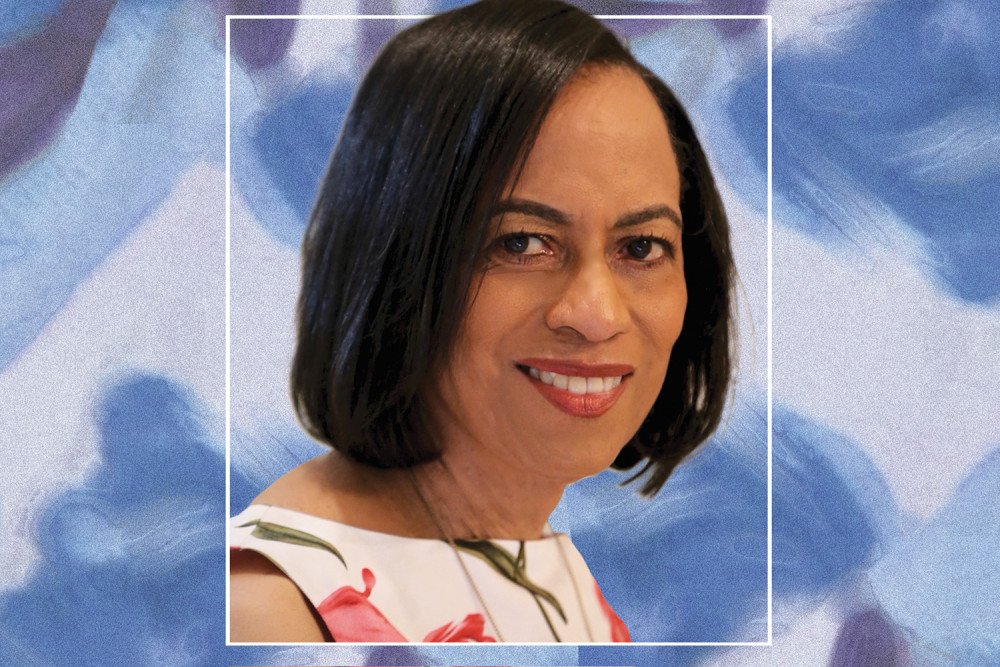
Lerita Coleman Brown was my roommate at my first Wild Goose Festival. We’d never met before that gathering in rural North Carolina, but we were assigned to share a small bedroom with two twin beds. When I woke violently ill the morning we were both scheduled to speak, there was no way for me to disguise my distress. I was fairly new to public speaking and deeply embarrassed to be so vulnerable in front of a far more experienced speaker, scholar, and teacher.
But Lerita said she was all too familiar with what she saw in me—she’d also had the experience of doing too much and not slowing down to listen to her body’s needs. She recognized before I did that I was overcommitted and overwhelmed. She gently reminded me of the necessity for rest and ease and told me to stay in for the day and sleep. She would cover anything she could on my behalf.
Read our latest issue or browse back issues.
“Spirit gets what Spirit wants, so you might as well listen,” she said, sitting on the bed across from me. So, I listened, stayed back, and rested.
Her words have stayed with me since that sweltering July day. Lerita and I stayed in touch, addressing each other in correspondence as “Roomie,” a nod to the bond we forged in that little room in North Carolina. The room where she told me about meeting her husband. The room where I shared my lavender and bergamot balm to rub on our temples for sleep; she liked it so much I gave it to her. The room where I met spirit in embodied flesh as a mentor, friend, teacher, and roommate. Lerita continued to encourage me as a young scholar and writer. Our shared nickname evolved to “Rumi,” an acknowledgment of the poetic presence of spirit in each other’s lives.
I knew only a fraction of what Lerita had accomplished when we met, though I recognized her wisdom. Her physical fortitude was as strong as her intellect. She’d been diagnosed with a heart murmur at nine months old. While she was completing her doctorate in social psychology at Harvard in the 1970s, she began experiencing shortness of breath, finding it difficult to traverse the short distance from her office in William James Hall to Widener Library in Harvard Yard. At age 26, she had her first open-heart surgery while completing her studies.
She went on to teach at the University of Michigan, the University of Tennessee, and the University of Colorado, where she was the only African American professor in the psychology department. In 2013, she concluded her teaching career as professor emerita of psychology at Agnes Scott College, where she directed the Science Center for Women. In the world of social psychology, her work examined the impact and role of women at midlife, the influence of self-esteem on our perceptions of performance, and the roles of stigma and stereotypes.
But throughout her lustrous career, Lerita’s heart never stopped asking her to slow down. In 1993, at age 41, she discovered she needed a heart transplant. Without it, she wasn’t expected to live more than 18 months. Her first book, When the Heart Speaks, Listen: Discovering Inner Wisdom (2019), recalls the conversations she had with her old and new hearts as she prepared for surgery. When she received a new heart in 1995, she says she heard, “Your inner life is where the action is. That is where the healing occurs.” In 2005 she had a kidney transplant, and in 2006 a heart valve replacement. Her health journey drew her to the contemplative path, where she found wisdom and tools for deep, embodied listening: “I teach everyone I can about being still and listening from within.”
But when she was at the Shalem Institute training to be a spiritual director, she wondered why she hadn’t encountered any Black contemplatives in her studies—and why she was usually the only Black person in the room at training sessions and workshops or on silent retreats. She prayed to be directed to a wisdom teacher in whom she could see her reality reflected, and soon she discovered the work of Howard Thurman, with whom she felt an “immediate sense of spiritual kinship,” as she writes in What Makes You Come Alive.
She’d go on to teach and lead retreats on Thurman and his vision for contemplative spirituality, focusing on sacred activism, radical resistance, seeing the divine in the ordinary, inner authority, and the power of listening for the genuine within. “Utilizing inner authority,” she wrote on the Shalem Institute website in 2017, “is just another manifestation of living from a sense of authentic Self; the one God created and a Self deeply embedded in the Presence.” Lerita was featured in the documentary Backs Against the Wall: The Howard Thurman Story, and later she wrote What Makes You Come Alive: A Spiritual Walk with Howard Thurman (2023), in which she highlights Thurman’s role as spiritual director of the civil rights movement.
I found Lerita’s own wisdom to run as deep as Thurman’s. She continued to support me as a young, queer scholar in contemplative studies, always ready to have a conversation about shaking awake our understanding of mysticism and the contemplative path. When I published Queering Contemplation, Lerita understood my application of queer theory as a means of pointing to the ways we subvert domination and institutions of harm. “Howard Thurman queered American Christianity,” she told me.
Weeks before Lerita’s death in December, I spoke with her by phone, and we expressed our love for each other—a call I believe she would have had with everyone she ever knew if it were possible. She spoke again, as she had in our room back at Wild Goose, of the need to listen to the Spirit—to Sophia, the divine wisdom—and to slow down. She also spoke of going home. “I know you’ll always be up to things with Spirit, with Sophia,” I told her.
After we hung up, I began to light candles and hold space for her days ahead as she faced new health challenges. I wrote her a letter of gratitude, love, and appreciation, thanking her again for being such a powerful teacher for me and others. Expressing my longing to continue our connection, I shared the words of Rumi: “Out beyond ideas of wrongdoing and rightdoing, / There is a field. I’ll meet you there.”
“I’ll find the field Sophia calls me to,” I wrote. “I’ll keep meeting you there.”
About a week after I sent the letter, I had a dream. I saw Lerita in a small room, sitting on a twin bed. It was not unlike our little room back in North Carolina. She told me, “I got your letter,” as her arms opened for a hug. I was compelled to get on my knees to hug her; it was the natural thing to do in the dream. It felt like hugging Sophia.
A few days after she died, I received a letter in the mail—my own letter, returned to sender. A big yellow sticker notified me I’d sent it to the wrong address. I was crushed. This couldn’t be true. I remembered the dream. I’d seen her receive my words. She’d hugged me. I sat for a moment in despair and frustration.
After hearing the news of Lerita’s death, memories of her support, wisdom, and spiritual companionship flooded my social media feeds. Theologian and psychologist Chanequa Walker-Barnes, who worked with Lerita on several occasions, wrote, “Lerita was a quiet soul who made a huge imprint on people who encountered her. She will be deeply missed.” The Center for Action and Contemplation shared that “Lerita’s life and work embodied the very heart of our mission: From her reflections on Howard Thurman to her gentle insistence on listening to what makes the heart come alive, we learned from her how everyday contemplation and spiritual practice shape us for love, resilience, and deep connection.” Author Bec Cranford wrote, “We lost a great mystic, and practitioner of the way,” and author Carl McColman, who was in a meditation circle with Lerita, shared this: “If you haven’t read her books, do so—they are food for the spirit.”
Lerita told me about her first experiences with mysticism. “I remember once telling somebody that I felt the sun, the moon, and the trees all at once,” she said on my podcast in 2021, “and they were like, Girl, you’re crazy. But that’s what it felt like to me as a child. I think we need to be a little bit more expansive about our definitions of what that is.” She said, “Mysticism is just one of those kinds of things that happens. I would hope that we will abandon this idea that mysticism happens only to special people, or only special people are mystics, and that it’s some special club that only a few people get invited to.”
She taught me that if I listen, really listen, with my whole self, I will be able to hear Spirit nudging me toward my own wisdom and Sophia’s direction. I can also hear Lerita, now fully with Spirit and fully herself, among the great cloud of witnesses who guide me. Maybe the dream was Lerita’s way of letting me know she knew everything I’d written in the letter. Looking again at the returned envelope, I believed it a little bit more. She’s already up to things with Spirit, I thought to myself. She always has been.