
At the end of the service, as I rose with the congregation to receive the benediction, I thought, So this is what it’s like to practice dead religion.
I’d been warned for years by my evangelical friends about the watered-down faith I’d find in mainline churches. And yet here I was, worshiping in an Episcopal church, complete with pews, kneelers, stained glass, a paid choir, and, at some services, incense that made my lungs burn. The space bore little physical resemblance to the start-up churches I’d attended, which met in rented elementary school gymnasiums or in buildings that looked like warehouses.
For most of my adult life I had worshiped in nondenominational congregations. A fair percentage of the people in these churches had been brought up Methodist or Lutheran or United Church of Christ and had left these traditions in search of a born-again encounter with Jesus. I’d heard their critiques of their former church homes: the liturgy was dry and repetitive, the pastors didn’t take the Bible seriously, the programming was irrelevant, the denomination’s politics leaned too far left for their comfort. As part of their new faith identity, they’d shaken the dust off their feet and headed down the road to join the evangelical world.
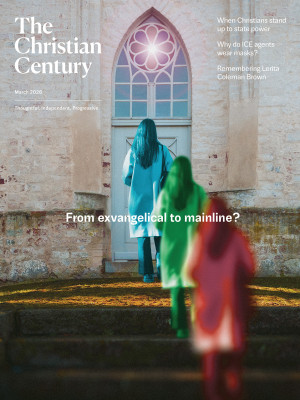
Read our latest issue or browse back issues.
But I discovered that this is a two-way road. According to the 2024 Religious Change in America study by the Public Religion Research Institute, mainline congregations continue their steady numerical decline, and a fifth of those who have switched their religious affiliation have switched from something to nothing, leaving organized religion altogether. That said, the PRRI report also notes that about 3 percent of Americans raised in a different tradition now identify as mainline or nonevangelical Protestants. I’m one of them.
As a child of the Jesus movement that swept the country in the late 1960s and early ’70s, I worshiped and served in a variety of nondenominational congregations for more than four decades before burnout and the lingering effects of spiritual abuse brought me across the threshold of an Episcopal church. That church turned out to be my gateway out of evangelicalism. Since then, I’ve also worshiped in Episcopal and United Methodist congregations.
Some of the differences I encountered were welcome. Evangelical identity tends to be anchored in a conversion narrative—I once was lost, but now I’m found—which can be a challenge for those who are born into evangelical families and can’t point to a single crisis moment that launched their faith journey. This can lead to repeated responses to altar calls or a shadow uncertainty about whether they are really born again. But many of the folks I meet in mainline churches were baptized as infants and are untroubled by their lack of a spiritual turning point in their lives.
Celebrating the Eucharist was a significant difference as well. In my previous churches, communion was a once-a-month affair, tacked on as a postscript at the end of a service and treated as strictly memorial in nature. In the Episcopal and Methodist churches I’ve attended, I’ve come to appreciate how weekly communion centers and animates corporate worship.
Another puzzle: Evangelicals evangelize. Mainline denominations seem more focused on simply loving their neighbors, no strings attached. If there is a downside to this approach, it is that some mainliners go silent regarding why they’re serving others, leaning a little too far into the axiom often attributed to St. Francis of Assisi: “Preach the gospel at all times. If necessary, use words.” Sometimes, words are necessary to more clearly reflect the light of God’s love.
My entry to the mainline came with hiccups, awkward moments, and growing pains. In retrospect, I realize that many of my fellow congregants assumed that since I already knew all my spiritual vocabulary, I automatically understood their church culture. (I didn’t.) In light of that, here are four things people in mainline churches should know that can help ease the transition for evangelical refugees like me who may be checking out your faith community.
People arrive carrying a church backstory. If an evangelical is trying out a mainline church, it’s likely that either they’re in search of a fresh start or they’re returning to a tradition they know from an earlier time in their life. They may arrive at your congregation with doubts, grief, or even significant spiritual trauma. For some people, a new church community can be a place of respite and renewal. For others, sitting in a church service—even if it is quite different in form from that of their former congregation—can be a trigger, recalling pain and conflict from which they’ve fled. Seek out your denomination’s recommendations for becoming a trauma-informed church.
Evangelicalism isn’t a monolith. As with the mainline, there are many different streams and rivulets within evangelicalism. Do a little research on where your new attendee is from, so you can better respond to their queries and concerns. For example, if an exvangelical who was baptized in a casual ceremony at a local swimming pool arrives at your church with questions about your approach to the sacrament, you may need to refresh your understanding of your denomination’s teaching on this question (especially if your denomination practices infant baptism).
There may be a learning curve, and it’s important to be patient. They may come from an evangelical church that leaned on felt-needs sermon series and plotted its worship life according to the Hallmark holiday calendar (Valentine’s Day, Mother’s Day, Father’s Day, Independence Day, Thanksgiving). If your congregation follows the historic church calendar and the lectionary, and formal liturgy shapes its weekly worship, it may be helpful to invite them to take their time embracing these rhythms. One Episcopal priest I met early in my journey out of evangelicalism suggested that I allow at least two years to become familiar with the full arc of this new-to-me way of worship.
Hospitality is healing. Someone who has left their church has likely lost some or even most of their social network. Chatting about the weather during coffee hour can be a starting place for friendship, but it shouldn’t be the only time hospitality is offered in a church. Be willing to take the next step by sharing a meal or inviting them to join you in a class, small group, or Bible study.
The writer of the book of Hebrews encourages persecuted, scattered believers to offer practical, embodied care to one another so that together they can persevere in the faith: “Therefore lift your drooping hands and strengthen your weak knees, and make straight paths for your feet, so that what is lame may not be put out of joint but rather be healed” (12:12). There are weary evangelicals stumbling into mainline churches who need lifting, strengthening, and a path toward healing. To offer this kind of welcome and nurture is to proclaim to them—and in the process, to remind yourself—that the religion you practice is anything but dead. It is as alive as the risen One we worship in spirit and in truth.