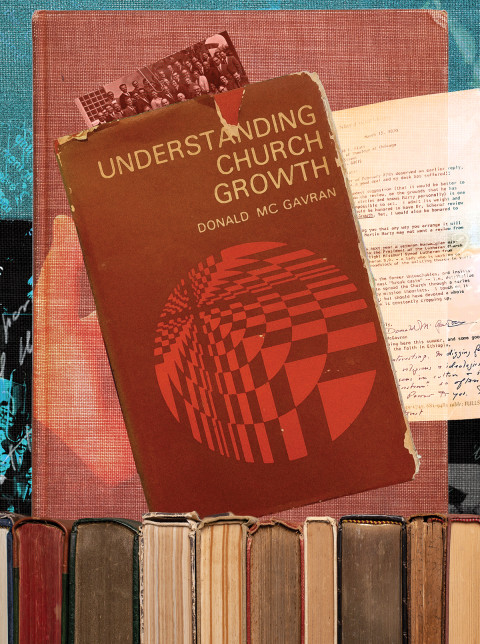
While sifting through a massive book drop at my seminary one day in 2022, I stumbled upon an old copy, torn dust jacket and all, of what is arguably the most controversial book on Christian mission in the 20th century: Understanding Church Growth. Written by the founder of the church growth movement, Donald McGavran (1897–1990), this book presented to a broad American audience a concept the author had developed over decades of researching evangelism efforts all over the globe: the homogeneous unit principle.
To grow the church as quickly as possible, McGavran wrote, evangelism should take advantage of the simple fact that people “like to become Christians without crossing racial, linguistic or class barriers” and should focus on building the church via homogenous units—groupings of people whose shared language, culture, and values make it easier to convert communities en masse.

Read our latest issue or browse back issues.
Once a must read among the mission minded, Understanding Church Growth isn’t anymore. White flight thrived on this book, leavening the reactionary politics of the anti–civil rights movement into the very mortar of countless White churches in the United States and laying the foundation for decades of intolerance among White American Protestants. So why did I take this raggedy, bigotry-enabling book home?
Because when I moved to set it down, some papers slipped out of it—a warmly written letter from McGavran (dated March 13, 1970) to the book’s recipient, Donald C. Flatt; a picture postcard of the students and faculty of the World Mission Institute at Fuller Theological Seminary, where McGavran taught; and a copy of a review of the book. A dedication from McGavran to Flatt on the inside cover indicates that not only is this copy a first edition but also that it was mailed to Flatt as a request to write a review.
My head in a swirl, I realized that this was not just an old and outdated tome. It was a relic of one of the greatest missteps of Christian mission history. Was my stumbling upon it God’s way of jolting me to pick up McGavran and get to understand him, his passion for church growth, and the damage it wrought? I wrapped the book in some scratch paper, tucked it carefully into my backpack, went home somewhat shaken, and began my study the next day.
So now, three years later, what have I learned?
Donald Anderson McGavran was born in Damoh, India, on December 15, 1897, into a missionary family, his maternal grandfather having ministered in the subcontinent like his father. Vern Middleton’s account of McGavran’s development as a missions thinker, Donald McGavran: His Early Life and Ministry, paints an almost idyllic portrait of McGavran’s first years. Raised by an Indian nanny, he grew up speaking both English and Hindi, had mostly Indian friends, learned to track and hunt game, and enjoyed a life of boundless reading and childhood adventures. Despite being based in Western missionary compounds, his family would often immerse themselves in India’s villages, loading “all they needed for a month’s stay on an ox cart” and wandering until they found a spot to “put up tents in the shade of some tree and stay for a week or two, walking to 15 or 20 villages in the neighborhood.”
When McGavran was about 13, his family returned to the United States, where he completed high school, earned two bachelor’s degrees (one from Butler University and one from Yale Divinity School) and a master of arts from the College of Missions in Indianapolis, and completed two years of army service. At Butler he met his bride-to-be, Mary Elizabeth Howard, and the two soon decided to jointly pursue missionary work in India.
After marrying in 1922, the newlyweds spent a year learning the requisite skills for their work overseas and were jointly ordained as missionaries for the Disciples of Christ in the summer of 1923. They departed for India that September, and when they arrived in early November, McGavran began his career as director of religious education for the United Christian Missionary Society.
It was a homecoming of sorts for McGavran. Although he saw Western Christian culture as central to human progress, his facility with and love of India’s vast cultural and ethnic diversity (rooted in bouncing back and forth between the cities and farmlands of Madhya Pradesh as a child) enabled his work within it. While still a “first term missionary,” his skill in reading and writing poetry in the sacred Sanskrit was so great that he won an award for it. He regularly reminded missionary trainees that since the people of India were “cultured” and held what Middleton calls a “religious devotion probably equaled by no nation in the world,” they needed to be approached with respect.
In 1937, he was commissioned to do ministry among the Satnami people in Chhattisgarh—his final assignment. There, an elderly local convert named Hira Lal mentored him. Under Lal’s loving guidance, McGavran “translated the Gospels into their vernacular,” developed “a Satnami hymnbook,” and wrote “a handbook on worship and a catechism.”
As for congregational culture, true to his roots in the Disciples of Christ that proclaimed “no creed but Christ, no book but the Bible,” McGavran readily accepted that baptism, communion, worship, and leadership could take wildly different forms in different communities and that it was wiser to allow diversity of praxis than to impose norms. He prioritized strong lay leadership, believing that “if all the work is done by the pastor, the laymen get nothing in the way of spiritual exercise.” He regarded this spiritual exercise as especially helpful because it strengthened local leadership in places where pastors were few. Even more unusual for men of his theology and time, McGavran welcomed Pentecostals, praising them as a “New Testament people” while decrying how “Old Line Evangelicals” such as himself showed them “a degree of arrogance which we would not think of applying either to Anglicans or to the Romans.”
A staunch opponent of India’s caste system, McGavran refused every effort by Western missionaries and the high caste to make the Christian faith accommodate, and thereby shore up, what he called India’s “system of graded races.” For him, Christianity wasn’t Christianity if it didn’t provide the Dalit (the outcastes and low-caste “untouchables”) with “a system of equal opportunities for all, regardless of racial origin.” The rising political fervor among the Dalit in the 1930s, “motivated him to become a vigorous champion of their rights,” writes Middleton. McGavran stood firm against efforts by high-caste parents to eject low-caste or Dalit students from his schools. He spent endless hours in court defending the rights of landless Christian and Hindu peasants and keeping them safe from violent caste- and family-driven reprisals.
This same unflagging dedication to racial justice showed itself again when McGavran moved to Indianapolis, Indiana, in 1958. In his 2019 dissertation, Jesse Nathaniel Curtis explains that, while “the city boasted integrated schools and the largest black population of any northern city” when McGavran went to college there, in the 30 years since, city leaders had enacted “Jim Crow-style segregation as the African American population grew,” a terrible reversal. In response, McGavran and his wife joined a Black church and advocated with denominational authorities to create interracial brotherhood. Most boldly, McGavran sent an open letter to the 49 White DOC churches in the city, lambasting their total segregation from the city’s two Black churches.
He also wrote in full support of then nascent Black theology in his fascinating work The Clash Between Christianity and Cultures, published in 1974. He agreed that Black theology rightly denounced “Caucasian Christianity” and its “mixture of affluence, white dominance, inherited privilege, [and] sex standards” as flawed. He also praised “black idiom and thought forms” for how they motivated in Black churches “a desire to live justly and to oppose oppression,” perspectives perfectly concordant with the Bible which needed to be taken seriously.
So what happened? How could McGavran, whose Christian witness is full to bursting with intercultural adaptation and the struggle against racism, become such a darling of White Christians barricading themselves against the Voting Rights Act and Roe v. Wade?
First, evangelicalism gave him a home, supporting his work in a way that the United Christian Missionary Society never did. Like much of the global ecumenical movement, McGavran’s superiors in India overwhelmingly prioritized social uplift over bringing people to Jesus and persistently deflected his evangelism efforts. By sharp contrast, evangelical leaders enthusiastically embraced McGavran’s ideas, finding them fresh and helpful. When Fuller launched its School of World Mission in 1965, not only did it tap McGavran to be the first dean, but his writings were part of its foundation.
Yet, at the same time, these new admirers and champions were also overwhelmingly White and largely hostile or at least hesitant regarding the social progress of the 1960s—progress for which McGavran had long advocated. Worse, they also had little experience interacting with cultures outside their own, making it difficult, if not impossible, to recognize and understand their often conflicted responses to such differences.
The less obvious answer is pedagogical, specifically, a frame for Christian pedagogy in which McGavran distinguished between discipling and perfecting. In his 1955 book The Bridges of God: A Study in the Strategy of Missions, he describes discipling as the “removal of distracting divisive sinful gods and spirits and ideas from the corporate life of the people” through the giving and confirmation of basic Christian teachings. Perfecting, which follows discipling, is the “bringing about of an ethical change in the discipled group” that leads to “holy living,” with requisite commitments to “social, racial and political justice.” This makes sense: some changes in the heart take time and should be made neither a requirement nor an obstacle to baptism.
However, McGavran also writes—shockingly—that if it can “be made into an aid to Christianization,” then “race prejudice” should be used as such. One just needs to be sure to confront this prejudice later, in the perfecting stage. As hypocritical as this may seem to us now, McGavran’s logic was ironclad. Since “nothing mattered more to [him] than converting people to Christianity,” confronting people on their prejudices needed to be subordinate to it, especially if such confrontation hampered church growth. Disciple first, perfect later.
There were two problems with this approach. The first, as articulated in a statement by participants in the First International Congress on World Evangelicalism of 1974, was that such a perspective drove “a wedge between evangelism and social action,” as church leaders used their “eagerness for quantitative growth” to sidestep the ethical dimensions of Christian life. Jesus never intended that after we profess to love God, our obedience to the command to love our neighbors should be postponed to a later, more convenient time. They must go together.
Second, and more deeply, Black and Hispanic evangelicals in North and South America reacted quickly, pointing out how McGavran’s ideas “gave white evangelicals theological justification and cultural analysis to recast their segregated churches and ongoing appeals to white identity as faithful evangelism rather than racism,” as Curtis puts it.
McGavran could easily deflect these criticisms at first because of his long history as a bold opponent of racial discrimination and White cultural dominance. In the 1950s and ’60s, he led multiple bus tours for missions students to take part in the civil rights movement. His dedication to ethnic Christian communities in the United States was so pronounced that he encouraged them to “not follow Anglo patterns” and to act as if White churches “didn’t exist.” And in order to keep American hands off global evangelism, he didn’t allow anyone to apply to Fuller’s School of World Mission who wasn’t fully bilingual—a rare skill among White applicants from the US.
Yet, as scrutiny mounted, McGavran doubled down. So much so that, far from simply advocating for evangelism with homogeneous units, Understanding Church Growth went even further, declaring that “insisting on [congregational] integration first . . . whether the church grows or not, is a self-defeating policy and, with rare exceptions, contrary to the will of God.”
Things came to a head at the First International Congress on World Evangelicalism in Lausanne, Switzerland, in 1974. As historian David Swartz narrates in his book Facing West, a caucus of delegates led by South American theologians Samuel Escobar, C. René Padilla, and Orlando Costas confronted McGavran and his supporters, denouncing their “American culture Christianity” for its capitalistic emphasis on numbers and indifference to the cries of non-White neighbors. McGavran responded to this group (which had the backing of 500 assembly delegates, a fourth of the total) by giving them the cold shoulder from that point forward. In 1977, Fuller hosted a much anticipated discussion at the Colloquium on the Homogeneous Unit Principle. When Padilla took the stage, colloquium chair John Stott lamented in a diary entry, McGavran and his supporters “put down their pads and pens, folded their arms, sat back and appeared to pull down the shutter of their minds.”
This doggedness around homogeneous units worsened significantly in the hands of McGavran’s protégé, C. Peter Wagner. Upon retiring in 1975, McGavran handed the reins of the School of World Mission to Wagner. In 1978, Wagner published his own commentary on homogeneous units, under the cringy title Our Kind of People: The Ethical Dimensions of Church Growth in America. In it, he uses the concept of an ethclass, a “subsociety created by the intersection of the vertical stratifications of ethnicity with the horizontal stratifications of social class,” as a way to quantify the existence of a White “American homogeneous unit.” By doing so, Wagner writes, he seeks to remove “a millstone around Christian necks . . . the Christian guilt complex arising from the civil rights movement” that overly troubled White Christian consciences and stifled their vitality and capacity for growth. But by doing so, Wagner also freed “discipled” White Christians from the responsibility for “ethical change” on behalf of “social, racial and political justice,” freeing them, by extension, to take their money, their biases, and their bitterness and set up homogeneous communities in the suburbs with nary a thought of the neighbors they left behind.
Thankfully, the global evangelical movement ultimately heeded voices like Costas, Escobar, and Padilla, steadily pivoting away from the United States and Europe and toward the Global South. White American evangelicals and their many theological kin didn’t, however. Our nation still reels from actions by Christians of “unperfected” faith, our polities and republic pockmarked by everything from culture wars to purity pledges to Bibles and nooses and Trump 2020 flags descending in a rage upon the Capitol building. Fifty years later, the direst predictions of McGavran’s critics all proved true.
On some level, I see what happened to McGavran as a classic case of the good kid falling in with the wrong crowd. Worn out after persisting through decades of mainline indifference to his evangelistic ideas, and maybe even slightly humiliated, his persistence may well have eagerly warped into pride, a pride that sealed his ears against all dissension and insisted that he was right. Still, far from dwelling on the reasons for his mistakes, I think of a story he often told, one that reveals his love for the gospel and his compassion for those around him. This story also, I think, helps redeem some of McGavran’s legacy—while also reminding those of us in mainline churches today why, despite evangelism’s bad reputation, we still must share the gospel.
Working in a mission compound in the northern province of Uttar Pradesh in 1933, one day McGavran asked one of the compound’s staff, Janki, why she and her people, the Dumar, hadn’t become Christians. “Sir, we would have become Christians long ago if only someone had urged it,” she admitted. Her work may have “brought her into daily contact with twenty-five missionaries,” but none “had ever bothered to share Christ with her.” Inspired like never before, McGavran launched his first personal effort to evangelize a community, using “dramas, films, and . . . Indian music” to connect with as many Dumar people as he could. From four families, he created a Christian prem sabha, a “spiritual love gathering,” that directly incorporated Dumar culture and spiritual practices.
When McGavran had to leave the region in 1936, he worried about whether the little Dumar church could keep going, but it did. When he returned in 1947, he found that those four families had increased to 50. But far from growth, his first and “most successful” effort at evangelism was moved by the simple desire to share Christian love.
It’s impossible to know why exactly those 25 missionaries never thought to tell Janki about Jesus, but their lack of outreach itself is easy to imagine. Maybe, despite being actual missionaries, they had a general indifference to welcoming people into the body of Christ. Maybe it was because the cultural and language barriers were too great for them to cross, or because they thought sharing Jesus with their Indian kindred was disrespectful, or even intolerant, as many progressive Christians do today. How lovely, then, that McGavran, overflowing with love and eager to share, simply shared. He marveled to see the Holy Spirit sprout so easily and then did everything he could to help it take root, grow, and blossom. But he knew that whether a church grows or not, it is the sharing of this love—and from its sharing, its growth—that matters most in the beginning and in the end.
It’s at this point that I strongly relate to, even sympathize with, McGavran. In my work visiting Christian congregations, I spend a lot of time in beautiful churches filled with beautiful people who love the way that the love of God moves among them. Many of these same Christians take their love of neighbor so seriously that they strive to exorcise their public witness of any -ism that might dampen a neighbor’s ability to experience that love: racism, sexism, heterosexism, classism, you name it. Such communities are filled with kindness, peace, and healing. Yet they so often stumble or falter when it comes to sharing that love with people outside of the community.
Though it may be hard to believe amid so much well-deserved cynicism toward Christians, there are in fact many people who are not only open to coming to our churches but long to do so. Since no one ever asks them and they rarely think to invite themselves, they languish. For all his faults, McGavran made being known by Christ’s love the cause of his life. Those of us fighting the good fight against Christian nationalism, bigotry, and exclusivity would serve our neighbors by doing the same. McGavran’s witness, despite its shortcomings, shows that when we invite people in, or even simply hold out a hand through word or in deed, the love of Christ flows from us and takes on a life of its own. And even if people react strongly against our offer (and some will), we can still lean into that love and repent on behalf of the church, atoning for past wrongs while bringing healing and justice to those in need. There are hearts to mend, bodies and souls to feed, and lives to save. Christ himself will meet us among them as we carry the cross of our lives in this world together.
********************
Francisco Herrera speaks with the Century's community engagement editor Jon Mathieu about Donald McGavran, whose “homogeneous unit principle” shaped a generation of mission work and church planting.