Books

Trending topics: Abortion stories

Five recently published books that tell stories of abortions from the perspectives of those who have had them

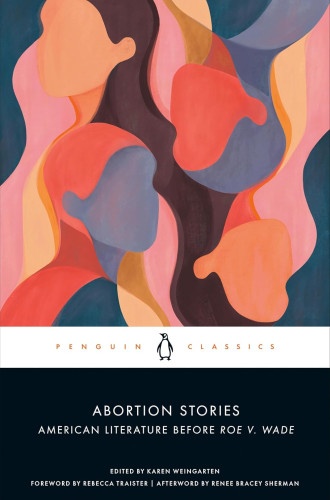
From a colonial-era field guide entry on an abortifacient plant to Shirley Chisholm’s 1969 speech to Congress on the necessity for legal abortion, this collection of poetry, fiction, memoir, oral histories, and essays helps readers understand how abortion was accessed, understood, and portrayed in the United States before 1973. Even when illegal, abortion was always a reality for women, across race and class, though it was mostly an open secret only obliquely mentioned in journals, letters, and occasionally a scandalous news story or work of fiction inspired by headlines—like Edgar Allan Poe’s lesser-known 1842 sequel to The Murders in the Rue Morgue.

As whispered knowledge among women gave way to increasingly medicalized illegal abortions, the discourse became more fraught. The first work of American literature with the word abortion in the title—the harrowing one-act play Abortion (1914) by Eugene O’Neill—dramatizes how illegal abortion enabled wealthy men who had affairs with working-class women to protect their social status while endangering those women’s lives. (It was never performed in O’Neill’s lifetime.) Only later do we begin to see literature by women coping with their own abortions, freely chosen or not. Gwendolyn Brooks’s poem “the mother” (1945) mourns the choice without condemning women who make it, which editor Karen Weingarten calls “an ambivalent and humanizing position . . . rarely represented in our present moment.”

Weingarten also includes rare first-person accounts of abortionists, such as Ruth Barnett, whose experiences with the often despairing women seeking illegal abortions convinced her that antiabortion laws “belong in the dustbin of history.”



Journalist Irin Carmon was pregnant when the Supreme Court overturned Roe v. Wade, and she’d been reporting on reproductive issues for a dozen years. She was among the many women who were accused of exaggerating the risks of pregnancy in the wake of Dobbs, but her research on the history of reproductive medicine and legislation that controls women’s fertility and reproduction shows how “this country makes pregnancy much more dangerous than it needs to be.”

Interwoven with that impor­tant context are the stories of five pregnant women navigating these often impossible systems. While the collection edited by Wein­garten provides a useful survey of abortion discourse before Roe, Carmon’s book reveals the importance of listening to pregnant women after Dobbs. Despite their racial, economic, geographic, and age differences, the women Carmon profiles are deeply interconnected. All are impacted by living in a country that endangers their lives by refusing to recognize their full 
personhood.


Jill Christman was six days shy of 20 weeks pregnant when she made a choice she says she never thought she’d make—to terminate her pregnancy. She wrote this biting, voice-driven memoir “because the late-term abortions no one wants to think about need to be part of the national conversation.” When she and her husband learned that their son had a heart defect that would make his life brief and painful if he survived to term, they sought a doctor who would perform a second trimester abortion, illegal in their home state of Indiana.

But Christman writes about so much more than that one terrible event, because to write about her abortion is to “think about all the years and the moments that led up to that choice” and “what life has been like inside this female body . . . what this body has accumulated—and what has been taken away.” That includes her own childhood sexual abuse, failed relationships, the sweetness of falling in love with her husband, and the births of her living children. It is often painful, but Christman is relatable, tough, and funny—the kind of company you want when the shit hits the fan (or pours from the ceiling, as it does in her hotel room while she waits to be admitted to the hospital). She is devastated by her son’s death, grieving and terrified, but, “there was nothing I was unwilling to face for my family,” she writes. “I knew my own capacity.” I was ready to follow her anywhere.


Despite how much I loved Christman’s memoir, I was ambivalent about reading Shelley Sella’s book about her experiences as the first female doctor to openly perform third-trimester abortions. Sella apprenticed herself to George Tiller, the late-term abortionist who was murdered at his Lutheran church by antiabortion extremist Scott Roeder in 2009. I still have a hangover from my days in Catholic media that makes me wince at references to Tiller, who was thoroughly vilified by the antiabortion movement. Something in me recoiled at the thought of reading about Sella’s work—honestly, it’s difficult for me to imagine a reader who’d be eager to read in detail about third-trimester abortions—but I’m glad I did; I’m exactly the reader she wants to reach.

By telling her own story and the stories of some of the women she’s cared for, Sella demystifies a reality that is seldom discussed or described outside of antiabortion propaganda, evoking not just compassion but a deep understanding of women whose complex stories challenge our assumptions about who seeks out late-term abortions. “There are better questions to ask instead of why did she wait so long?” Sella writes. “What were the barriers to abortion care the patient faced . . . the life circumstances that compelled her to seek an abortion in the third trimester?” Again, the personal stories of women seeking care–each of them unique but all of them trapped in systems that devalue their lives–offer the best answers to those questions.


While all five of these books are clear that abortion has always been a racial issue in this country, Renee Sherman and Regina Mahone offer a history of abortion told specifically through the stories and history of Black women and people of color. They also offer a basic primer on reproductive health care. “Because of unfounded fears about our bodies and our sexuality, many of us weren’t taught about the birds and the bees in medically accurate ways,” they write, so they break down the physiology of how pregnancy and miscarriages (spontaneous abortions) happen and how women once practiced and shared wisdom about natural fertility regulation and abortifacients. They also clarify how lawmakers have used abortion against people of color to prevent them from wielding political power and to criminalize sexual pleasure. The end goal of the book is a new framework for abortion liberation: “to bring into being a world in which every person has the ability to decide if, when, and how to become a parent, and pregnancy and parenting decisions are met with respect and are free from violence and coercion.”


Jessica Mesman

Jessica Mesman is a senior editor at the Century.

All articles »