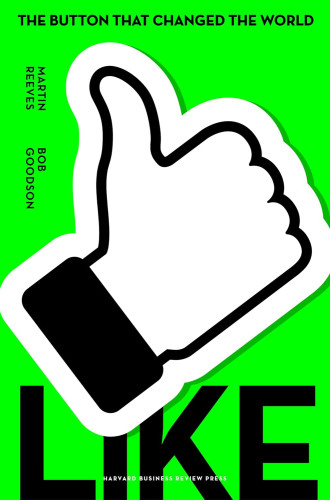
Like
The Button That Changed the World
The nerviest part of my postcollege radio job was hitting the big yellow on-air button to start the broadcast for each day’s morning show. The feeling of pressing two fingers down on that button—ker-chunk!—came to mind after reading Martin Reeves and Bob Goodson’s Like, which is about the history, neuropsychology, and economics of the upraised thumb icon. Whereas punching the on-air button used to make my morning broadcast possible, clicking the like button has turned everybody into a sort of broadcaster. But have all those clicks changed the world, as Reeves and Goodson argue? Your answer depends, I think, on what you mean by “the world.”
Like is a smart and absorbing read from a pair of writers who were on scene for the genesis of emotional response technology. Their book’s small-bore focus on the like button contrasts with the work of more philosophically minded writers like Jaron Lanier and Meghan O’Gieblyn, who tend to use large metaphoric frames. Lanier’s Ten Arguments for Deleting Your Social Media Accounts Right Now describes online engagement as a baptism, a quasi-religious engulfment. And O’Gieblyn’s God, Human, Animal, Machine describes information as “the ultimate metaphor, an umbrella wide enough to extend across forests and cities, insect colonies and highway systems, computers and human minds.” But Reeves and Goodson zoom in on a single clickable icon as a synecdoche of digitalized life. This move allows them to tell an engrossing story without getting entangled in existential questions about the kind of world digital technology might be making—and changing.
Read our latest issue or browse back issues.
Like manages to address readers with the knowing positivity of a TED Talk, a kind of performativity reliant on carefully phrased questions, anecdotes, and surprising findings. The book’s nonobvious findings begin with the observation that the like button showed up first not on Facebook but on Yelp. Coders at Yelp found they could use JavaScript to enable clickable likes without leaving a web page, an essential condition for near-frictionless interaction. But of course, the upraised thumb traces back much farther, all the way to ancient gladiatorial arenas. Although Reeves and Goodson don’t exactly settle what the upraised thumb meant in first-century Rome, they show that, in our own times, its near-universal recognizability makes it remarkably effective at creating interaction.

From semiotics and ancient history, the authors then shift focus to evolutionary biology and psychology to answer the question, “Why do we like likes?” Their conclusion: “The very old machinery of the human brain is perfectly adapted to respond to the very new machinery of platforms like Facebook, TikTok, and Instagram.” The computer science behind the synchronicity of these two “machines” proves economically profitable, although at first “no one realized how lucrative the data it creates would be.” Not that it took the tech bros at Facebook too long to notice that their platforms “have all the data they need to keep refining their algorithms and constructing more-detailed profiles of account users—and making the whole whirling system of likes and money spin off money even faster.”
At this point in the book, readers may be feeling discomfort at the thought of making the Zuckerbergs of the world wealthy by compulsive like-clicking. And to their credit, Reeves and Goodson discuss, in the penultimate chapter, the like button’s sometimes harmful consequences for mental health, privacy, and civic engagement. Still, they frame this discussion in terms of a narrative of “unintended consequences,” which feels at times like a shrug.
Should tech designers get better at anticipating the societal consequences of their platforms? Maybe, say Reeves and Goodson, but it’s a lot to ask of them to be both inventors and predictors. Should social technologies be more tightly regulated? Again, maybe, but market forces might do better work redirecting tech innovation. Reeves and Goodson add that “with any consequential innovation, the unforeseen outcomes end up exceeding the intended ones—by far.” This feels dissatisfactory, especially in an age of AI, when nothing seems more environmentally urgent than anticipating untoward technological consequences.
Which brings me back to the most persistent question the book raised for me: What kind of world do Reeves and Goodson think the like button has changed?
I remember one morning 30 years ago, five minutes into my morning show, catching a peripheral glimpse of a bulky shape at the studio’s sliding door. I hit play on the next song and turned to see the station engineer pointing at one ear and shaking his head. I shot a glance to the upper right corner of my sound board: I hadn’t hit the big yellow button. While I had been hearing my own voice in my headphones, my listeners had been hearing dead air. Something like this experiential disparity happens often in what Reeves and Goodson call the “like economy.” Our online engagements may seem loud in the headphones of our social media activity. But go for an evening walk, stare at a cottonwood, and you will eventually discern that the like economy is a very small thing indeed.
My hunch is that Like reduces “the world” to what’s measurable in digital clicks—and then tries to see the sheer volume of these clicks as world-changing. In other words, the book does what Wendell Berry warns against in his 1984 essay “Two Economies.” The authors exaggerate the like economy in comparison with what Berry calls the “Great Economy,” which comprises all of being and all of time. The like economy, in contrast, touches only some of being some of the time. I wish this book had done more to point out the actual smallness of the like economy. Digital clicks can be caffeinating and compulsively fun. But sober reflection suggests that meaningful transformation comes less by liking those clicks than by loving the world and the fullness thereof.