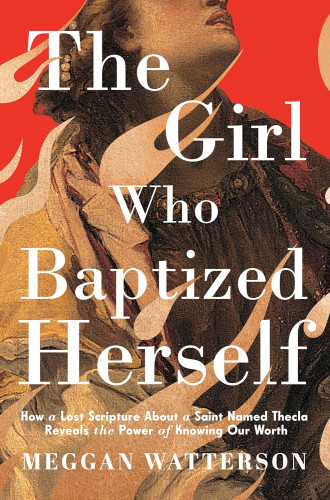
The Girl Who Baptized Herself
How a Lost Scripture About a Saint Named Thecla Reveals the Power of Knowing Our Worth
Meggan Watterson, best known for her work on the apocryphal Gospel of Mary Magdalene, continues her search for “the Christianity we haven’t tried yet” (as the subtitle of her 2019 bestseller Mary Magdalene Revealed puts it). While stuck in a cycle of returning to a dysfunctional relationship and deep in the isolation of the coronavirus pandemic, Watterson turned to another apocryphal work—the Acts of Paul and Thecla—for inspiration. The result is The Girl Who Baptized Herself.
Watterson mines Thecla’s ancient story of conversion and ministry for insights to apply to the lives of contemporary women. For context: Watterson is very clear that she has never belonged to any Christian church aside from the one she started, and she is primarily interested in the institution as an object of critique and analysis. She wants to recover the radical egalitarian energy of the “Christ Movement” without necessarily believing in the divinity of Jesus or being invested in the reformation of the church from within.
From her reflections on the Acts, Watterson maps out a seven-step journey for personal growth, which includes hearing a call, answering it, dying, and experiencing resurrection. Though Watterson explicitly rejects calling it a “hero’s journey,” it is useful, I think, to read her project as a retooling of Joseph Campbell’s framework as a prescriptive model for life, with the important revision of placing women—any and all women—in the role of protagonist.