Pluck
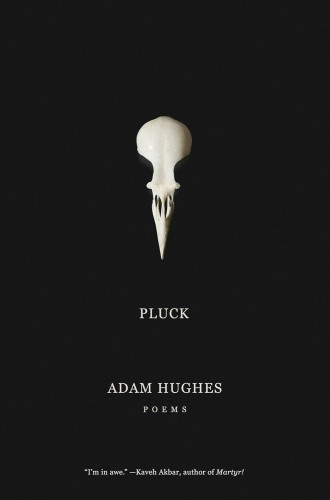
What’s left when certainty begins to erode? That’s the question haunting Adam Hughes’s poetry collection Pluck, and it’s not rhetorical. Hughes, like so many of us, says he once held certainty in both hands. A pastor for many years, he inhabited spaces where belief was not personal but vocational, communal, and structural—spaces where certainty is often assumed.
Pluck moves between poetry and prose, exploring the far side of certainty as Hughes traces what happens when the beliefs that once held us together begin to dissolve. This mixture and juxtaposition of forms mirrors Hughes’s experience losing a sense of certainty: Some moments require the compression of lyric language; others spill into reflection. In one prose passage he writes, “What is left when certainty erodes? I once held all of my beliefs in one hand, my future in the other. I stand now with empty hands after a lifetime of grasping.” The image is stark but recognizable. Many readers—religious or not—will recognize that moment when the frameworks that once made life legible no longer seem sufficient.
Read our latest issue or browse back issues.
One poem opens with a deceptively ordinary memory: learning to tie shoes. “Of all the things I’ve ever accomplished,” Hughes writes, “perhaps the greatest / has been learning to tie my shoes.” The act of tying shoes becomes a metaphor for the things we learn in order to survive: habits, beliefs, disciplines holding us together. But the poem turns when Hughes tells us, “When I buy a new pair now / I tie them once and never again / slipping them onto—no, cramming / my foot into their soft insides.” Our most useful skills, like tying shoes, can become protective shells that bar us from engaging with the world honestly—cramming our feet into the soft insides of our soles. Another poet might stop here, but Hughes turns the poem again to show us the other side: “Sometimes the things we learn / are a shell, a refuge, a stillness . . . only half- / filled and then only / of reticence.” That moment of realization represents a collapse of certainty, and it reminds us that our rituals—or perhaps the certainty underlying our rituals—have the power to prevent us from living honestly, but they also protect us.
For Hughes, the dissolution of this kind of certainty is incarnate before it is intellectual. He describes the unraveling of relationships (with self and others), the end of his pastoral vocation, and the isolation that followed. While living alone in a small apartment after a marriage ended, surrounded by little more than books, Hughes says he was left with “something resembling God.” That phrase may be the most honest answer the book offers to its central question.
To a casual reader this might seem bleak, as if Hughes is only lamenting the loss of belief and an absence of experiences with God. But Pluck is not so interested in lament. It is interested in detailing the experience of the absence of the God Hughes once knew. This requires courage—a lot of pluck, Hughes might say—but it also requires hope and, strangely, belief.
In one poem, Hughes confesses, “God, I’m jealous / of your grace. Not the grace / you give other people— / the grace you give me.” The lines capture the strange tension of a person who has received grace and acknowledges its weight. Another poem goes further, declaring, “God . . . I forgive you / for the foolishness / with which you’ve forgiven me.” The line is both playful and serious. It reverses the traditional language of absolution, revealing a relationship intimate enough for argument. That is not despair. Between the comedy of those lines linger hope and some sense of certainty.
Even when Hughes questions belief, something like prayer remains. One poem asks, “What do I know / of you except / sparks / traces of smoke / the charred remnants / of altar fire / in the cathedral / of my rib cage.” Belief survives not as certainty but as its residue, as flashing embers still glowing somewhere inside the body.
This begs a question: Can we hold onto that residue? And if so, how?
How easily devotion can become possession, how tightly we sometimes strangle the very things we claim to love.
Hughes imagines skipping a stone across water: held too tightly it sinks, held just right it flies. But he admits that he does not yet know how to hold things so gently. Instead he grasps like “a child holding a kitten / while it scratches my arm . . . until it goes still / and spent and dark / from love and adoration.” The image is unsettling, even painful. It suggests how easily devotion can become possession, how tightly we sometimes strangle the very things we claim to love. To recognize all this, to confess it, and to receive the grace that comes in this epiphanic moment—that is the great hope of Pluck.
Hughes does not replace religious certainty with more religious certainty or with the certainty of disbelief. Instead he writes from within the wrestling match between belief and doubt, acknowledging that faith may not survive in the forms we once knew it. But something will always remain in their place, even if they are only questions, fragments, sparks.
For readers shaped by religious traditions and imaginations, Pluck will feel especially familiar. Many people today find themselves standing beside Hughes with empty hands after a lifetime of grasping. Hughes’s poems do not tell us how to resolve that condition. They simply invite us to learn how to hold it.
And perhaps that is the work that remains when certainty fades—not to grasp again and risk strangling but to learn, slowly, how to hold something gently. Something like courage—something like pluck.