A Sure Way
Following Truth in a World on Fire
Mine is the first generation of my family not to speak Yiddish. The significance of this didn’t fully dawn on me until I turned 40. Here I was, living halfway across the world from the city of my birth, St. Petersburg, Russia, which itself is 2,000 miles removed from the region where my Jewish ancestors had lived until 1941. That summer, the Germans marched across Ukraine. Jews from village after village were rounded up and shot, ending up in unmarked mass graves in a forest somewhere on the outskirts of town. My grandparents survived, but by the time the war ended, the world of their childhood was gone forever.
My family left Russia shortly before the Soviet Union collapsed, emigrating to Israel along with another million or so Russian Jews. A few years later, we emigrated again—this time to the United States, where I have now spent nearly two-thirds of my life. And in a complicated set of events, the year I turned 30, I left secular Judaism and became a Christian.
Read our latest issue or browse back issues.
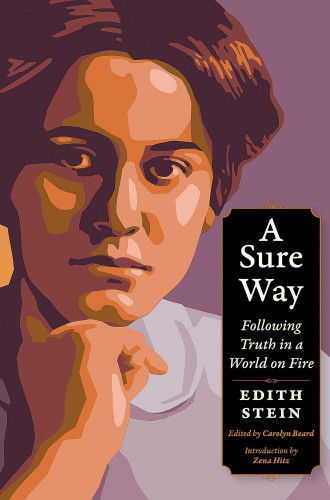
On the one hand, every conversion is an extraordinary event, a miracle even. Yet at the same time, the history of the church is filled with tales of converts from Judaism to Christianity. Rarer, though, are written testimonials from women converts, and particularly rare are stories like that of philosopher turned Carmelite nun and mystic Edith Stein. Now Carolyn Beard has edited a new collection of Stein’s work, A Sure Way: Following Truth in a World on Fire.
Part of the Plough Spiritual Guides series, this little book assembles excerpts from Stein’s philosophical and theological works, including her poetry. As the series title suggests, a key aim is the reader’s spiritual formation. In the process, one question the excerpts address is this: How do we flourish spiritually in a “world on fire”? As we face the brokenness of our own world today, this is our question as well.
As it happens, Stein’s world was not too far geographically from that of my ancestors. Born in 1891 in Broclau, a German city that is now in Poland, she grew up in an upper-middle-class family that did not take its Jewish observance too seriously. Instead, education became her religion for a time. She earned her doctorate in philosophy at age 25. But then in 1922, Stein was baptized into the Catholic Church, taking on the name of Teresa Benedicta of the Cross.
She may not have thought much about her Jewish ancestry, but it caught up with her with the rise of the Nazis to power. Along with other Jews, Stein lost her employment in 1933, at which point she became a Carmelite nun. For a time, she remained in a convent in Cologne, but the persecution of Jews in Germany eventually forced her to escape to a convent in the Netherlands. She did not find safety there for long. Arrested in 1942, she died in the gas chambers of Auschwitz just a week later.
Left unfinished on her desk was The Science of the Cross, a meditation on the soul’s journey to God. In this final work, Stein echoes another Carmelite monastic—St. John of the Cross, whose Dark Night of the Soul reflected on the soul’s journey to God through suffering nearly 400 years earlier. The night is dark. How might we go through it? What can we do?
For Stein, the answer is clear and unwavering: We uphold God’s truth, always. In the darkest of nights, we still pray and we know that Christ will not forsake us yet. In a convent message for the Feast of Epiphany in 1940, Stein affirms that “when the gentle light of the Advent candles begins to shine in the dark days of December—a mysterious light in a mysterious darkness—it awakens in us the consoling thought that the divine light, the Holy Spirit, has never ceased to illumine the darkness of the fallen world.”
In her introduction to the book, Zena Hitz—another academic philosopher and Jewish convert to Catholicism—writes this: “Wisdom is not to be found in the halls of power nor in the halls of scholarship. It is found, by the reception of grace, in the depths of the human heart. There, through the action of the living and almighty cross of Christ, we find the scope for action we have always longed for.” For Stein, a mystic and a philosopher all at once, to love God with all her mind, heart, soul, and strength came together much more organically than it does for most of us.