The Books That Made Us
Deconstructing the Modern Christian Classics
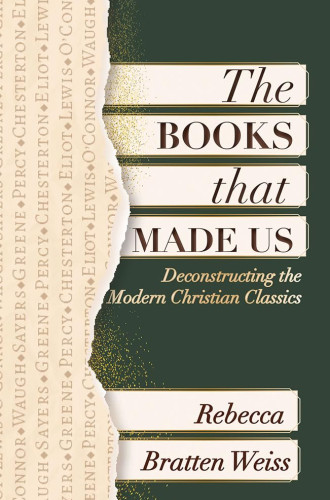
In her new book, Rebecca Bratten Weiss takes on the literary legacies of major authors now considered royalty in the hallowed halls of the Catholic imagination. Among them are G. K. Chesterton, T. S. Eliot, Dorothy Sayers, Evelyn Waugh, Graham Greene, C. S. Lewis, J. R. R. Tolkien, Flannery O’Connor, and Walker Percy.
A lot has been made of the Catholic imagination, from Andrew Greeley’s 2001 book on the subject to the Future of the Catholic Imagination conference held biennially since 2015. But it’s Walter Brueggemann’s The Prophetic Imagination that may best describe Bratten Weiss’s accomplishment in The Books That Made Us. Brueggemann writes that the prophetic imagination envisions a possible world in which justice, compassion, and freedom oppose the regime of the “royal consciousness,” the systemic powers that damn the present to a denial of both its own necessary death and the new life that could spring from its demise. Brueggemann critiqued this “royal consciousness” in 1978, in a post-Nixon America. Bratten Weiss—in her own way, on her own terms—performs a similar critique of the Catholic intellectual tradition, showing the ways in which that tradition, in order to gain political power, has sold itself out to the MAGA movement under Trump.
Read our latest issue or browse back issues.
Bratten Weiss tells of her reaction to Trump’s arrival on the political scene in 2016. At the time, she considered herself pro-life, to the point of feeling “pressured to vote for the Republican candidate because of the abortion issue,” but she couldn’t see Trump, with his reputation and rhetoric, as “a viable pro-life option.” By 2020, during the COVID-19 pandemic, Bratten Weiss had begun to deconstruct her faith: to examine things like her tradition’s obsession with “Disney princess theology,” described by Erna Kim Hackett as a worldview in which Christians always see themselves as the princess in the story, never the antagonist or villain.
I’d like to say things are different for us Protestants, but they’re not. We too love to see ourselves as the victims of nefarious cultural forces. Protestants, of course, hang on Catholic coattails here. We all love to gather together in swank, scholarly locales and listen to regally presented arguments we’ve all heard before on why we should look back to the Christian classics, why we should keep discussing them ad nauseam to the exclusion of taking seriously the work of new writers with deep yet troubled ties to our precious Christian communities.
So it was refreshing to go back through the ruins of these modern Christian classics with Bratten Weiss as companion and guide. Take her fresh and irreverent argument that C. S. Lewis is an unlikely gender theorist in That Hideous Strength. Lewis, after all, does in that novel tease out intriguing ideas about multiple genders. Those may not be the bits of Lewis’s canon that conservatives like to tout, but they are provocative, even attractive ideas conjured out of a prophetic imagination.
Bratten Weiss traces such an imagination in Tolkien as well. Though there are things to critique in Tolkien’s mythos, his drive to invent real languages for grief and loss is prophetic, as is his ability to surprise us with new hope after all hope has been lost. Bratten Weiss mines such mithril in her reading of Tolkien, finding something worth more than gold under the cloak and vest of a hobbit.
There is real treasure in the ruins that Bratten Weiss explores. She doesn’t deny this. But to find such treasures, she insists, the idols need to be smashed—idols made from trying to regain, re-enchant, or otherwise make our “royal” past great again. The Christian classics don’t need to be enshrined; they need to be deconstructed with intellectual rigor—prophetic imagination—bent toward the justice and grace of Christ’s coming kingdom.
Bratten Weiss exhibits that kind of rigor, chapter by chapter, rendered with a prophet’s poetic flair. Her deep dives into Eliot’s poetry and Greene’s fiction show the political relevance of these authors’ works, if they are unshackled from traditional readings used to prop up the Christian conservatism that has thrown its support behind the MAGA movement.
If you love the modern Christian classics, as I do, The Books That Made Us will sting a bit. After all, the books that made us also marred us in ways we are only now beginning to recognize. Bratten Weiss performs necessary triage on our cultural wounds, using the balm and bandage of her own personal story. And with intellectual acumen and prophetic vision, not to mention a good draught of humor, she imagines a way forward. She offers genuinely good news, especially for those of us wounded by the blades that our own religious communities have turned on us. We, like Frodo, will always feel the bite of those betrayals.
But Frodo always had Samwise to drag him from despair. And we have Rebecca Bratten Weiss.