

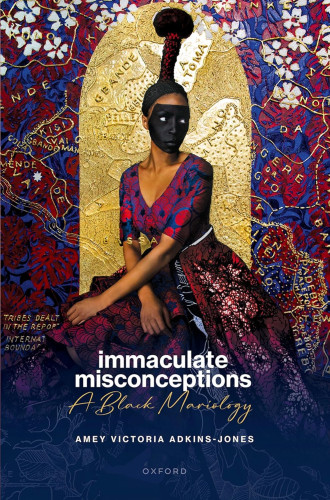
Immaculate Misconceptions
A Black Mariology
Opening with a stirring description of the discovery of Nossa Senhora Aparecida, the Black Madonna statue pulled from the nets of fishermen in Brazil in 1717, Immaculate Misconceptions wastes no time in detailing the central question of the book: What would it mean for the church to imagine Mary the mother of God as Black? Amey Victoria Adkins-Jones writes: “To claim—or rather, acknowledge—that ‘Mary is Black,’ is to state both the personal and the political as they are entrenched in the theological.” This interplay between political, historical, ethical, and artistic insights marks the entirety of Immaculate Misconceptions. Adkins-Jones’s writing is a master class in layered nuance and connections drawn between seemingly disparate aspects of the world and our understanding of theology. Unflinching in her account of Christianity’s collusion with colonization, Adkins-Jones lays out the aim of her monograph clearly: “Staged as a Black feminist and womanist theological conversation between the Black Madonna in image and icon, this project is a rally against the loss of sacred Blackness.”
Framed as a Black Mariology, Immaculate Misconceptions is a womanist study of the theology of Mary the mother of Jesus. Tracing the historical roots of doctrines and traditions surrounding Mary, Adkins-Jones explores how the church has shaped our understanding of the mother of Jesus, and in turn of the sacred itself, in a manner that impedes us from seeing Black as holy. Exploring the theological impact of art such as Christiaen van Couwenbergh’s Rape of the Negress (1632) and the numerous accounts of icons of Mary appearing as Black, Adkins-Jones explains that she is not asserting that Mary’s skin was black as a historical fact, but rather that these venerated representations of Mary as a Black woman “rais[e] the issue of who, or what, is iconic. Which is to say, of who can bear the image of God.”
Adkins-Jones’s lens of study is both womanist and social justice oriented. She states that an icon of Mary “becoming Black” shows “a signal of solidarity with those who are poor, those who are oppressed, those who are in search of (and attempting to enact) liberation.” Readers who enjoy the writing and speaking of Wilda Gafney will find similar wisdom and heart in the writing of Adkins-Jones. However, Adkins-Jones adds her own musicality and tapestry of sources to this rich monograph.


