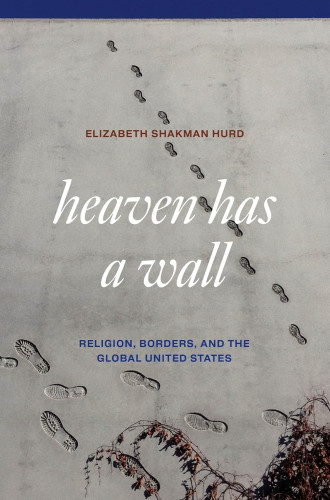
Heaven Has a Wall
Religion, Borders, and the Global United States
Borders are narratives. Borders are also realities, which is obvious for the very real people who try to cross them and who are often turned away, sometimes violently. The fact that borders are constructs that conform to the worldviews of those in power—and simultaneously real, demarcated spaces—makes borders and borderlands difficult to write about. What place-names do we use? Whose geography do we privilege? When does the limited language that we are given, and the decisions we make on how to wield our language, itself become an act of bordering?
As a writer who grew up in the borderlands of Texas and lives in the borderlands of the Middle East, I wrestle with these questions daily. Like many people writing in these spaces, I know the insufficiency of the frameworks I have been given and the possibility of harm if I don’t question them. To write about borders and the diverse people who live in borderlands is to accept that every sentence is a political decision on whether we should privilege the vocabulary of those embattled individuals whose stories we tell or surrender to the vocabulary of those who might be reading the story but have already assimilated into a different, dominant geography. I think of the trend among recent Latino writers not to italicize their use of Spanish in their writing in English. The italics were not only a typeface but a border, communicating a message of who belonged in the English-speaking world.
And yet too often we still speak of borders as fixed spaces. I was recently listening to my friend Marie-Farouza talk about her grandfather Doos, who lived in a village in Egypt on the Nile in the 1940s, before the construction of the Aswan Dam. Every year, when the Nile flooded, it would deposit silt, changing the agricultural landscape of the surrounding villages. His job was to measure and reestablish the property borders of each house after the yearly flood. His story provides insight into a world that acknowledged the ever-changing geographical realities true for all of us. That which seems solid is not solid at all, nor is it forever.