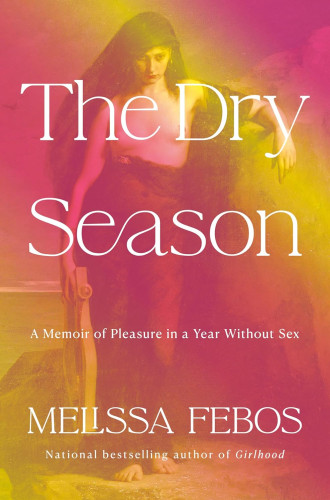
The Dry Season
A Memoir of Pleasure in a Year Without Sex
As a millennial raised in evangelical culture, I was surrounded by girls who signed purity pledges and wore abstinence rings. I wrote letters to my future husband and promised to “save myself” for him. And for years after marriage, even when sex was sanctioned as good, I dealt with the consequences of idealizing virginity: I suffered from purity culture–induced trauma in the form of vaginismus, a psychosexual condition that makes penetrative sex incredibly painful and often impossible.
So, upon picking up Melissa Febos’s stunning new book, The Dry Season: A Memoir of Pleasure in a Year Without Sex, I rolled my eyes. A whole year without sex? I thought sarcastically, as I considered my own half-decade of sexual pain in marriage and the many years of abstinence that preceded it. Though I am well past this period in my life (after years of talk therapy and pelvic floor therapy), I still felt sadness when I thought about my former, newly married self, a woman who had tried so hard to repress her sexuality under the guise of spirituality and who felt like a broken failure when she couldn’t figure out how to turn it on after saying, “I do.”

Read our latest issue or browse back issues.
But Febos speaks to this impulse to dismiss her commitment early on in the book: she notes that there are many who might view her voluntary year of abstinence as something privileged or out of touch. A year of abstinence isn’t that long, after all, she writes. And many people have no choice in these matters. In the first pages, she writes about a woman friend who’d been single and celibate for three years who was not impressed with Febos’s decision to abstain for such a short period of time. Still, Febos asserts her own need to refrain from sex in order to find true pleasure.
After a particularly volatile relationship, Febos realizes that saying no to sex might allow her to live less compulsively and treat others with more integrity. She writes, “I wanted to stop making other people my higher powers.” Though Febos does not denounce physical pleasure, she does call into question her intent in pursuing sexual relationships. She examines the context of her desires and sees errors in her past behaviors. She discovers that in pursuing sexual relationships, she was valuing the needs of the self to the detriment of others. The aim of her abstinence, then, is to live more humanely and, ultimately, to connect with the Divine by eschewing a lifestyle that centers the self.
Throughout The Dry Season, Febos’s decision to abstain from sex is characterized as a spiritual endeavor. Rather than pursuing physical pleasure, she seeks “the ecstasy of self-forgetting, a total engrossment and devotion to something other than the self.” This concept of losing the self in order to find it reminds me of Matthew 16:25: “For those who want to save their life will lose it, and those who lose their life for my sake will find it.”
And upon reflection, it is not lost on me that Jesus’ call to lose the self stands in contrast to my adolescent insistence that I was “saving myself.” My own pursuits were less concerned with knowing the Divine than with adhering to hierarchies of control. When I signed my True Love Waits pledge card, I wasn’t simply seeking God by promising to save sex until marriage. My commitment was less spiritual covenant and more patriarchal transaction, though I didn’t have the language to describe this at the time. Abstaining from sex wasn’t a way to shift my focus to the Divine. It certainly wasn’t something that helped me know myself or my desires more fully. My pledge to keep myself pure, without blemish, and untouched was motivated, in part, because I was promised a reward for my restraint: a savior. And by savior I mean a husband.
This framework is a far cry from the perspective of the beguines, who Febos references often in her memoir. These medieval celibate religious women were not sexual, but they were sensual: “They may never have had sex as I or anyone in their time defined it, but they knew passion.” Febos writes about female mystics and nuns who renounced sex (and its attendant demands of marriage and children) in order to more fully pursue a relationship with God: “The female mystics claimed a desire to yield to the divine, to disperse their selfhood into the universe.”
Celibacy for female mystics was about God. But it was not as if these women did not pursue pleasure. Hildegard von Bingen writes of passionate (though allegedly not sexual) relationships; she describes “the sense of heat in her brain.”
In many ways, celibacy was a way of escaping the patriarchal confines of matrimony. Febos writes that these women who were devoted to God and secluded from men were often ambitious, talented, and hungry for challenge: “Yielding to the divine was the only way to avoid yielding to men.”
In contrast, abstinence for evangelical teenage girls is, in my experience, mostly about men.
Febos argues against an all-or-nothing treatment of sex. While her decision to pursue abstinence for a set period of time was, in part, because she considered her relationship with sex to be an addiction, she doesn’t believe that the answer to sex addiction is total removal of sex from one’s life. Sex is human and necessary, and one shouldn’t feel the need to give it up completely, she argues, just as someone who struggles with work or food shouldn’t abstain from those things entirely. Febos writes, “I understood that asceticism was not always the enemy of indulgence. All and nothing had more in common than either of them did with moderation.” Work, food, and sex are all things that someone can become addicted to, but the treatment of those addictions should be nuanced and complex. A person has to live with these things healthfully, for the sake of both the self and others.
To heal from harmful abstinence messages I learned in evangelical purity culture, I had to recover from fundamentalist thinking. I did this through expression rather than repression: in conversations with trusted friends and with skilled therapists. Finally, years into marriage, I booked an appointment with a pelvic floor physical therapist. I disclosed my condition and revealed the extent of my sexual pain. And then, with a number of interventions, we worked toward healing.
My pelvic floor physical therapist noted that when she saw her patients recover from years of sexual dysfunction and pain, it wasn’t just their sexual lives that improved—their entire lives shifted. She saw formerly timid women become confident, pursuing career advancements and speaking assuredly about their opinions in public spaces. Once they regained sexual agency, they became more active agents in the entire scope of their lives.
Though Febos’s relationship with sex was quite different from mine, we experienced similar shifts after healing. Febos began to enjoy her own company, and in this way she could fully pursue her own desires, too—and not to the detriment of others. She moved away from a desire for visibility. She was less driven to be seen through the lens of the internalized male gaze. She began to live in the world as a subject, as her full and rounded self.
At the end of Febos’s yearlong abstinence, she describes the feeling of being in love—not with another person, but with the world and her life. “I sprang into each morning and ran through Prospect Park,” she writes, “its trees bright as struck matches, my heart pounding, elated, until I was drenched with sweat and soft-brained. I smiled at everyone, felt delighted by hot showers and dinners of cheese, green apple slices, and pickles.” All this letting go was, in itself, a kind of salvation.