The Role of the Moon
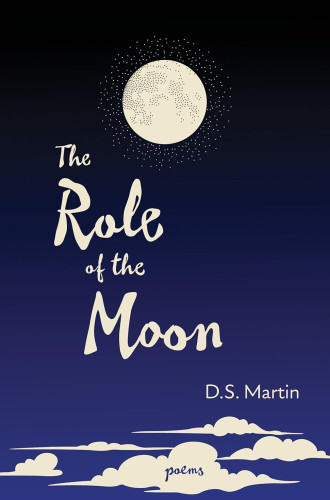
In his prefatory note to this collection of poems, D. S. Martin suggests that perhaps he should be called one of the New Metaphysicals, which seems the most accurate way of describing his style, allegiances, and heritage. The Metaphysical poets of the 17th century, especially John Donne, are the most salient influences on this collection. Read the first poem in The Role of the Moon, and you will see a metaphysical conceit, or exaggerated comparison, yoking two disparate images: the ampersand and our “bent & all so twisted” human condition as we reach for something else out there, a connection “with what is yet to come.” Donne’s best-known conceit is probably his comparison of two lovers separated by distance with the two legs of the compass:
If they be two, they are two so
As stiff twin compasses are two;
Thy soul, the fixed foot, makes no show
To move, but doth, if the other do.Read our latest issue or browse back issues.

In Martin’s poem “Carwash,” a dirty car in need of a good wash becomes a metaphor for the soul:
Have you ever desired
a carwash for the soul rushed
right up to those
retractable doors to drive
right in let the gush & spray
wash away mud-splatters
& grease? You knew didn’t you?
you’d still have to face that bang
clang under your hood
Martin has created poems that are commentaries, interpretations, and applications of many of the ideas and images found in Donne and other Metaphysical poets’ work. Occasionally, Martin will even repeat lines from Donne’s poems. His appendix contains Donne’s 19 Holy Sonnets, which correspond to the poems labeled “Metaphysicals” in this volume, creating the possibility of the pleasant exercise of reading Martin and then reading Donne.
It takes both boldness and humility, often seen as contradictory traits, for a poet to conceive of and to undertake such a project. As the series editor of the Poiema series at Cascade, Martin is known to be an exacting, inspirational, and helpful editor, bringing together Christian poets whose voices have never before been highlighted in such an endeavor. His theological, artistic, and literary expertise and experience serve him, and the world of poetry, well in this role.
Poets and writers other than Donne also enter into Martin’s poetic conversation, such as Robert Frost in “Miles to Go,” a poem that steps outside of, or more deeply inside of, Frost’s poem, “Stopping by Woods on a Snowy Evening,” which ends with the well-known lines, “And miles to go before I sleep,” as the speaker regrets not being able to stop longer to savor the beauty of the scene. Martin imagines complications in the life of the speaker that Frost has omitted:
He has no tranquility
despite what his poem later tells for his
return
is empty-handed with Christmas near
& no ability to buy gifts for his wife &
their dear
children with his life mirrored in the
emptiness that
dwells
in the dark woods on this long long night of the
solstice
where he uncontrollably weeps over
promises
he’s unable to keep & then Eunice his
mare
shakes her harness bells
The poems in Martin’s work echo a variety of influences: Thomas Traherne, Gerard Manley Hopkins, George Herbert, Emily Dickinson, and so many others. But Donne predominates, and Martin becomes as tricky as Donne, offering puns, altering normal syntax (“Pride be not Death” instead of “Death Be Not Proud”), and refusing to shy away from an obsession with death and doubt but insisting that “The Infinite is infinitely / up to the task.” The realist surfaces: “Like all creation we wait.”
Martin has initiated and brilliantly exploited his bond with Donne’s work. How refreshing to find poetry that avoids narcissism, that communicates in breathtaking imagery, and that exemplifies so dramatically what T. S. Eliot wrote in his essay “Tradition and the Individual Talent”: that poets must show a “historical sense,” and they must reshape the past with their work.
Martin’s titular poem is written as a response to these lines at the end of Donne’s “Holy Sonnet IX”:
O God, O! of Thine only worthy blood,
And my tears, make a heavenly Lethean flood,
And drown in it my sin’s black memory
That Thou remember them, some claim as debt,
I think it mercy if Thou wilt forget.
Martin envisions God as the moon, “in this silent ceaseless standoff,” inattentive, distant.
Your distance is just a pose mine
a fallacy I think it mercy
that you feign to turn away.
We see Eliot’s dictum that poetry must be an “escape from emotion.” There is no hand-wringing, whining, or complaint, even though it is clear that Martin patiently and expectantly waits for the infinite to appear. Both Donne and Martin state what they have experienced—an impassive God. But Martin uses metaphysical conceit (God as moon) to emphasize his point, enlarging Donne while respecting him completely.