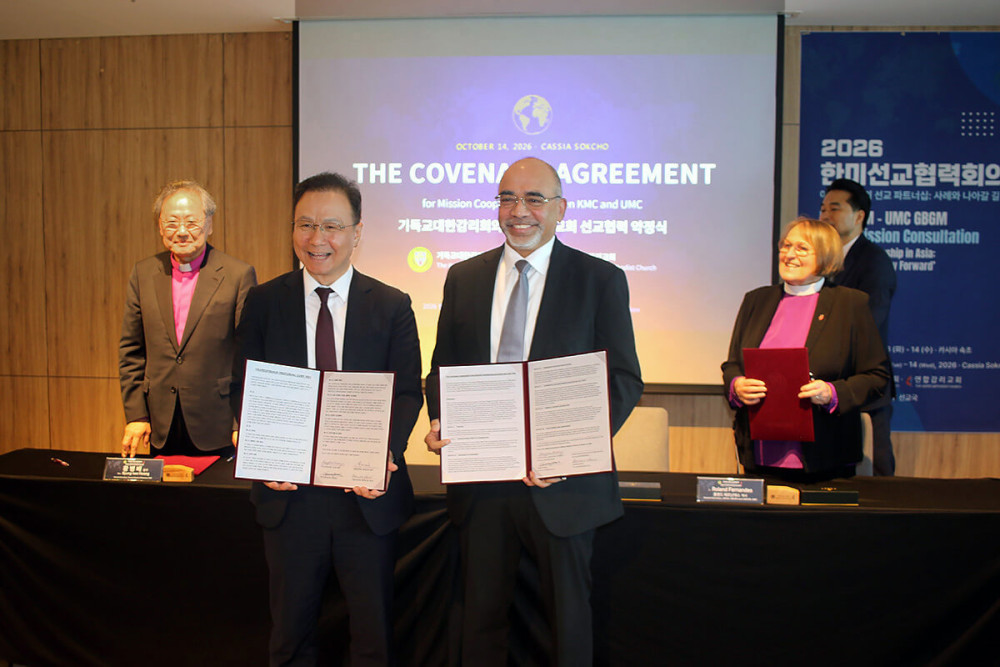
The United Methodist Church and the Korean Methodist Church signed a mission cooperation covenant earlier this month, committing their mission agencies to annual consultations, expanded leadership exchanges and sustained cooperation in Korea, Asia, and worldwide.
The covenant concluded a two-day mission consultation in South Korea and recognizes an era in which mission proceeds “from everywhere to everywhere” and affirms cooperation as equal partners.
Before the covenant signing on October. 14, Tracy S. Malone, former president of the UMC’s Council of Bishops, preached a sermon titled, “What We Carry Forward.” Drawing on the stones the Israelites carried from the Jordan River, she urged the two churches to carry their shared missionary heritage into future ministry.
“The stones were not meant to become monuments to the past,” she said. “They were meant to become testimony for the future.”
Byung-bae Hwang, general secretary of the Korean Methodist Church’s general board of missions, proposed authentic communication between agency leaders, sustained cooperation and joint projects involving migrants.
“If our history has brought us this far, our mission partnership will carry us further still,” Hwang said.
The renewed commitment followed candid discussion of the Korean Methodist Church’s relationships with both the United Methodist Church and the Global Methodist Church, a theologically conservative breakaway denomination that launched in 2022.
Korean Methodist speakers said cooperation with the Global Methodist Church did not diminish their longstanding United Methodist partnership.
United Methodist leaders welcomed that assurance while describing continuing pain associated with disaffiliations.
Roland Fernandes, top executive of the United Methodist Board of Global Ministries, cited hostility, misstatements, and legal disputes. “Healing cannot happen if the wounds are being deepened,” he said.
Rosemarie Wenner, an ecumenical officer of the UMC’s Council of Bishops, reminded participants that the UMC extends beyond the United States.
“We as United Methodists serve in many parts of this world,” said Wenner, whose home church is in Germany.
Mutual recognition as valid expressions of Christ’s body is essential, she said.
Wenner also urged a more inclusive worldwide Methodist connection, peacebuilding on the Korean Peninsula, and cooperation on creation care and climate justice.
“Unity and mission belong together,” she said, recalling Jesus’ prayer, “so that the world may believe.”
Wenner affirmed the desire for reconciliation while describing what she viewed as continuing harm, particularly in Africa.
“We hope, we pray, and we work towards a future where we can come together,” she said. “This requires that the Global Methodist Church affirms that the United Methodist Church is a vital expression in the body of Christ.”
Chungsuk Kim, president bishop of the Korean Methodist Church, assured participants that their churches’ relationship would continue.
“Let us move forward together, building on the deep trust we share,” he said in his closing remarks.
Participants reviewed the Young Adult Pilgrimage of Peace, ASCEND leadership development, and Global Mission Fellows as examples of cooperation. Afterward, participants visited the construction site for a new church and mission center named for William and Mary Scranton, US missionaries who helped establish Korean Methodism in the late 19th century.
In his closing reflection, Hee-Soo Jung, bishop of the UMC’s Ohio Episcopal area and president of the Korean Ministry Plan of the United Methodist Church, emphasized that the covenant would require continuing faithfulness.
“A covenant is never fulfilled simply by reaching an agreement,” he said. “It grows deeper as we honor our promises, discern faithfully amid changing circumstances, correct our course when necessary, and renew our commitment to one another.”
He urged the churches toward a hopeful future.
“We remember the past, but we refuse to be imprisoned by it,” Jung said. “We acknowledge our wounds, but we will not allow them to define our future. Rooted deeply in love, we move forward together as communities of mission, abounding in hope.” — United Methodist News