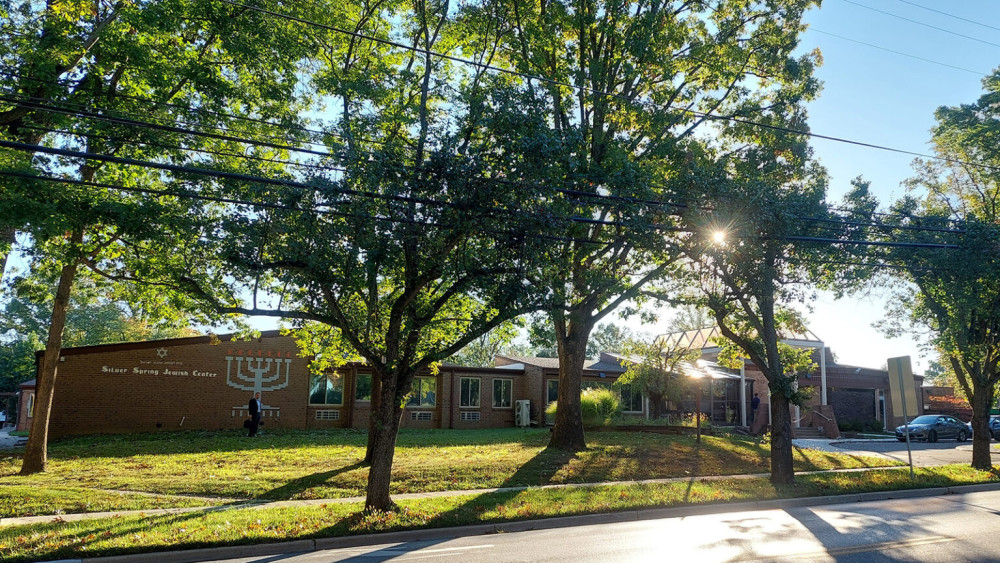
Shortly after October 7, 2023, a group of men at the Silver Spring Jewish Center in Maryland devised a plan to arm the synagogue during prayer services with members ready to fire a gun.
Synagogues in the US had already experienced mass shootings and other acts of vandalism, harassment, and assault. But the Hamas attack, in which 1,200 Israeli civilians and soldiers were killed, jump-started the Silver Spring congregation’s resolve to bear arms.
On the third anniversary of October 7, the Orthodox congregation, also known as Congregation Ahavas Yisrael, in the Washington, DC, suburb, has a team of five congregants that carry guns. Most are active or retired military and special forces. They all have advanced firearms training.
The congregation is now suing Montgomery County, Maryland, which passed a law in July prohibiting the carrying of firearms in or within 100 yards of houses of worship.
Jewish institutions in the US have vastly expanded security since October 7, 2023, in response to a surge of hate crimes. Last year, the Jewish Federations of North America estimated US Jewish institutions spent more than $1 billion on security.
Each of the 141 Jewish federations in North America has a dedicated professional on staff directing security for the Jewish institutions in its geographic area, including synagogues, schools, community centers, and camps. Their security plans have included hardening infrastructure with cameras, fortified doors and gates, and also employing an on- or off-duty police officer, usually outside the building.
But now some synagogues say that’s not enough and are pushing for armed congregants in the building during services.
“We are seeing a huge upsurge in interest in firearms amongst the Jewish community since October 7,” said Michael Masters, national director and CEO of the Secure Community Network, the official safety and security organization for the Jewish Federations of North America. “We are also seeing, in a more structured way, the proliferation of organizations and entities which are designed or interested in training individuals to carry firearms.”
Masters and his organization do not recommend that congregants carry firearms informally to services. The SCN recommends that if synagogues want congregants carrying guns, they should do so in an organized way with synagogue leadership oversight, clear use-of-force protocols, and coordination with local law enforcement.
“If you’re going to carry, you need to be well trained, and you need to be prepared for the consequences, whatever they may be, up to and including taking another human being’s life, and being able to deal with that,” Masters said.
The best model, he said, is hiring one of a growing number of nonprofit private security firms that train community members in responsible gun use.
But many congregations—exact numbers are impossible to know—have gone ahead and created their own armed volunteer security teams.
Orthodox Jewish congregations lead the pack.
“I think you would be very hard pressed to find an Orthodox synagogue where you would not find members who are carrying,” said Menashe Shapiro, a rabbi and a third-year law student at Georgetown University who is part of the Silver Spring Jewish Center’s security team. “This is pretty common.”
The reasons are multiple and varied. Orthodox Jews are the most visibly Jewish with their distinctive dress (at a minimum men often wear a yarmulke) and therefore more vulnerable to antisemitic attacks. They meet for services more frequently—often three times a day—and therefore require ongoing security, not only on Shabbat. And their shuls are generally smaller than Reform and Conservative congregations, some of which have thousands of members, and therefore don’t have big budgets. Orthodox Jews comprise just about 10 percent of US Jews and tend to be more politically conservative and therefore pro-gun.
One of the first private nonprofit security firms to cater to Jewish congregations was started by a Los Angeles Chabad rabbi in 2017. Called Magen Am, which means “protector of people,” the firm has a patrol and response team made up mostly of volunteer members of the Jewish community who are trained and licensed in firearm use. Congregations can hire the firm to provide security and handle government compliance and licensing.
Magen Am now provides armed security to 60 congregations in Southern California and Arizona. Rabbi Yossi Eilfort, its founder, is a certified law enforcement firearms instructor and believes Jewish volunteers are as good at protecting their synagogues as police or private security firms.
“No one is going to know the base for that community as well as a community member,” Eilfort said. “They’re literally going to know the individuals walking through the door. Law enforcement doesn’t, because they’re from a different community.”
Not all Jewish groups are comfortable with armed defense. The Community Safety Campaign is a national group of Jewish organizers that aims to protect Jewish safety through practices of mutual support and relationship-building with other communities. Its 134-page guide to safety cautions against armed defense and points out that gun use is often used against Black and Indigenous people. The guide also pointed to a study that showed, statistically, owning firearms puts one’s household at greater risk of fatal violence.
Private nonprofit security groups like Magen Am and the Collective Threat Response Initiative, based in northern Virginia, say that increasingly half of their clients are non-Orthodox Jewish congregations.
Groups like the Secure Community Network argue the best approach to safety is layered. It includes securing buildings and training lay people in how to respond in moments of crisis. The group recently completed a series of documentary-style videos in which survivors of attacks on synagogues talk about what they’ve learned, including the strategy of “run, hide and fight” when confronted with an imminent threat to life.
Audrey Glickman, who survived Pittsburgh’s 2018 Tree of Life Synagogue massacre by hiding in a choir office, is interviewed in the documentary. In a phone call this week, she said training is critical. “When you’re prepared, then you can kind of rest easy,” she said.
Asked if she believes in synagogue members carrying guns, she said, “I feel like they need to have whatever security is appropriate for themselves. There are different conditions in different places.”
Members of Silver Spring Jewish Center believe an armed security team is critical. The synagogue got a district court judge to issue an emergency order to block Montgomery County’s ban on firearms inside the synagogue. The judge said the ban violates the Second Amendment.
But the synagogue is still fighting to expand its preliminary injunction to also include the carrying of guns within 100 yards of the synagogue. Technically, members of the security team cannot walk to synagogue with a gun.
Shapiro, who has five children and says he keeps his gun in a safe, is hopeful that the court will rule in the synagogue’s favor.
“Firearm use is generally pretty safe,” he said. “Unfortunately, living in America today in the Jewish community is not always.” —Religion News Service