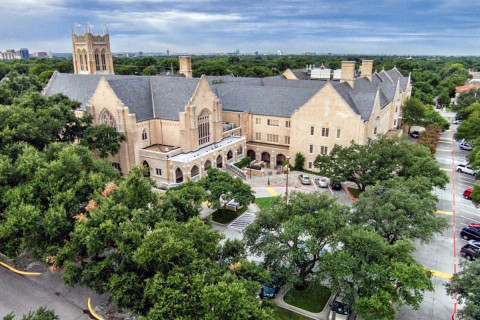


One of the architectural glories of Washington, DC, is the National Cathedral, which was planned in the early 20th century as a material symbol of the nation’s Christian faith and intended to provide a splendid setting for the nation’s great religious celebrations. In the 1920s, the project required a major effort to raise the enormous sums needed to finalize construction of the national shrine. The designated head of the fundraising campaign was the nation’s most esteemed soldier: John Pershing, who had led US forces in the First World War. Pershing ardently supported the cathedral project because “to try to build a worthy nation without God is impossible.” Washington urgently needed an “adequate expression of the religious faith of the people.”
But at the time an observer might well have understood the story in terms that were imperial rather than merely national. When Pershing spoke, his “worthy nation” was an empire on an enormous scale, at least comparable to the European powers that then controlled much of Africa and Asia, and it was still expanding aggressively. The United States ruled the Philippines and Puerto Rico, as well as such lesser-known places as Guam, which enjoyed a disproportionate strategic significance. Also within that ambit were territories that we do not presently think of as imperial possessions because of their incorporation into the United States proper: Arizona and New Mexico had achieved their official recognition as states as recently as 1912, while Alaska and Hawaii wouldn’t become states until 1959. Meanwhile, in the 1920s the United States exercised control over multiple territories in its Gulf/Caribbean backyard, its “near abroad.” Throughout the early part of the century, the United States regularly invaded and occupied such notionally independent nations as Nicaragua, Guatemala, Honduras, Haiti, and the Dominican Republic, and it thoroughly dominated Cuba. Even the prospect of (another) US invasion of Mexico was under active discussion.
Read our latest issue or browse back issues.
Meanwhile, American cityscapes were increasingly marked by public monuments and statues vaunting recent imperial struggles: New York’s USS Maine National Monument (dedicated in 1913) is an impressive surviving example. The great cities actively looked ever more imperial, and that was especially true of the fast-rising centers of California. In 1915, the outward-looking America proclaimed its Pacific outreach through two great world expositions, the Panama-Pacific International Exposition, held in San Francisco, and San Diego’s Panama-California Exposition. Both have left magnificent remains.

“Black Jack” Pershing himself was a consummate imperial warrior with much experience of fighting on the shifting borderlands. His military service had begun in the 1880s with operations against the Apache in New Mexico and the Lakota Sioux in the Great Plains before he led American forces against Muslim rebels in the newly conquered Philippines. In 1916, he led an expeditionary force 10,000 strong into northern Mexico to hunt down the insurgents of Pancho Villa.
His Washington, evidently, was an imperial capital, and the cathedral of which he dreamed would be its spiritual heart, directly comparable to the role of London’s Westminster Abbey within the British Empire. Although Pershing spoke in terms of a Christian nation, he sought to place that larger American empire under divine protection. In so doing he was following precedents dating back to the nation’s founding.
From colonial times onward, Protestant Christianity was a foundational part of social ideology in an intellectual world in which clergy occupied a prominent place, especially the representatives of the best established and most respectable denominations—Congregationalists, Presbyterians, Unitarians, Episcopalians, and the rest. Those clergy dominated a sizable network of colleges and seminaries, they preached sermons and lectured, and they presented their views through a booming publishing industry of books and denominational magazines and newspapers.
Together, these comprised a major portion of available social knowledge in the early 20th century. These denominations possessed a vigorous institutional memory, which in the case of the Congregationalists traced directly back to the earliest Puritan settlers. Much mainstream opinion about politics and society came from such contexts. The national and religious ideology they taught was imperial, in that it demanded and justified the extension of control over new lands and the subjugation of their people. All was understood as part of a divine plan. In the later 19th century, the country’s most visible advocate of racially based imperial expansion—what we might term manifest biology—was a Congregationalist clergyman, Josiah Strong.
At the heart of such projects was the definition of religion itself, which in every aspect strongly reflected Protestant visions. We are used to a world of multiple and very diverse religious structures, each with its distinctive founders and scriptures. Nineteenth-century American Protestants likewise knew something of the great world faiths, but rarely did they think to apply the label of “religion” or “faith” to the Indigenous beliefs and practices that they found in their own lands. Through much of American history, “religion” was synonymous with Christianity, and specifically Protestantism.
That conceptual constraint profoundly shaped the fate of subject peoples. In repeated clashes over religious freedom through the centuries, Protestant authorities rejected the suggestion that Native rituals, dances, or ceremonials should properly be viewed as in any sense religious, as opposed to mere customs or superstitions that might properly be reformed out of existence. Even when individual White Americans might be humane and benevolent, their understandings of “faith” and of “a faith” tended inevitably to the suppression of rival spiritualities and their distinctive approaches. That applied, for instance, to the definitions of what might be considered sacred as opposed to secular. To take a potent example, very seldom did Christians show any sympathy for the fundamental Native belief in the spiritual significance of the land.
Beyond justifying the American “errand into the wilderness,” Protestant thought determined the type of new social order that was under construction. This meant not just ruling a restive territory but also cleansing it of its earlier inhabitants, of their cultures and spiritual ways, and replacing them wholesale with new populations and races. This kind of transformation is today known as settler colonialism, and—like the concept of empire—it attracts lively scholarly attention. In North America that settler project had clear biblical origins, and its consequences comprehensively formed the country’s religious traditions.
In fact, American religious life was constantly remade in the context of the advancing frontiers of empire. This follows the common theme of modern imperial history concerned with any era: that frontier regions—literal liminal spaces—are overwhelmingly productive in terms of their effects on the politics, culture, and religion of the metropolis. The United States is by no means the only society in which such border adventures provided ample material for literature and popular culture, both elite and vernacular, and in the process those treatments left an indelible mark on national ideologies. Also at work here was another common theme: how empires acquire images and ideas in one conquered area that they then apply to other very different regions. That might apply merely to loanwords, clothing styles, or food preferences, but it can also involve fundamental aspects of social ideology.
Empires have long memories. The British settlement in America occurred in exactly the same years as the prolonged English conquest and settlement of Ireland, and many of the New World settlers in the 17th century had direct experience with the conditions on those hard-fought Irish borders. These settlers imported ruthless approaches to warfare, as well as the idea that dissident local populations must be thoroughly removed from occupied lands and transferred far afield. If the Bible provided a blueprint for ethnic dispossession, Ireland offered recent practical experience.
Religious continuities are evident too. The English in Ireland were in bitter confrontation with extremely restive subject peoples whose religious traditions they found abhorrent and rigorously suppressed by law. Irish imperial memories were powerfully reinforced by the later influx of Presbyterian settlers from Ulster and Scotland, the “Scotch-Irish,” who for many years remained prominent in American military history. Amply illustrating such long continuities are controversial figures like Andrew Jackson and the founding generation of White Texas history, not to mention many of the heroic figures of western expansion.
Each new phase of the American conquest from the 17th century onward involved stereotyping and demonizing the new enemies and subjects those settlers found on the frontier. Often, they drew on a standard repertoire of images that were sinister if not actively diabolical. American faith, and the national ideology that was grounded on it, defined itself in opposition to those nightmares. Such perceptions encouraged White American Christians to portray their own faith in terms of racial superiority over and above religious virtues. In Pershing’s own lifetime, there were armed clashes between US forces and rivals who variously espoused Native American traditions, Islam, and Roman Catholicism.
Recent studies of American empire differ starkly from their predecessors in terms of geographical scope and chronology. Half a century ago, historians would have concentrated almost exclusively on the new territories gained following the war with Spain in 1898, which chiefly meant the Philippines and Puerto Rico, together with Hawaii. According to this older vision, these lands were acquired by a nation that was presumed to have its natural boundaries within the Lower 48 states and that now undertook a giant leap to empire. Today, in contrast, it is common to trace the story of empire from the country’s earliest colonial days, so that the whole of that later national territory must properly be seen as a series of acquisitions and conquests that were ultimately integrated into a new entity. That realization is the single most significant development in the modern study of American empire.
According to this newer scholarly consensus, at no phase of its development, colonial or national, was American history anything other than imperial in nature. British America in 1700 was an empire in progress, just as the new United States was in 1800, or in 1898. Nor, crucially, is it possible to draw a chronological line between that “continental” phase of empire building and subsequent overseas expansion. To take one example, the gradual American conquest of its western continental lands coincided with its prolonged consolidation of power and settlement in the Sandwich Islands—that is, Hawaii.
By no means were all the British settlers of early North America heroic religious dissidents seeking to build utopias. Most primarily sought new lands and opportunities. But from the start, elites commonly framed that settlement in terms of fulfilling the commands of Divine Providence, of pursuing what would come to be defined as a manifest destiny to expand across the continent. Those religious concepts laid the foundation for later American thought, including its exceptionalism and what in recent times has come to be known as Christian nationalism.
In the 19th century, biblical ideas of national chosenness were merged with newer racial and biological themes and with evolving concepts of Whiteness and Anglo-Saxonism. Across the Western world, the peak era for such ideas stretched from roughly the 1880s through the 1940s, which coincided closely with the golden age of American empire. In the US context, religious leaders were at the forefront of developing such biological rationales for empire, and at a surprisingly early moment in the larger story.
To borrow the language of crime fiction, if religious leaders supplied the motives for an American empire, they also provided the means and the opportunity. American churches’ profound commitment to foreign missions successfully opened the doors for imperial expansion, initially in the Pacific but also in many parts of the world. The missionary enterprise not only gave new justifications for political expansion but also gave religious leaders the skills and linguistic abilities that placed them at the vanguard of all such endeavors.
The celebrated debates over imperialism around 1900 had a substantial religious element, depending as they did on the issue of determining divine intentions concerning the nation’s purpose. Anti-imperialists achieved wide visibility for their views, which are often quoted admiringly to illustrate the enduring critique of empire as a violation of America’s republican principles. But that critique must be examined carefully, as much for what it did not say as for its overt content. Anti-imperialists virtually never challenged the settler colonialism on which their national state was founded, and rarely did they contest America’s right to rule its backyard in the Gulf and Caribbean. Whenever we meet the term anti-imperialism in a US context, we must always ask which particular (and limited) variant of empire is being opposed, and at what given time.
In fact, the highly selective character of such opposition is ample testimony to how thoroughly Americans—including churches and religious leaders—accepted the nation’s imperial role and its further expansions. That paradox was apparent during the first half of the 20th century, when the empire was still thriving and expanding but the evidence for anti-imperialist thought or activism is patchy. Such a tradition certainly did exist, and it produced some powerful statements of democratic principle and even racial equality. But those admirable manifestations had surprisingly little impact on popular opinion within the metropolitan United States, where the principle of American hegemony was little challenged.
Although American anti-imperialism was far less potent a force than we sometimes think, the attack on missions and “missionary imperialism” was more effective. Almost from the beginning of the history of US missions, critics denounced the movement for its potential abuses in the name of secular power, and such a skeptical assessment became commonplace during the debates at the turn of the 20th century. To a remarkable degree, that critique transformed thoughtful Christian believers themselves. If religious ideas and thinkers made empire, the fact of empire in turn decided the forms of religion that would dominate the emerging society.
The demands and constraints of empire, and specifically of settler colonialism, formed essential aspects of American faith as we have come to know it. Some of these features seem so self-evident that we rarely contemplate their imperial and colonial contexts. Most significantly, the nature of colonial settlement meant that White Americans never had to accommodate Native American spiritualities, to address issues of syncretism that were so pressing in other societies, notably in Central America. Likewise, the need to boost White settlement gave American societies a pressing impetus to encourage immigration by offering the religious liberty that was so precious in an age of ferocious religious divisions. The resulting migration created the basis for the country’s seemingly boundless religious diversity. Empire formed the faiths that exist to the present day, and that same fact accounts for the absence of other once-thriving traditions and the oblivion that overcame them.
Moreover, the dispersed nature of imperial settlement ensured the success of particular Christian denominations, which coped well with such a decentralized and nonhierarchical setting. The history of American religion has always been affected and even determined by evolving kinds of transport and communication, which are the inevitable by-products of empire and expansion.
Most histories of American religion still focus almost exclusively on the Judeo-Christian traditions of the settlers and conquerors, who in numerical terms long remained a small minority within North America, where they coexisted with sizable Native communities and cultures. As White settlers expanded their rule over the continent, they used the supposedly satanic character of those older religions to justify their own advances. The imperial religious order demanded the annihilation of Native religious ways, violently or otherwise. Even those White Americans who found some worthwhile aspects in Native spirituality advocated the utter destruction of any practices or rituals that might delay total assimilation into the colonial order. “Superstitions” must be crushed in order for true religion to flourish. The needs of empire demanded religious erasure and oblivion.
When conquests led White Americans into contact with other religious ways, they usually interpreted these practices through inveterate stereotypes originally applied to Black Africans and Native Americans. Surprisingly to modern eyes, Protestant prejudices against Catholics long played a substantial role in forming these very negative images. Interactions with African-derived religions and with Islam served to popularize toxic stereotypes of racial primitivism and savagery, which represented quite literally the dark shadow against which Whiteness defined itself. Those attitudes and prejudices affected attitudes in the metropolitan homeland, and they still resurface sporadically in barely disguised form.
Historians of empire note the paradoxical attitudes of the ruling nations and societies toward their subject peoples. While rulers often condemn the supposedly backward ways of the ruled, they often end up absorbing their customs—and especially their spiritualities. While such importations result partly from migration and the movement of peoples, they also reflect a fascination with the exotic and arcane. American imperial history is replete with such transformations, exemplified by the systematic White appropriation of those once-despised Native American spiritualities. Similar stories emerge from the creation of America’s now flourishing Buddhist traditions and its more nebulous but influential New Age movements. Under the influence of empire, American approaches to religion and spirituality became radically more cosmopolitan and more relativistic. Paradox added to paradox.
Although the United States withdrew from most of its formal imperial role in the 1940s, it retained its long-standing areas of informal hegemony. Some of the key pressure points of the Cold War involved such territories, notably in Central American and the Caribbean, that became the subject of lengthy political controversies extending into the 1980s. These were largely fought out on both sides by religious activists and movements deploying biblical rhetoric and imagery, much as they had been in the 1840s and again in the years around 1900. And as in earlier eras, overseas wars and conquests had their religious impact both in the metropolitan homeland and in the “imperial” lands themselves.
Empire is the missing dimension in the history of American religion. The concept of empire is essential to understanding that history, and that connection should form a major theme in our writing and teaching about our religious past. It also raises critical issues for modern churches and religious congregations, including the close linkages that have traditionally existed between faith and political power. Such discussions are all the more urgent in a United States increasingly populated by the descendants of nations and societies that were themselves the subjects of that sprawling empire.
This article is excerpted from American Empire, American Faith: Conquest, Christianity, and the Shaping of a Nation, published this month by Baylor University Press. Used by permission.