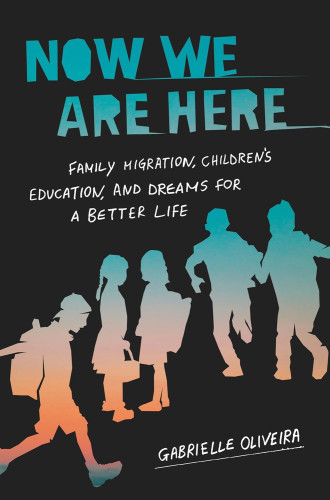
Now We Are Here
Family Migration, Children’s Education, and Dreams for a Better Life
“Who gets a chance to live a life of dignity?” This question posed by a young woman in Gabrielle Oliveira’s study echoed through my mind as I encountered stories of migrant students and families throughout the book. At a time of increasing violence against migrant communities and constant violations of their dignity, Now We Are Here offers a space for bearing witness to the journeys of migrant students and families. Oliveira invites readers to an active witness—one that stands in solidarity with families who migrate as a bold venture of care and seek education for their children as a path to hopeful futures.
Now We Are Here traces the stories of 16 migrant families from Latin America who experienced detention and/or separation at the US-Mexico border between 2018 and 2019, following them through to the COVID-19 pandemic in 2020 and 2021. Oliveira bases her ethnographic study on the premise that “to migrate is to care.” She describes her own relationships with the students, families, and educators in her study and the various ways that families and educators show care through the education of youth. Likewise, she interweaves a keen analysis of the barriers to care in US migration policies, both on a broad policy scale and in the particular experiences of each of the students and families in her study.
Read our latest issue or browse back issues.
The centering of children’s accounts of their own migration stories is an especially powerful characteristic of this book. Ironically, children’s voices are often excluded and marginalized in educational research. Oliveira’s inclusion of their stories prioritizes deep consideration of children’s experiences and dignity in conversations regarding their education and care.
In an early chapter, Oliveira discusses children’s narratives of leaving home, family separation, schooling experiences, and navigating policy realities such as the Migrant Protection Protocols (often referred to as the Remain in Mexico policy). She includes quotes, transcripts of conversations, and children’s art to frame how children experience, interpret, and navigate journeys of migration. These stories illustrate that children are keenly aware of their circumstances—and that they make meaning of their experiences while navigating oppressive systems. This data challenges the idea that children are too young to understand or unable to comprehend complexity. Rather, Oliveira shows that children navigate complexity while also continuing to engage in the routines of childhood in playing, learning, and growing.
For example, Oliveira highlights the story of Luz, a six-year-old who was separated from her father for 72 days during their migration journey. As Luz excitedly begins kindergarten in a dual-language immersion classroom, she continues to ask questions about the other children she met while in US custody. The image of Luz playing with Play-Doh while asking Oliveira, “Did they find their parents?” juxtaposes the hope of stability and peace in education for migrant children with the realities of the trauma many experience as they journey to the United States.
I’m an educator of teachers, and during the pandemic I was a teacher of migrant primary school students. From that perspective, I found Oliveira’s discussion of “pedagogies of silence” particularly important for our current moment. Oliveira discusses how migrant students’ experiences were often sidelined by educators in the classroom. Her engagement with this dynamic through relationships with educators offers a nuanced perspective on how and why various educators marginalized migrant children’s experiences. While some educators described feeling unprepared to handle difficult topics such as migration in the classroom, others were cautious about discussing those experiences because of fears of over-politicizing the classroom space or concerns about getting “off track” from required classroom instruction.
Oliveira emphasizes the importance of educators creating and maintaining space for migrant students to share the fullness of their stories and offers concrete suggestions for how educators may do so. She also, however, recognizes the various realities constraining the teachers with whom she engaged in research. In our current moment of increased attention, concern, and debate as to the work of teachers—particularly in public schools—this book offers important insight into the necessity of allowing educators to create open spaces of dialogue and encounter in their classrooms so that every student can be fully themselves and their dignity can be honored.
The stories in Now We Are Here offer powerful witnesses to the strength, hope, and courage of migrant students and families. As Oliveira asserts, migrant families journey out of deep commitments to love and care for their children. During this time when the dignity of migrants is routinely being challenged and denied, Oliveira has lifted up powerful testimonies—stories that have the potential to drive those who encounter them into deeper care for migrants on their paths toward hope.
This review was produced in partnership with the Narrative Project.