Almost 100 years separate Dorothy Day’s experience of abortion from my own. But last year, as I searched for light in the dark woods of my grief, I looked to the words of the Catholic Worker cofounder, whose movement I joined in 2009. “Writing is prayer,” Day would say. She also said, “We write what we suffer.” I hoped she could help guide me back out to the sun.
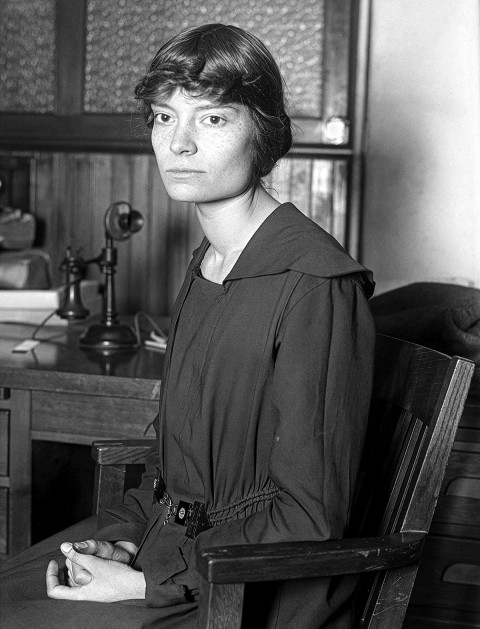
I read the 2017 biography by her granddaughter Kate Hennessy. In it, I met young Dorothy, who was madly in love with Lionel Moise, a journalist and a philanderer who wouldn’t be tied down by any woman, especially not a pregnant one. When Dorothy discovered her pregnancy in the summer of 1919, she kept the news from Lionel, only telling him after he decided to leave New York City and move to Chicago. He suggested she keep the baby and find a wealthy man to marry.
Read our latest issue or browse back issues.
But Dorothy didn’t want to marry anyone else, and she didn’t believe she could raise the child on her own. Later in life, Dorothy confided in her doctor: “When I was young and leading a ‘free life,’ it never occurred to me to have the baby.” So even though abortion was illegal, Dorothy was determined to terminate the pregnancy.
When Lionel went to Chicago that fall, Dorothy followed him. She did not self-administer the abortion, though she knew, from conversations she had overheard between her mother and her aunts, that this was something women did. Nor could she afford a reputable physician. Instead she went to Ben Reitman, known as the “hobo doctor.” Reitman offered his services at a low cost to prostitutes and the poor; Hennessy writes that he was also known for being “arrogant, unbearable, and a pathological womanizer.” A few years before her death, Dorothy recounted the experience to longtime Catholic Worker Daniel Marshall. The “dirty and furtive” doctor, she said, “left hastily after it was accomplished, leaving me bleeding. The daughter of the landlords assisted me and never said a word of it.”
The abortion left Dorothy physically ill and emotionally traumatized. Her relationship with Lionel was over, and she returned to New York—where she twice tried to end her own life. She was not yet 22 years old.
Dorothy wrote very little about her abortion. Her words were unusually sparse, Hennessy notes, when it came to her deepest wounds: “Her memories were painful to her, and she keenly felt misery at having her life raked over and commented on.” Given the moral and legal status of abortion at the time, not to mention the trauma of her experience, it makes sense that Dorothy did not desire to revisit the disturbing memories of her abortion and her suicide attempts.
Dorothy’s silence about abortion also made good political sense. Brian Terrell is a Catholic Worker who lived with Dorothy in the late 1970s and helped edit the movement’s newspaper. “There was clear understanding that Day was adamant that birth control and abortion were not among the controversies that would be contended with in the pages of The Catholic Worker,” he wrote in the National Catholic Reporter in 2015. He went on: “Her opposition to abortion and birth control was quiet and personal. . . . Day never spoke, wrote or marched in favor of criminalizing abortion.” Her silence testifies to the pain of her personal experience, an experience that did not translate directly into a straightforward political position.
Silence serves a purpose but also has consequences. Silence on this divisive, deeply personal issue protects us from conflict and disagreement, but it also prevents us from telling stories that heal. What the Catholic Worker needs—what Christian communities more generally need—is not a clarification of thought but a clarification of heart. We need not the activism of righteous unity behind a singular moral good so much as the activism of love and compassion for diverse beliefs and experiences. We need the willingness to see paradox and complexity and to enter into openness as a form of solidarity.
Unlike Dorothy, I do not have the instinct to be silent when I am hurting. I understand my life and my losses best through conversations and stories, and that means I must write about my experience of abortion—despite the polarizing landscape of this issue, and despite the Catholic Worker movement’s tradition of silence around it. My healing is connected to my choice to speak plainly and openly. The specter of shame in the shade of silence is what tells me to be quiet, and I reject it.
In late July 2022, I thought I might be pregnant. I was 39 years old, married to David, and the mother of two children. Common Home Farm, our Catholic Worker farm in Bloomington, Indiana, was in its third season of magical, glorious abundance. I’d rise early to sit on a poplar stump, watch the goldfinches pluck seeds from the sunflowers, and give thanks for the dawn’s soft light. I gave over my days to the joyful chaos of children, the work of tending the garden, and the love-in-action of building community. I stole moments in the evening to revise my new short story about the healing power of creation. That summer I was preparing to enter a graduate program in mental health counseling, eager to learn new ways to be with others in their pain.
This was also the summer of the Supreme Court’s Dobbs v. Jackson decision, which overturned Roe v. Wade. I remember feeling reluctant to engage with either the outrage or the rejoicing. Each side’s fervor repelled me, and it seemed easier to just look away—until I suspected I was pregnant. Then I anxiously researched what was happening with abortion access in Indiana in the wake of Dobbs. The state legislature had just passed a bill making abortion illegal except in special circumstances. The ban was set to take effect on September 14.
In mid-August, I bought a pregnancy test at the grocery store and, eager to know the result, took it right into the store’s bathroom. In seconds, a blue cross appeared. I carried the knowledge with me throughout the day, like an unfinished sentence. That night at home, after dinner, while the kids were brushing their teeth, I leaned over David, who was sitting on the floor, and whispered, “I’m pregnant.” He raised his shapely eyebrows and scrunched his full lips into a tight, silent oh. “I know,” I said with a smile, rehearsing the same script from my previous two pregnancies, expecting joy to follow the surprise. But David never wanted a third child, and I had my own unarticulated doubts and fears.
I feared going back to the self-depleting, physically painful labor of birthing, nursing, and raising a young child. I feared being isolated and lonely on the farm with an infant, feared diverting energy away from all I was already creating and tending. I had just started to reclaim an identity aside from being a mother, with time to pursue my writing. And yet, of course, my children are gifts of love, and loving them has been the hardest and most satisfying part of my life.
I felt stuck. I was drowning in the feeling that I could make no right choice, that loss was inevitable either way. I wanted the life I was living exactly as it was, and I wanted the love and delight of another child. I wanted to have the baby but not the elevated risks involved with a geriatric pregnancy. I wanted to raise another child but still have quiet time to write. Like Dorothy at the time of her abortion, I had plans for my creative life, for stories, essays, and encounters with God in the mystery of the written word. I felt the agony of a split self who wanted neither to give birth nor to have an abortion. The choice forced a reckoning with my finitude: I could not have it all.
God affirmed this one morning when I was praying outside, observing the gardens. God showed me the sunflowers, volunteers that had sprouted all on their own in the pepper patch. And God showed me the peppers, the ones we had started from seed and transplanted into rich soil. They were stunted by the unexpected growth of the sunflowers. God showed me the mint that was taking over the strawberry patch, and I understood that, as a farmer, I am always making decisions about what lives and what dies. God’s creation is full of life, and life is always a choice. God didn’t tell me what to do that morning at prayer. But I knew that God’s love for me was not contingent upon this choice. My options would lead to different futures but also to the consistent gift of God’s love.
When I told David about the metaphor that came to me in morning prayer, he said, “I’m right there with the peppers.” While I continued to imagine future realities, conversely frightening and beautiful, my husband stood by with an unwavering certainty. He knew, with a gut kind of knowing, that he could not raise another child. This kind of certainty is rare for David. Among his gifts to our family is his joyful support of the visions and ambitions that our children and I bring forth. I wanted to honor his vision for his future. There would be no perfect decision for us but instead a commitment to listen to each other, trust each other, and love each other well.
The ultrasound revealed a small white dot on which was another dot smaller than a blackberry seed: the embryo. I was seven weeks pregnant. The abortion procedure lasted five minutes. Compared to the physical trauma of childbirth, it was practically painless. Still, I was emotionally distraught by the experience of holding life and death together in my body. Motherhood, I learned, is also about death. I joined the community of women who have had a miscarriage, a medical termination, or an abortion, who know this tortured and sacred experience of love and loss embracing in the womb.
I was surprised by the grief—maybe because many women, like Dorothy, do not share the intimate details of their experiences with abortion. Maybe I was surprised because postabortion grief does not make an appearance in proabortion rights rhetoric, while in antiabortion rhetoric it is used as a weapon. Neither side speaks to the complexity of emotion I experienced, nor to the paradoxes of choice, life, loss, and grief: I felt grateful to have had a choice about this pregnancy but also devastated by our decision. Grief led me to those dark woods where I yearned for all that I had lost in choosing not to have another child. I did not know what to do with my yearning, so I read stories and began to share my own.
In my grief, I was consoled to read of Dorothy’s struggles. As a Catholic Worker, I am familiar with Dorothy as a peace activist, as a voice of moral justice, as a devout and defiant Catholic. Until Hennessy’s book, I did not know Dorothy as a whole person shaped by guilt, trauma, fatigue, single motherhood, abortion, and depression. Here is a woman I can relate to rather than just aspire to imitate. This portrait of Dorothy gives me permission and courage to tell my story, because it banishes any notion of perfection in our founder or our movement. It inspires me to proclaim the unabashed truth that love is complicated and life is messy. Our encounters with grief and loss are the precise moments that bear witness to God’s unfailing presence and love. These are the experiences that can connect us more deeply with one another if we find the courage to share them. As I’ve practiced courage and trust in telling this story, many others have shared their own stories of unplanned pregnancy, of abortions they have never talked about, of grief and pain. I have been healed by these gifts of vulnerability and solidarity.
We can’t wish away the hardships of our lives. But we can take them tenderly in our hands. We can ask others to take them tenderly in their hands, too, and to hold them with love, just as God does with our whole, messy lives. We do not need to keep quiet about the stories that break our hearts wide open—no matter the stigma attached to them, no matter the silence that surrounds them. The courage to share our pain and suffering may shape us into more liberated, loving people.