
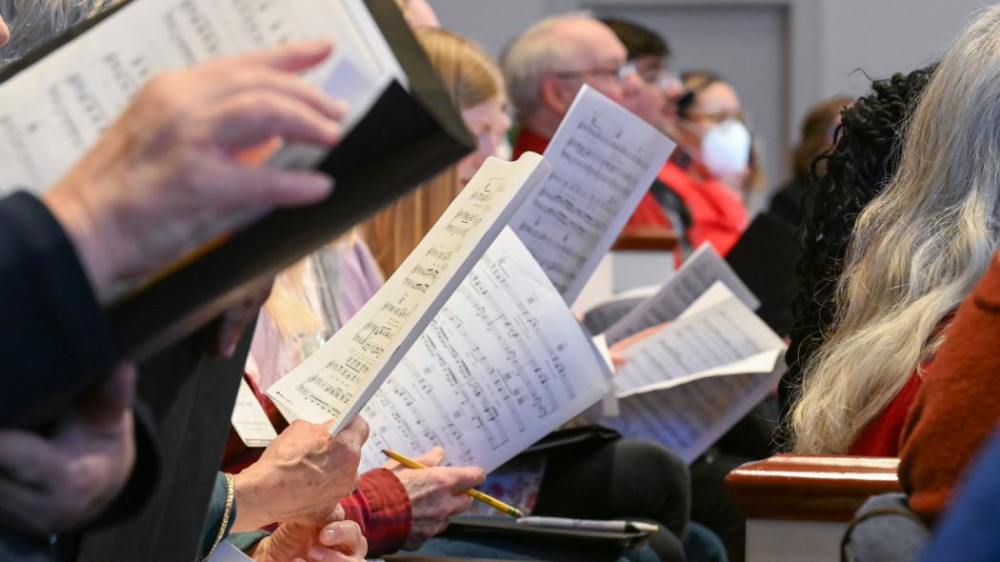
A pair of Presbyterian Church (USA) pastors and hymnwriters, Stephen M. Fearing and Carolyn Winfrey Gillette, joined earlier this month to offer a virtual workshop on hymns that resist Christian nationalism. More than 300 people registered.
Fearing is pastor of Guilford Park Presbyterian Church in Greensboro, North Carolina, and Gillette is designated pastor at First Presbyterian Union Church in Owego, New York.
Hymns are not neutral documents, Fearing said. “Hymns teach. Hymns form memory. Hymns give language to our loves, our fears, our hopes and, of particular interest to us tonight, our loyalties,” Fearing said, adding that, as Evangelical Lutheran Church in America pastor Andreas Teich said in a Hymn Society lecture last summer, hymns are theological projects.
Gillette, who’s written more than 550 hymns, said she tries to write lyrics “by starting where people are.” Among her goals is to help people “make connections between church and society, between faith and life—what it means in practical terms to love God and love their neighbors.”
For Fearing, Christian nationalism is a “rival” liturgy.
“It trains us to conflate the kingdom of God with our nation’s destiny,” he said. “It encourages us to replace the cross with a flag, discipleship with domination, baptismal identity with national identity and the lordship of Christ with the mythology of power.”
The church “must take special care with its hymns,” he said. “We need hymns that refuse to baptize national arrogance. We need hymns that expose the idols of violence, greed, fear and scarcity. We need hymns that widen our vision beyond tribe and border.”
In the workshop, he posed a few questions for participants to consider: What kind of disciples are our songs and our hymns forming us to be? Are our hymns training us to clutch power or relinquish it? Are they forming us in grievance and triumphalism or in humility and hope? Are they making us more useful to empire or more faithful to Jesus?
Both hymnwriters shared a handful of their hymns. Gillette’s “O God of Love, This is a Time of Turning,” set to “Finlandia,” brought to mind a friend who’d been deported from the United States to China after not having lived there for 30 years.
“These issues of immigrants, neighbors and refugees are real to many, many people,” she said. “Hymns are prayers. We need to pray we will have faith and that God will help us as we seek to labor on.”
Fearing wrote “We Trust the One Who Brought to Life” as a paraphrase of Psalm 146 and set it to “Kingsfold.” He’s given permission for the hymn's use in congregational worship, with appropriate credit given.
“It’s my attempt to give the church language that’s biblical and singable and unambiguous in this moment when many of us are tempted to place our deepest trust in political leaders or political parties or myths of national power,” he said. “Christian nationalism thrives on misplaced trust. Psalm 146 says rulers are mortal and their plans perish, and that they are never worthy of the kind of trust that belongs to God alone.”
The hymnwriters also offered comments on hymns that have long been loved by online participants, including “This is My Song” and “Lift Every Voice and Sing,” a hymn that Fearing says “does a lot of theological work. It does not offer a sanitized or mythic version of America. It tells the truth. It sings of the stony road and the chastening rod.”
“Christian nationalism depends on collective amnesia,” Fearing said. “It requires us to forget enslavement and terror and White supremacy. It expects a nation draped in perceived innocence.”
The final line: “true to our God, true to our native land,” gets the order “exactly right,” Fearing said. —Presbyterian News Service