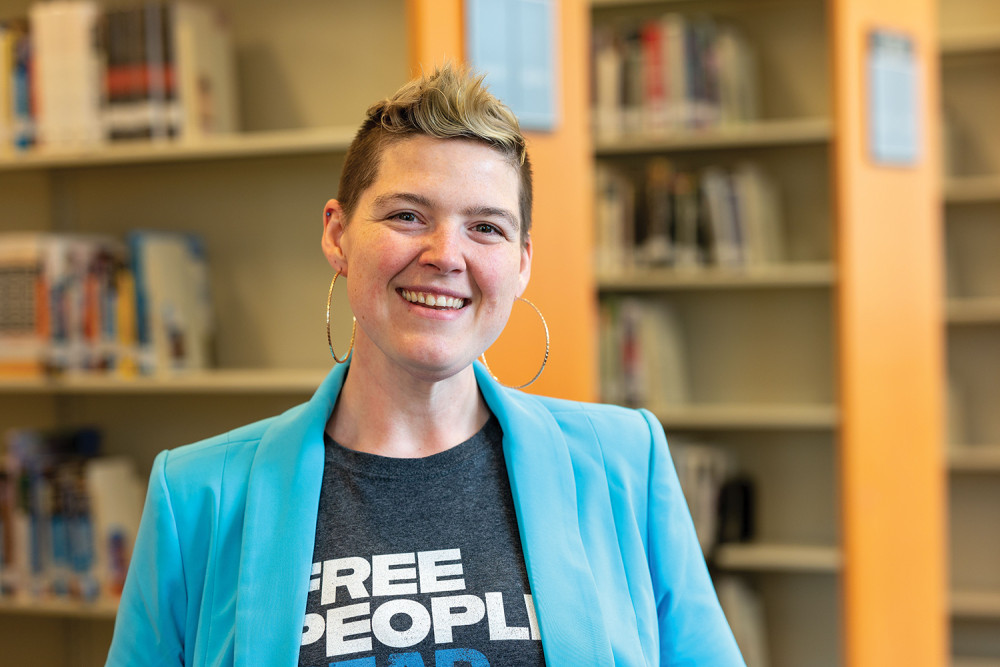
Sam Helmick, who served as 2025–2026 president of the American Library Association, is community and access services coordinator at the Iowa City Public Library. A longtime advocate for intellectual freedom as a basis for healthy relationships between libraries and the communities they serve, Helmick has advocated against censorship and book bans in libraries across the world.
What does a day in the life of a librarian look like?
One of my favorite things about librarianship is that there isn’t a single answer. It varies tremendously depending on the type of library and, just as importantly, the needs and aspirations of the community at that moment. A school librarian, a public librarian, an academic librarian, and a special librarian might all have completely different calendars, but they’re united by the same purpose: connecting people with information, opportunities, and one another.
Read our latest issue or browse back issues.
At the Iowa City Public Library, my day rarely looks the same twice. I might start the morning coaching and supporting staff, spend part of the day solving operational challenges or planning outreach, meet with community partners, work on strategic planning, write communications, advocate for libraries at the state or national level, and still find time to help someone discover their next favorite book or navigate a difficult question.
Tell us about some of the more difficult aspects of your work.
When I was the intellectual freedom chair for the Iowa Library Association, we had a minister who took out all of the LGBT titles from Orange City Public Library and burned them on Facebook Live. My job was to make the community aware of that event, work through it, and support the board.
I’d never dealt with a book ban. As a true Midwesterner, I remember sending the board a gift card for donuts and saying, “I hope carbs help, but when I get there, we’ll figure it out together.”
Book bans are becoming common across the country—we had them in Missouri when I was a teacher there. What is the role of a librarian in the face of such efforts?
The role of librarians is not to tell people what to do with their community’s library. It’s to provide all of the information that is reasonably available, so that people can opt in and out. It is our responsibility to steward the collection and give you the most choice possible.
I’ve been in libraries all around the globe, and I’ve learned that the United States was one of the first places where libraries opened their stacks. Before, you’d go ask the librarian for the book and then they would determine where it was, whether you got it, for how long. Open stacks require trusting your community.
What role has learning played in your life?
Learning is such a vulnerable process. I’m dyslexic, and when I was in the fourth grade, I missed every single recess. I sat in a closet-sized library where the gym teacher—of all people—took the time to help me phonetically spell out words. We went through all of the Laura Ingalls Wilder books. I actually found that teacher in adulthood and thanked her, because that was the making of me. It’s like God spoke the world into existence and all of a sudden the power of language and words hit me at another level, and I was like, I think this is my future here.
The theme you chose as ALA president was “Our stories are worth sharing.” Do you see any connections between storytelling and your personal faith?
This is such a profound question. It’s a gift that you and I can share a story, can share language and connect in a way that no other species really does. Animals communicate in beautiful ways, but not quite in this way.
Storytelling is the basis of both our descent and our ascent. The Tower of Babel story reminds me that we need to be very careful with language. In the preface to Mere Christianity,
C. S. Lewis talks about how the term gentleman used to have a very specific meaning, and if we dilute that meaning, then we lose the word’s value.
As a librarian and a public speaker—and, recently, as a very amateur poet—I always find myself trying to find the exact right word. Because each of us is unique, down to our DNA, our fingerprints, and even our tongue prints. Finding the right language to convey the right thing, speaking to understand or be understood, is so important. The more we practice this, with storytelling and song and writing and reading and praying, the more I think we’re honoring part of what we were always intended to be.
Are there particular words that have power in your life?
Beloved is a good one. I always refer to people in group settings as beloved, because even if I don’t know them, I’m being called to love them. And if I never get to meet them beyond this room, I want them to remember that they are loved.
I love that. There is so much power in calling every single person at the library beloved.
Don’t you feel like your life’s a little bit full of wonder, knowing that everybody is made in the image of a living God and you get to walk around and interact with them? For some reason, God has woven your string and theirs into the fabric of existence at the same intersection.
There are random people who I met on a plane or shared a cab with, and I find myself thinking of them and lifting them up in prayer. More than ten years ago I happened to visit a church on a Sunday when a little kiddo was being dedicated with his family, and I still think about him now. Isn’t it beautiful that we don’t have to be directly connected to care about all these other people and their stories and their inner lights?
You mentioned being an amateur poet. How did that come about?
To be honest, I never would have guessed this would be a role I’d serve. I felt like I was drifting a bit, so writing poetry was my version of saying prayers, trying to be the encouragement I wanted to see in the world, and keeping a journal while constantly on the go.
Are there any recurring themes in your poems?
I think there’s wonder, finding the sublime in the mundane—because there really isn’t any mundane if you give yourself a half pause to look at it. And I seem to be a little bit preoccupied with squirrels, but maybe that’s a phase.
Do you see poetry as an extension of your personal spiritual practice?
Yes. I’ve been really inspired lately by the Psalms. I keep thinking about selah, how we all have our theories about what that word precisely means, and if nothing else, it makes us pause.
I’ve been thinking especially about Psalms 30 through 32. We’ve got this man who is after God’s own heart, but he’s also an adulterer and an accessory to a murder. He just sort of owns the fact that it is the human condition to know better and to choose to not do it. God’s face is probably not being hidden from us; we’re turning away from God’s face.
David is able to break his own heart open and share this through musical or poetic verse. And many years later, Christ is a descendant of his. David’s failures aren’t the end of him. One of the wisest kings in the world, Solomon, is the child he has with Bathsheba. Poetry is this beautiful way of allowing us to really understand the depths of existence, because they are unimaginable.
The Bible is constantly showing us that you don’t need a perfect messenger to understand the story of God’s redeeming love. I have to remind myself that God doesn’t call us to be the most perfect versions of ourselves; God calls us to show up as ourselves, do what we can, and try to be better tomorrow.
We all feel so powerless right now, and we don’t know what to do with our justice structures. And this is what I got to tell librarians around the country and around the globe when I served as president of the ALA: You get to contribute to the public good. You help people find jobs, learn languages, and find community. It’s okay if you’re having a C+ day. Keep going.
Listening to an interview you did last year with Paul Raushenbush of Interfaith Alliance, I was struck by the similarities between libraries and churches as places people can go to ask questions and seek answers. What parallels do you see between these spaces?
When somebody at the library feels shame and I have the chance to offer grace. It’s amazing to me how shame-ridden our communities are. I have folks who come up to me and say, “I have a stupid question.” Those don’t exist! But I’m a complete stranger, I’m sitting at a monolithic desk, and this might be a new place for you.
Learning and faith are both vulnerable processes because they’re both dedicated to the idea that you don’t have everything figured out. Whether it’s eschatology or finding the nonfiction section, you have to decide that you don’t know and that you need to talk to others to find an answer. I love the fact that I get to be a part of that in a way that encourages people.
Also, being president of the Iowa Library Association when Iowa had the second-greatest number of library-adverse bills in the nation really gave me an opportunity to recognize that you are supposed to love your enemy. So whether it’s somebody who has mildly frustrated me in traffic or somebody who I think has mischaracterized something that my profession does or that I’ve done, my first response is to pray for them.
We were not created with all the answers, and to presume that we know everything is out of line with faith because it deifies the self. While at this point in my life I am on the way to figuring some things out, there are few things that I am 100 percent certain about. Still, it is hard to let go.
Which is where I think trust and faith come into play. Both institutions require a lot of trust. You’re trusting somebody with your eternal destiny; you’re trusting somebody to help you navigate your life as it is right now. In both churches and libraries, there’s a deep need for confidentiality and privacy, and it’s important to make sure everybody feels welcome.
I think of both churches and libraries as sacred places that are there for people at any point in their lives. You have no idea who’s walking into the synagogue or the mosque or the church on a given day. You have to trust that God does. I feel privileged to experience parallels to this in my work at the library.
Given the proliferation of book bans and hostility toward libraries, how can people take action so that their stories won’t be erased?
If you want to be active—to learn how to write letters to the editor, run for the library board, and talk to your representatives—there’s a great resource called Unite Against Book Bans. It’s a consortium of advocates, both individual and organizational, against the abridgment or censorship of information. Another good resource is Faith for Libraries, an Interfaith Alliance initiative that connects people of faith with librarians so they can work together for intellectual freedom.
And then if I could offer one more resource, because I am a reference librarian, the ALA website has a campaign called Show Up for Our Libraries. This one is important, because budgets are values in action. If we don’t fund libraries, then they can’t provide heat and shelter and community and education and discernment in this information age.
When people try to remove the stories of those they disagree with, I think they’re actually giving them more power. Also, I want the people I care about to read things that I disagree with.
Yes. The presence of an idea doesn’t have to be its endorsement. I feel like my God is strong enough to guide me regardless of what information I come across.
The best way to support your local library is to use it. Stay informed about what’s happening there. Be part of a community of readers and exemplify that for others. Remember that your library belongs to you and needs you.