In his 1891 essay “The Critic as Artist,” Oscar Wilde notes that anonymity through disguise offers a certain freedom to be honest. Genuine convictions emerge when we’re insulated from having our reputation or vulnerability exposed. “Man is least himself when he talks in his own person,” writes Wilde. “Give him a mask and he will tell you the truth.” In our day, we see this idea play out on social media. People might curate idealized or fanciful versions of themselves—or they might mask their identity behind a pseudonym and drop their guard in order to share raw and sometimes toxic thoughts.
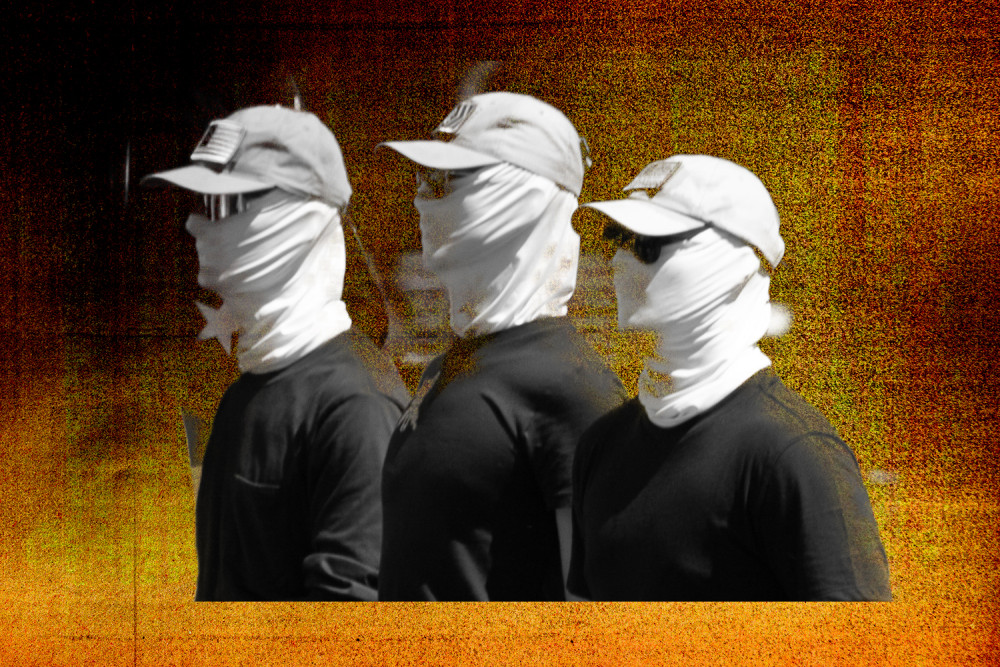
It happens offline as well. On July 4 of this year, about 400 men descended on the Capitol Hill neighborhood in Washington, DC. Dressed in matching khaki pants, navy shirts, white ski masks, and sunglasses, they might have been mistaken for a team of paintball enthusiasts. In fact they were members of the Patriot Front. Like other White ethno-nationalist organizations whose members like to hide their identity behind masks, gaiters, and balaclavas, the Patriot Front designs its pop-up protests to create a visual threat of intimidation. Going viral online is their dream, fulfilled this time by a Reuters photograph depicting a lone Black woman surrounded by masked Patriot Front members on a DC Metro train.

Read our latest issue or browse back issues.
The mask is the message: the performance of an identity, a choreographed display of power, a visual cue of contempt for Black and Brown people, migrants, Jews, Muslims, and the LGBTQ community. The mask provides the silent voice for broadcasting a deep inner hatred for all who don’t fit a particular White vision of America.
It’s fair to wonder why White supremacists cover their faces if they really think they’re doing the right thing. But remember Oscar Wilde. When a member of the Patriot Front returns to his home, he can toss his ski mask, his sunglasses, and his ballcap with a fascist logo into the closet and instantly jump back into a life of public respectability. No fear of job loss, tainted reputation, or recrimination from neighbors. Others may have no idea he donned a mask with his buddies on the Metro.
Outward appearances of good cheer and innocence can easily hide a person’s inner deceit and closeted evil. We know this. “One may smile and smile, and be a villain,” says Hamlet in the first act of Shakespeare’s masterpiece. Jesus throws the word hypocrisy (hypokrites) at religious leaders who behave like stage performers acting under a mask: “You are like whitewashed tombs which look beautiful on the outside, but inside are full of dead bones and all kinds of filth” (Matt. 23:27).
Even if every mask-wearing extremist (fascist or otherwise) isn’t full of inner rot and filthy hatred, the act of covering one’s face to terrorize others can shape the wearer into becoming such a soul. Philip Zimbardo’s and Stanley Milgram’s psychology experiments of the past demonstrate how easily we conform to learned behaviors. So does the gambling and drinking protagonist in Max Beerbohm’s The Happy Hypocrite. Lord George Hell wants to marry a woman who will only marry a man with the face of a saint. So he purchases a saint’s mask and, wearing it constantly, undergoes a complete moral conversion. Once the couple is married, the man finds himself in a scuffle with a former lover who tears off the mask, only to discover that George’s face has now assumed its contours. His life has conformed to the image on his face.
Maybe this is what Paul is trying to communicate when he writes about contemplating or gazing at Christ’s glory with our unveiled face and over time being changed into Christ’s likeness and coming to reflect him (2 Cor. 3:12–18). The constitutional freedom to wear a mask and be as hateful or bigoted as you want to be is indisputable. But so is the Christian freedom to be as hopeful, joyful, and loving as we want to be.