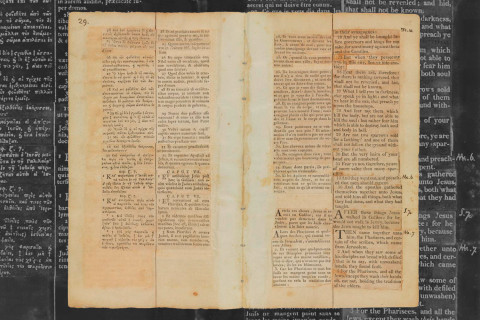
In may 1940, the Nazis invaded Western Europe. Their totalitarian drive to hegemony pounded its fist all the way to the Atlantic. They exerted dominance over Denmark, Norway, Belgium, Luxembourg, the Netherlands, and France. In the same month, the SS created a work and extermination camp near the little German-occupied Polish town Oświęcem—in German, Auschwitz.
Adorned in Nazi red, how did evil’s dark triumph feel in 1940? Dizzying events had plunged the world into war, for the second time in 25 years. What did citizens of the conquered nations experience? What was it like at that point for Jewish residents and members of other groups the Nazis targeted? How did the Germans who were opposed to the Nazis feel?

Read our latest issue or browse back issues.
After returning to Germany in 1939 from the United States, having rejected pleas to remain there, this is where Dietrich Bonhoeffer found himself. In 1940 he published the little book Psalms: The Prayer Book of the Bible. The book takes only a morning or afternoon to read. It is quiet, simple, and refreshing. “The disciples want to pray,” Bonhoeffer begins, “but they do not know how.” He suggests that the Bible’s prayer book furnishes speech clear and pure enough to tame the “confused speech of our heart.” Praying to God with God’s words to us, he reasons, makes the Psalms God’s training manual for prayer in bewildering times.
Bonhoeffer assumes the traditional Christian reading of the Psalms as the prayers of Christ through his forerunner David. “In the Psalms of David the promised Christ himself already speaks,” he writes. One is to lift the disquieted heart before God in prayer with Jesus, to attend to the light the Savior’s words shed on creation, the law, history, life, guilt, and suffering, among the Psalms’ other topics. While all these become forcibly palpable during unsettling times, one theme attracts Bonhoeffer’s scrutiny as causing “greater difficulty today” than anything else in the Psalter. He writes of the “shocking frequency” of psalms that imprecate enemies, and he lists those he has in mind.
Bonhoeffer rightly pinpoints this issue. As they appear in these prayers, the “enemies” mirror the radicalized ideological actors fueling the terror, chaos, and conquests Bonhoeffer had witnessed. They possess aggressive mouths and tongues, which create distorted speech. They speak with deceit. They boast. They utter words both treacherous and destructive. Their tongue, “like a sharp razor,” loves “lying more than speaking the truth,” as one prayer cries: “You love all words that devour, O deceitful tongue” (52:3–4). Their mouths appear “filled with cursing and deceit and oppression; under their tongues are mischief and iniquity” (10:7–8). Such venomous speech resonates with the machinery the Nazis developed for proliferating propaganda, churning out words “smoother than butter” and “softer than oil” that cut like “drawn swords” (55:21).
The art of shaping discourse thus becomes an issue when the prayers turn to enemies. The spoken or sung prayer, itself a product of tongue and mouth, attempts to speak differently. Before God the prayer flattens and arrests the malevolence in the enemies’ discursive practices. Praying the Psalms can furnish counter-discourse and offer a refuge in speech with God, wherein the oppositional and critical-prophetic spirit finds nourishment.
We need this because when enemies speak, they act. Their speech gives way to persecution and accusation. They act with cruelty (71:4); they taunt (70:3, 137:3) and slander (69:4, 11–12) the righteous. They incite violence, strife, ruin, oppression, and fraud (55:9–11). They are insolent, ruthless, and godless (54:3). Greedy for gain, they target the poor and helpless (10:2–3, 7–9). Acute is the anguish in betrayal when onetime friends and neighbors join in praising or participating in the enemies’ schemes (41:9, 55:12–14).
Surveying the breadth and depth of their menace, the prayer’s reflex is to anathematize enemies such as these. Without timidity, the prayer is an earnest request for God to punish with terrible violence. The imagery can be unsparingly vivid: enemies should be trodden down like grass, venomous fangs broken and torn from their mouths (58:6–8). The psalmist’s prayers fantasize about the righteous bathing their feet in their enemies’ blood (58:10, 68:22–23). In Psalms 70, 69, 68, and 55, the prayers ask for shame, confusion, obliteration, destruction, blindness, shattered heads, and death to befall these enemies.
The readiness to indulge in this brand of violent speech varies from psalm to psalm. In some cases, such as Psalm 41, the curse remains understated. At the other extreme, though, the brutality can be too terrible to speak, much less to pray. This includes one of the most chilling expressions of vengeance in the Psalter, which takes the form of a twisted beatitude: “Happy shall they be who take your little ones and dash them against the rock!” (137:9). The wish can veer into the genocidal, as God “will destroy their offspring from the earth, and their children among humankind” (21:10). Upon witnessing such vengeance, the righteous laugh (52:6).
In a situation like that of Europe in 1940, in which malicious operatives driven by quixotic ideologies wielded state power and aimed to expand it through terror and conquest, the candid exposure of their pernicious speech and action gains a certain kind of power in prayer before God. Certainly, the move to ask God for their punishment and defeat feels spontaneous and natural.
But the indulgent violence of the imagery may be less than palatable in some cases. Moreover, for Bonhoeffer, who prays these prayers as Christ’s prayers, another problem emerges. This same Christ prays on the cross for his enemies’ forgiveness (Luke 23:34) and teaches his followers to do the same (Luke 6:27–28). The imprecatory psalms prayed as the words of Jesus pull in one direction, toward clear-eyed denunciation of evil and its just demise. The Savior’s instructions pull in another, toward forgiving, blessing, and accomplishing good for the wicked. How does one stand in such crosscurrents when they tug so strongly?
Another problem arises in that the rhetoric these prayers initiate is pliable. Where speech itself is defunct and truth finds itself spinning, imprecations of this sort cut both ways. In one prayer we find “deceitful mouths” and “lying tongues” targeting the just with the very same curses the just themselves pray against the enemies elsewhere (109:2–19). The curses rebound upon those who speak them.
Facing these problems, Bonhoeffer—in attempting to discern the power these psalms may offer for shaping a life of prayer and just praxis during arduous periods in history—makes five interpretive moves.
First, ruthlessly violent though it is, the prayer for vengeance expresses yearning for God to appear just in judgment. Amid the confusions of a desperate age, the prayers insist on making God public as the one “enthroned forever” who “judges the world with righteousness” and “the peoples with equity” (9:3–4, 7–8). Residing beyond mortal prevarications, the preeminent God shows lovingkindness and faithfulness (36:7, 40:11, 52:8, 54:5, 21:7); God uplifts the needy, oppressed, afflicted, orphans, widows, poor, and even animals (9:9, 12; 36:6–7; 41:1–2; 68:5–6, 10; 69:32–33). God provides refuge, fortress, hope, deliverance (71:1–5), food, drink, life, and light (36:7–9).
In an age fraught with ambiguity, the desire is for the day when people can declare, “Surely there is a reward for the righteous; surely there is a God who judges on earth” (58:11). Praying becomes one way to generate publicity for this God. It promulgates comfort and motivation and contributes to forming the sensibility that still affirms, “Yes, there is justice.” Praying propels opposition and resistance as well as hard-won hope. Especially where evil appears darkest and most dire, these prayers enflame and nurture the justice-hungry spirit.
Second, the prayer for divine justice, as such, is not personal. It has no bearing on personal grievance. The enemies are enemies of God’s justice. Anyone who prays these psalms also stands under God’s judgment and has no right or power to hinder it. As a consequence, Bonhoeffer writes, “Nowhere does the one who prays these psalms want to take revenge into his own hands.” He is right that in many cases it is God who executes judgment, though not in all (e.g., 137:9). The mechanism for its enactment often remains unclear, or at least imprecise. In a few cases, by a kind of poetic justice, the enemies’ downfall grows from the seeds their own actions sow (7:15–16, 9:15, 35:7–8).
Third, Bonhoeffer suggests that praying the prayers of Christ allows God’s judgment and hatred of evil to be channeled through Christ. Channeled, that is, through the one who prays on the cross for his enemies, “Father, forgive them, for they do not know what they are doing” (Luke 23:34). “Jesus Christ bore the wrath of God,” Bonhoeffer writes, “for the execution of which the psalm prays.” God hates justice’s enemies and yet “redirects” them to the one who bears God’s wrath for them and prays for their forgiveness. On the cross, divine hatred becomes love and vengeance becomes grace.
Fourth, praying the prayers Christ prays provides Bonhoeffer a source of outside power. He confesses he is unable to find this within himself and his own resources. In 1940, from Germany, he understandably asserts, “I cannot forgive the enemies of God.” But he can pray the words Jesus prays, which unequivocally denounce the wicked in the Psalms yet lead to the cross, where God meets them with love and forgiveness. “Only the crucified Christ can do that,” he writes, “and I through him.” Praying the Psalms in a perilous age thus becomes “grace for all,” which includes both those who pray and their enemies.
Lastly, Bonhoeffer is too wise to leave it there. In the very year of the first activities at the Nazi camp near Oświęcem, Bonhoeffer counteracts the potential supersessionist coloring of his reading. He might, after all, be taken to support the view that the New Testament Christ saves these Old Testament prayers by placing their violent vengeance on love’s higher plateau. Implying Jewish inferiority feeds too readily into antisemitism. But it is important to understand that God’s mercy and forgiveness feature prominently in the Psalms too. Bonhoeffer emphasizes also that imprecations and joy in the violence of divine wrath are far from absent in the New Testament (Gal. 1:8–9, 1 Cor. 16:22, Rev. 18–20). In any event, even where emphasis falls on love and forgiveness, divine judgment prevails. Imprecatory prayers, redirected though they may be through the cross, rest nonetheless on the finality of God’s just judgment. “Whoever corrupts the word of the cross of Jesus,” Bonhoeffer writes, “must bear the curse of God some time or another.”
These interpretive moves empower one to pray the Psalms. They help to cultivate a disposition inclined toward love and justice that stands in opposition to inimical operatives in any disturbing age. These psalms foster wide-eyed protest against evil speech and action. They assert and publicize the God of love and justice. They hold God accountable, demanding God to act in compliance with the attributes God declares God to possess. They give voice to the yearning for justice. They numb the temptation of personal vengeance. At the same time, they channel God’s judgment through the cross, where it transforms into love and forgiveness. And yet all the while they remain firm in the expectation that God’s just judgment will intervene.
Bonhoeffer’s strategies for praying the imprecatory psalms can mitigate the pliability problem. They can serve as criteria for assessing the uses to which others put this rhetoric, which the enemies easily turn back against those who pray in this way. These psalms fully blossom only when, with God’s help, they exclude personal grievance, complicate revenge enacted by one’s own hands, and redirect the passion for punishment through the detour of loving forgiveness. Absent such qualities the prayer fails before God, who champions the oppressed and sees through spin that holds no viability.
Bonhoeffer had no illusions. He knew the Nazis posed a grave threat. It’s remarkable that in 1940 he still sought to hold together the yearning for justice with love for the enemies. This little book on the Psalms would be Bonhoeffer’s last before the Nazis prohibited him from publishing. In three years, they would arrest him for his role in the resistance movement. Two years after his arrest, he would hang, executed at the Nazis’ hands. In our own sinister age, praying the Psalms as Bonhoeffer ardently prayed them may once again spark the spirit he courageously exuded—that of insistent love and fierce justice.
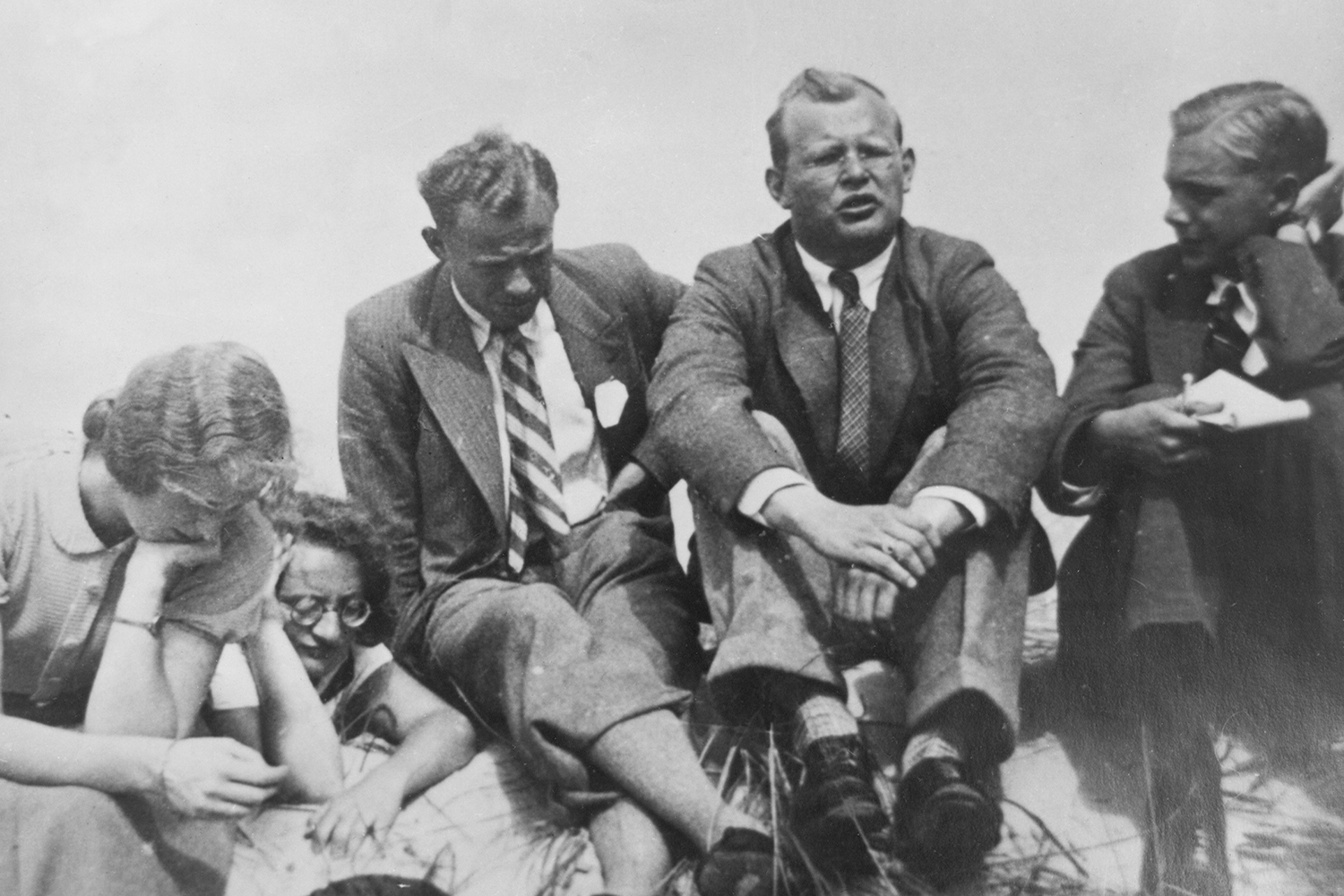
Dietrich Bonhoeffer (2nd from r) with pastor Pfarrer Otto Dudzus (2nd from l) and members of the Youth Delegation of the Confessing Church on the Danish island of Fanö. (bpk Bildagentur / Staatsbibliothek zu Berlin / Rotraut Forberg / Art Resource, NY)