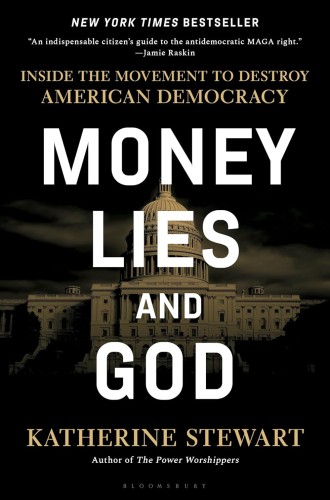
Money, Lies, and God
Inside the Movement to Destroy American Democracy
Katherine Stewart is a veteran chronicler of evangelicals in politics. Her first book examined the Good News Club, an organization that sought to hold Bible studies in public elementary schools to expose children to an evangelical worldview. Her next book, The Power Worshippers, traced the role of evangelical Christians in Donald Trump’s rise. In Money, Lies, and God, she explores the strange alliance seeking to impose an antidemocratic economic and moral vision on the United States.
Stewart argues that this movement, which she calls “the new American fascism,” has multiple factions, including socially conservative evangelical Christians and ultra-wealthy individuals seeking government deregulation and the privatization of public services in order to amass more wealth with which to influence politics. These two groups haven’t always worked together. Evangelical activism used to focus more narrowly on cultural issues such as school prayer, restricting abortion access, and fighting against gay and lesbian rights. But the more attention they gave economic policy, the more wealthy allies they gained—allies who, thanks to runaway inequality, have deeper and deeper pockets. Billionaires—including the Koch brothers, the DeVos family in Michigan, and Richard Uihlen, chair of the Bradley Foundation in Wisconsin—contribute massively to conservative political organizations, and some, such as Betsy DeVos (who is both a billionaire and an evangelical), have been elevated to influential government positions.
Stewart draws on the work of historians to show how the rapid spread of Christian nationalism in recent years has been facilitated by various forces, including a network of sympathetic congregations long primed for conservative political action. The coalition between evangelical Christians and Republican politicians emerged with Jerry Falwell’s Moral Majority in the late 1970s. While earlier histories located the movement’s source in the legalization of abortion with Roe v. Wade, newer scholarship traces the coalition to a decision by the federal government to withhold funding from the evangelical Bob Jones University after finding that the school’s policies on interracial dating violated the civil rights of both students and faculty. Historians such as Randall Balmer have demonstrated that a focus on abortion only emerged later, to broaden the alliance’s appeal.