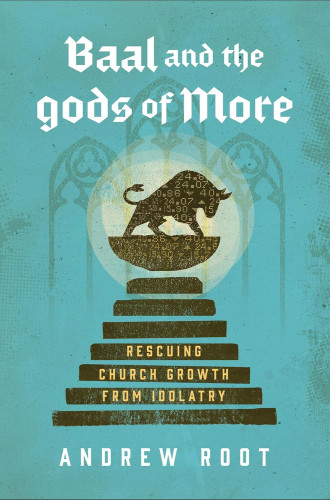
Baal and the Gods of More
Rescuing Church Growth from Idolatry
Practical theologian Andrew Root is a prolific writer and teacher who, in previous books, has addressed topics related to secularism, youth ministry, and the love of dogs. In his engagingly written new book Baal and the Gods of More, he argues that late-modern Protestantism, with its emphasis on growth, has fallen into an ancient form of idolatry. While his focus is specifically on church growth, his argument has implications that extend beyond the church.
Academics and clergy would appear to be the author’s intended audience. I’m neither, however, and I found this book captivating, not only because of the analysis he presents but also because of the way he presents it. Root weaves together biblical commentary, cultural critique, analysis of ancient art, and narratives about real people he encounters in his travels. This is by no means a dry theological tome.

Read our latest issue or browse back issues.
For background, it helps to have some knowledge of the showdown on Mount Carmel between Elijah and the prophets of Baal as told in the book of 1 Kings. However, if you don’t recall the story, Root’s lively retelling (which he delays until later in the book) provides all the background you need.
The lesson I recall learning from this story as a student in Christian elementary school is simply this: Baal bad, YHWH good. One might not argue with the lesson itself, but one might wonder why it is so. Root’s analysis involves contrasting what he characterizes as the growth-accelerating fertility cult of Baal with the rest-providing maternal embrace of YHWH. This requires some explanation on two counts. First, the question arises as to what exactly is wrong with fertility in an ancient culture so dependent on the cycles of nature. Second, maternal embrace may not be the first image one conjures when contemplating the character of YHWH.
The crux of the issue, Root explains, has to do with the fertility cult’s never-ending demand for production and groveling to the insatiable demands of Baal. YHWH, by contrast, provides rest and consolation—enoughness, as it were. This, of course, is the sabbath concept as portrayed in the Hebrew scriptures. Root draws heavily on the work of Walter Brueggemann and others to support this idea. He illustrates this difference by contrasting ancient fertility artwork with portraits of the Madonna and Child, specifically the medieval icon Our Lady of Vladimir, which exemplifies the maternal embrace.
Flashing forward to the 21st-century United States, Root identifies two dominant strains in Protestantism that have unwittingly succumbed to the cult of Baal: the techno-optimists and the identitarians. While fundamentally different in many ways, both strains, he argues, are beholden to the idolatry of growth. Techno-optimists, with their emphasis on new trends and new technologies, look to the next alluring thing on the horizon that they hope will draw people into the church. The identitarians by contrast place their hope for growth in the inclusion of more and more previously marginalized identities.
Both camps, according to Root, focus on growth rather than remaining faithful to the consolation of the divine embrace. Providing this embrace, Root argues, is the mission of the church and cannot be improved upon or grown. It must simply be done.
Many century readers might respond that the identitarians are legitimately correcting the church’s historic and continuing failure to address the needs of a number of marginalized groups. It could be argued that providing that maternal embrace through the inclusion of marginalized identities is in keeping with Root’s definition of the church’s legitimate task. One might also wonder whether the techno-optimists and the identitarians are as distinct and bifurcated as he describes them to be.
My sense is that Root would welcome discussion about these points. And, while he critiques the identitarian growth emphasis, it is clear that he is oriented toward inclusion, while simultaneously decrying the pursuit of growth for growth’s sake.
As for wider implications, one does get the sense that Root is addressing something broader than church growth. His analysis touches on economics, culture, technology, and citizenship. If it is true, as he argues, that endless growth is a form of idolatry, then this points directly to the economic system we are all embedded in and on which our livelihood and future security depends.
Or does it? An important question this book raises is what a resistance to the gods of more might look like, not just with respect to the issue of church growth but more generally. How might we live prophetically in the midst of a culture of accelerating cycles of growth, production, and consumption? How might civilization structure its life together going forward in a way that maximizes flourishing and mutuality rather than endless growth? This book provides a way into that discussion.